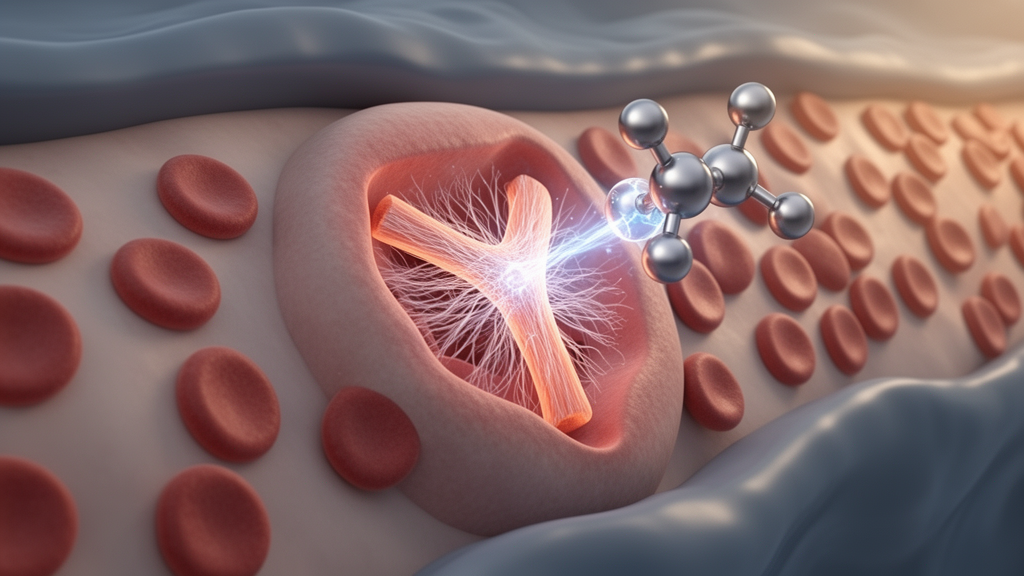
Platelets are the smallest cells in the blood, and among the most dangerous. In a healthy vessel they patch leaks within seconds; in a diseased one they build the clots that trigger heart attacks and strokes. For decades, antiplatelet drugs have attacked this process broadly, hitting every platelet response they can reach — and paying the price in bleeding complications. Now a team of researchers in South Korea has reported something unusual: a gadolinium-conjugated anti-inflammatory molecule that quietly disables only one arm of the platelet’s clot-building machinery, leaving the rest intact. The compound, called ETN102, is described in a new study in Frontiers in Pharmacology as a thrombin-context-selective modulator of platelet function, with antithrombotic effects in mice comparable to aspirin and, remarkably, protective effects against ischemic brain injury.
ETN102 is not a typical drug candidate. It is a derivative of diflunisal, a salicylic acid-derived nonsteroidal anti-inflammatory drug, conjugated to gadolinium — the heavy metal at the heart of most magnetic resonance imaging contrast agents. The molecule was originally developed as an anti-inflammatory MRI agent, designed to visualize inflamed tissue while suppressing cyclooxygenase-2, the inducible COX enzyme tied to inflammatory prostaglandin production. Earlier work by the same collaboration showed that ETN102 reduced COX-2 levels, dampened glial activation, and protected neurons in models of stroke-related damage. But the question of what such a molecule might do to platelets — the anucleate cell fragments that carry the COX-1-driven machinery of thromboxane synthesis — had never been asked. The new study, led by Malk Eun Pak and Yeon-Ji Kim of the Korea Institute of Oriental Medicine together with colleagues at Etnova Therapeutics, set out to answer it.
The first surprise came from the aggregation assays. When mouse platelets were pretreated with ETN102 and then stimulated with thrombin, the enzyme that sits at the center of the coagulation cascade, aggregation was strongly and dose-dependently inhibited at concentrations of 100, 300, and 500 micromolar. Yet when the same platelets were challenged with collagen, adenosine diphosphate, or U46619 — a stable analog of the thromboxane endoperoxide that normally drives platelet activation through its own receptor — their responses were essentially untouched. This kind of agonist selectivity is rare. Most antiplatelet agents, including aspirin, suppress responses across multiple agonists because they remove a common amplification signal. ETN102 did something more surgical: it spared the proximal activation pathways triggered by other agonists and zeroed in on the thrombin-driven response.
The clue to how it works came from what ETN102 did not do. Thromboxane B2, the stable metabolite of the platelet-derived amplification molecule thromboxane A2, was generated at normal levels in ETN102-treated platelets. COX-1 protein expression — the dominant isoform behind platelet thromboxane synthesis — was unchanged, while COX-2 was selectively reduced. Because platelet COX-2 is minimal to begin with, the authors conclude that the antiplatelet effect of ETN102 cannot be explained by conventional COX-1 inhibition. ATP secretion, a marker of dense granule release and secondary amplification, was reduced during thrombin-induced aggregation — but when the researchers added EGTA, a chelator that disrupts the fibrinogen-integrin interaction and prevents platelet-platelet aggregation, the reduction in ATP secretion disappeared. In other words, ETN102 was not blocking the primary secretory response to thrombin; it was indirectly limiting ATP release by preventing the integrin-dependent reinforcement that normally follows once platelets begin to stick together.
That pointed the investigators toward the αIIbβ3 integrin — the fibrinogen receptor that is the final common pathway of platelet aggregation. Flow cytometry showed that ETN102 dose-dependently suppressed thrombin-induced conversion of αIIbβ3 into its activated form, while leaving P-selectin exposure, the surface marker of α-granule secretion, completely unchanged. Intracellular calcium mobilization, one of the earliest events in platelet activation, was also unaffected. The compound did not broadly dampen the classical intracellular activation cascades: phosphorylation of Syk, PI3K, and AKT — kinases central to agonist-induced signaling — remained at normal levels. What ETN102 did suppress was the outside-in signaling that follows once the integrin engages fibrinogen: phosphorylation of focal adhesion kinase and proline-rich tyrosine kinase 2, the two kinases that transmit mechanical force from the engaged integrin to the platelet cytoskeleton.
Those two functions — platelet spreading on fibrinogen-coated surfaces and clot retraction — are the physical manifestations of αIIbβ3 outside-in signaling, and both were markedly impaired by ETN102 in a concentration-dependent manner. Spreading is how an individual platelet flattens itself to maximize contact with its neighbors; clot retraction is how the entire platelet mass pulls the fibrin scaffold tight, compacting and stabilizing the thrombus. Disrupting these processes weakens the thrombus without necessarily preventing its initial formation. The biochemical signature matched: FAK phosphorylation at Tyr397 and Pyk2 phosphorylation at Tyr402 were significantly reduced under thrombin stimulation, while Syk activation during integrin engagement was preserved — consistent with prior reports that Syk-deficient platelets can still undergo fibrinogen adhesion and thrombin-induced aggregation in certain contexts.
In vivo, the antithrombotic effect was dramatic. In a ferric chloride-induced carotid artery thrombosis model, vehicle-treated mice occluded their carotid arteries at a mean of 12.2 minutes after FeCl3 application. ETN102-treated mice at 40 and 83 milligrams per kilogram body weight occluded at 29.4 and 38.2 minutes respectively — prolongations comparable to the 33.2 minutes seen with aspirin at 100 milligrams per kilogram. Tail bleeding time and hemoglobin content at the amputation site were also significantly increased, mirroring the hemostatic impact of aspirin. The authors are candid about this: ETN102 produced comparable reductions in thrombus formation while simultaneously increasing bleeding risk, underscoring the need for rigorous dose refinement and comprehensive safety assessment before further development.
The neuroprotective findings add a second dimension. In a murine model of middle cerebral artery occlusion followed by reperfusion — the standard model of ischemic stroke — ETN102 reduced infarct volume from 31.58 percent in controls to 21.69 percent at the low dose and 16.48 percent at the high dose, corresponding to reductions of roughly 31 and 48 percent. Expression of NeuN, a mature neuronal marker, and Bcl-2, an anti-apoptotic protein, were both enhanced in ETN102-treated brains. The authors caution that these findings do not distinguish whether the neuroprotection resulted from altered platelet-dependent thrombosis and cerebral perfusion, direct effects on neural or vascular cells, or the previously reported anti-inflammatory actions of the compound. Still, the convergence of antithrombotic and neuroprotective effects in the same molecule — one originally designed as an imaging agent — is striking.
The mechanism, as the authors frame it, is one of context-selective modulation rather than broad-spectrum inhibition. ETN102 preferentially interferes with integrin-dependent platelet aggregation and thrombus stabilization under conditions involving substantial thrombin generation, while providing limited inhibition of platelet responses driven predominantly by collagen, ADP, or thromboxane receptors. The study does not establish whether ETN102 directly binds to αIIbβ3, FAK, Pyk2, or another upstream regulatory molecule; the compound should be considered a functional modulator of thrombin-associated integrin outside-in signaling rather than a confirmed direct inhibitor of a specific target. The high concentrations required in vitro, the intravenous doses used in vivo, and the observed prolongation of bleeding time all indicate that further pharmacokinetic, dose-optimization, and safety studies are necessary. The presence of gadolinium adds its own safety questions, since gadolinium-based contrast agents have been associated with nephrotoxicity and tissue retention, particularly in individuals with impaired renal function. Conjugation to a pharmacologically active compound may alter biodistribution, stability, and clearance in ways that must be characterized before any clinical relevance can be determined. But the conceptual advance is clear: a molecule that disables the mechanical arm of platelet clot-building — the outside-in signaling that turns a soft platelet plug into a stable thrombus — while sparing the secretory and calcium-driven activation machinery, offers a mechanistically distinct approach to antithrombotic therapy, one that may prove tunable in ways that broad-spectrum agents like aspirin are not.
Subject of Research: The inhibitory effect of gadolinium-conjugated diflunisal on platelet function through regulating outside-in signaling of αIIbβ3 integrin
Article Title: The inhibitory effect of gadolinium-conjugated diflunisal on platelet function through regulating outside-in signaling of αIIbβ3 integrin
Article References: Pak, M. E., Kim, Y.-J., Choi, H., Choi, G., Kim, Y.-H., & Kim, K. (2026). The inhibitory effect of gadolinium-conjugated diflunisal on platelet function through regulating outside-in signaling of αIIbβ3 integrin. Frontiers in Pharmacology, 17, Article 1936307. https://doi.org/10.3389/fphar.2026.1936307
Image Credits: AI Generated
DOI: 10.3389/fphar.2026.1936307
Keywords: inhibitory, effect, gadolinium-conjugated, diflunisal, platelet, function, regulating, outside-in, signaling, integrin, scientific research
News Source: Ophelia Keating. (October 19, 2026). The inhibitory effect of gadolinium-conjugated diflunisal on platelet function through regulating outside-in signaling of αIIbβ3 integrin. Scienmag.