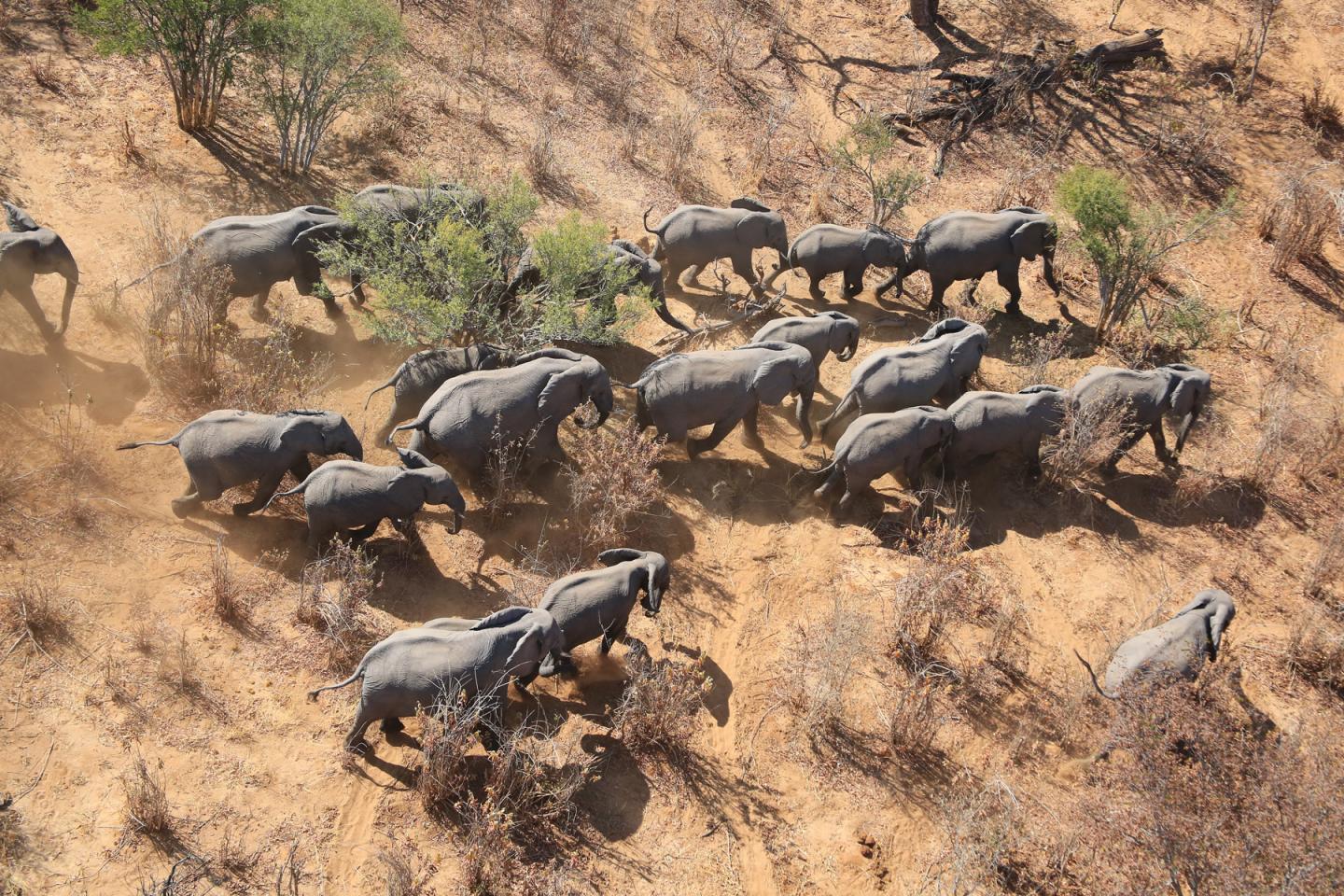
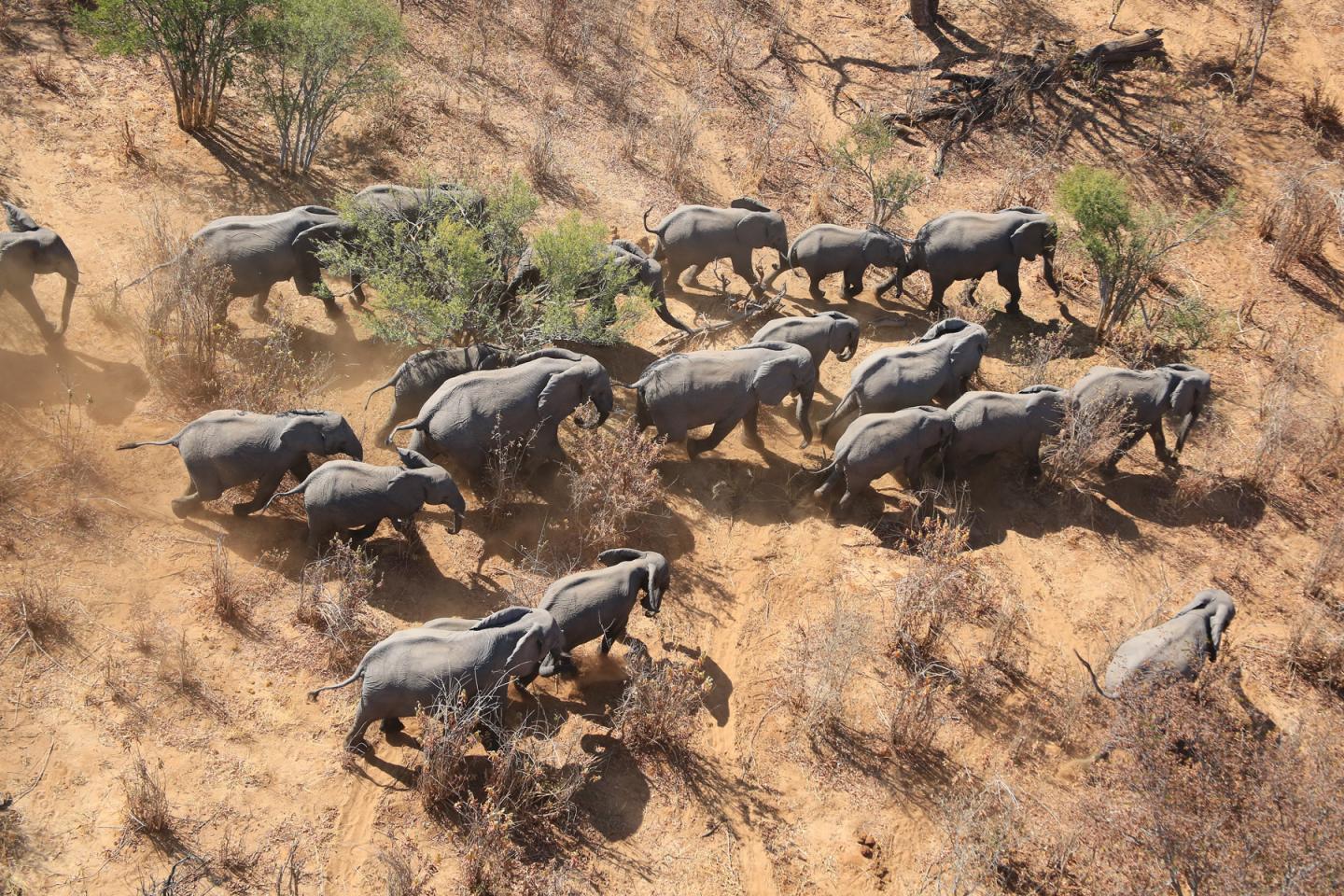
Credit: EWB
AMHERST, Mass. – Results of the two-year, $8 million Great Elephant Census (GEC) of African savannah elephants led by Elephants Without Borders (EWB) were released today at an international wildlife conference in Hawaii, confirming massive declines in elephant numbers over just the last decade. The researchers report the current rate of species decline is 8 percent per year, primarily due to poaching.
Investigators led by EWB director Mike Chase say the Pan-African survey shows that for savannah elephant populations in 15 GEC countries for which repeat counts were available, populations declined by 30 percent, or 144,000 animals, between 2007 and 2014. Billionaire philanthropist Paul G. Allen and his sister Jody Allen are the primary funders of the survey. Chase and colleagues presented results at the World Conservation Congress in Honolulu on Sept. 2, and findings were published on Sept. 1, in the peer-reviewed open access journal PeerJ.
Wildlife ecologist Curt Griffin at the University of Massachusetts Amherst, with postdoctoral researcher Scott Schlossberg, are members of a research team that compiled the data, conducted statistical analyses and applied new data analysis techniques to help Chase and EWB estimate the abundance and geographic distribution of savannah elephants across Africa using the most accurate, up-to-date statistical methods to analyze the survey data. Results provide a baseline that governments and wildlife conservation organizations can use to coordinate conservation efforts.
Chase was Griffin's graduate student at UMass Amherst when Chase founded the Botswana-based EWB in 2007. The GEC is the first continent-wide aerial survey of African elephants. Griffin, who visits Africa every year to conduct research with Chase and EWB, says, "We at UMass Amherst are very proud to be a key partner in this great elephant count. We continue to advocate and work hard for the conservation of elephants in the face of the slaughter they are caught in."
Until now, Griffin says, there has not been a coordinated continent-wide survey of elephants, and "we really didn't know how accurate the estimates were, coming in from the various countries." For this work, EWB worked with dozens of elephant researchers, government wildlife agencies and conservation groups to conduct aerial surveys from small planes and helicopters to count elephant herds across African savannahs. These surveys covered 463,000 km, equal to flying to the moon and a quarter of the way home.
Overall, 90 scientists, six non-governmental organization partners and two advisory partners collaborated in the GEC. EWB partnered with park biologists and rangers, game wardens and organizations including the International Union for Conservation of Nature's African Elephant Specialist Group, Wildlife Conservation Society, Save the Elephants, The Nature Conservancy, Frankfurt Zoological Society and African Parks Network.
"An important question we wanted to answer in our research," Griffin adds, "is how many elephants are being missed by observers on aerial surveys. To answer that we did a double observer study to understand the sources of error, so we can develop more accurate estimates of elephant population numbers."
Further, Schlossberg conducted unique statistical trend analyses that yielded the first quantitative model of elephant population trends across Africa. "Although these statistical tools were out there," Griffin notes, "they had never been applied before to elephant populations. Results from the GEC now provide us benchmarks to gauge if elephant conservation efforts are successful and to identify areas where more work is needed to conserve habitat and stop poaching."
Overall, GEC researchers estimate the savannah elephant population is 352,271 in the 18 countries surveyed to date, representing at least 93 percent of savannah elephants in these countries. They say the rate of decline increased from 2007 to 2014.
In their surveys, they sighted 84 percent of the elephants in legally protected areas compared to 16 percent in unprotected areas. However, large numbers of carcasses were counted in many protected areas, indicating that elephants are struggling both within and outside of parks. Experts say that poaching and the ivory trade pose serious threats, and if not stopped, savannah elephants could disappear from many parts of Africa.
The GEC was launched in late 2013 and the first flights were in February 2014 over the Tsavo National Park in Kenya. The census has completed 18 country surveys with two countries still to be completed, organizers say. South Sudan and the Central African Republic are to be flown by the end of 2016, depending on safety conditions.
###
Media Contact
Janet Lathrop
[email protected]
413-545-0444
@umassscience
http://www.umass.edu