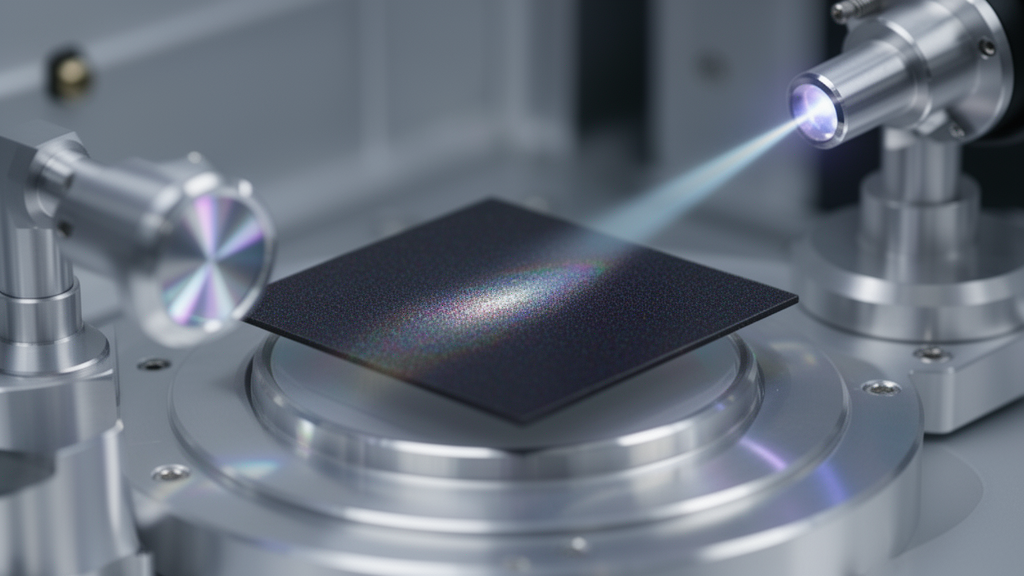
Researchers have demonstrated a method for monitoring the degradation of methylammonium lead iodide (MAPbI3) perovskite thin films in real time using terahertz time-domain spectroscopy. Published in the journal Frontiers of Optoelectronics, the study provides a non-destructive approach to assessing the stability of these organic-inorganic hybrid semiconductors, which are critical for next-generation optoelectronic devices. The team, led by Jinzhuo Xu and colleagues, identified specific terahertz absorption peaks that correlate with the aging status of the perovskite material, offering a potential tool for both fundamental research and commercial quality control.
The stability of organic-inorganic hybrid perovskites remains a significant barrier to their widespread commercial application in solar cells, photodetectors, and light-emitting diodes. While these materials have achieved remarkable performance metrics, such as power conversion efficiencies in solar cells exceeding 25%, their long-term durability under environmental stress is a persistent challenge. Aging phenomena profoundly affect the optoelectronic performance of perovskite-based devices, leading to declines in photocurrent and other key parameters. Consequently, the ability to detect and monitor this aging process in real time is crucial for understanding degradation mechanisms and ensuring the reliability of devices intended for practical use.
Traditional characterization techniques, such as scanning electron microscopy, photoluminescence, Raman spectroscopy, and X-ray diffraction, are commonly used to evaluate the physical properties and crystal quality of perovskites during synthesis. However, assessing the aging behavior of encapsulated optoelectronic devices presents unique challenges due to the need for non-destructive testing that can penetrate device packaging. Thermal decomposition tests, while frequent in stability studies, lack the capability for real-time, in situ detection. Terahertz technology offers a solution due to its non-destructive nature and strong penetration capabilities in non-polar dielectric materials like quartz, sapphire, and plastics, which are often used in device encapsulation.
In this study, the researchers selected MAPbI3 as the subject material due to its widespread use and outstanding photoresponse performance. They prepared perovskite thin films on sapphire substrates using a spin-coating method with a precursor solution of lead(II) iodide and methanaminium iodide in a mixed solvent of dimethylformamide and dimethyl sulfoxide. To induce varying levels of aging, the team employed two distinct methods: thermal decomposition, where films were heated at temperatures ranging from 60 to 200 degrees Celsius for five minutes, and natural aging, where films were exposed to ambient conditions at 20 degrees Celsius and 43% humidity for seven weeks.
The characterization of the as-prepared films confirmed their high quality. Scanning electron microscopy revealed a smooth surface with homogeneous grain distribution and a measured thickness of 448 nanometers. X-ray diffraction analysis showed a well-defined tetragonal phase with narrow full width at half maximum peaks, indicating excellent crystallinity. The calculated grain size was approximately 79.18 nanometers. Optical measurements via UV-visible absorption spectroscopy yielded a bandgap of approximately 1.59 electron volts, while time-resolved photoluminescence tests indicated carrier lifetimes with characteristic times of approximately 6 and 286 nanoseconds, suggesting potential for high-efficiency photovoltaic applications.
The core of the investigation involved the use of a terahertz time-domain spectroscopy system to analyze the films at different aging stages. The system, utilizing an 800 nm femtosecond fiber laser, provided time-domain data that was Fourier transformed to obtain frequency-domain absorption spectra. The researchers identified two distinct terahertz absorption peaks in the perovskite thin films, located at 0.968 terahertz and 1.895 terahertz. These peaks are attributed to lattice vibrations, specifically the buckling of the iodine-lead-iodine bond angles at 0.968 terahertz and the stretching of the lead-iodine bonds at 1.895 terahertz.
As the perovskite aged, the intensity of the absorption peak at 0.968 terahertz exhibited a monotonic decay. In the thermal decomposition experiments, the peak intensity showed a slight attenuation of approximately 20 percent as the aging temperature increased from 20 to 160 degrees Celsius. However, once the temperature exceeded 160 degrees Celsius, the intensity decreased rapidly, dropping from 0.049 to 0.006, representing a reduction of about 90 percent. This sharp decline suggests that the perovskite lattice framework undergoes accelerated degradation at higher temperatures, leading to the disintegration of the crystal structure. The linear decay characteristics observed in both low and high-temperature regions indicate that the 0.968 terahertz peak intensity can serve as a quantitative metric for assessing the degradation status.
Under natural aging conditions, the intensity of the 0.968 terahertz peak also decreased over the seven-week period, consistent with the thermal decomposition results. However, the aging rate was not uniform. The degradation proceeded at a slower pace during the initial three weeks, followed by a pronounced acceleration in the aging rate beyond that point. This non-linear behavior in ambient conditions highlights the complexity of perovskite degradation, which is influenced by multiple environmental factors. The underlying mechanisms for this accelerated aging phase remain unclear and warrant further investigation, but the terahertz data clearly captures the progression of structural deterioration.
The study also examined the changes in the position of the terahertz absorption peaks. The 0.968 terahertz peak exhibited a slight blue shift as aging progressed, which the authors attribute to the distortion of the iodine-lead-iodine bond angles caused by crystal aging. In contrast, the 1.895 terahertz peak showed a red shift. X-ray diffraction analysis of the aged films revealed the emergence of a peak corresponding to lead(II) iodide (PbI2) at 12.7 degrees two-theta, indicating the formation of PbI2 crystals as the perovskite decomposed. The intensity of this PbI2 peak increased sharply above 160 degrees Celsius, mirroring the red shift trend of the 1.895 terahertz terahertz peak.
To verify the origin of the red shift, the researchers measured the terahertz absorption spectrum of pure PbI2, which showed an absorption peak at 1.617 terahertz. This position is close to the shifted peak observed in perovskite films aged at 200 degrees Celsius or after seven weeks of natural aging. The findings suggest that the red shift at 1.895 terahertz is due to the formation of PbI2 during the aging process. Additionally, the intensity of the 1.895 terahertz peak increased after more than five weeks of natural aging, likely because PbI2 has strong terahertz absorption properties due to its direct bandgap and strong excitonic effects.
The results demonstrate that terahertz time-domain spectroscopy can provide a real-time, non-destructive assessment of perovskite aging. By tracking the intensity and position of specific absorption peaks, researchers can quantify the degradation status of perovskite films without destroying the device. This capability is particularly valuable for monitoring the long-term stability of encapsulated optoelectronic devices, where traditional methods are limited. The study provides a promising method to expedite the commercialization of perovskite-based devices by enabling continuous performance calibration and early detection of degradation.
The findings contribute to the fundamental understanding of perovskite degradation mechanisms, linking terahertz spectral changes to specific structural defects and chemical transformations. The ability to monitor these changes in real time offers new insights into the dynamics of perovskite aging, which is essential for developing more stable materials and device architectures. While the study focuses on MAPbI3, the methodology may be applicable to other organic-inorganic hybrid perovskites, broadening its potential impact on the field of optoelectronics.
To prevent environmental interference during spectroscopic evaluation, the researchers continuously supplied dry nitrogen to the testing chamber, shielding the perovskite films from ambient moisture throughout characterization. The experimental apparatus incorporated a TeraPulse 4000 system powered by an 800 nm femtosecond fiber laser operating at an 80 MHz repetition rate, an 800 mW power output, and a 100 fs pulse duration. Photoconductive antennas served as both emitter and receiver across a broad 0.1 to 4.5 THz span, although scanning parameters and thin-film absorption restricted the effective detection window to between 0.5 and 2.5 THz. Operating in transmission mode, the team calculated optical absorbance from the logarithmic ratio of reference signal intensity to sample transmission intensity.
The spectral variations correspond to distinct atomic-scale degradation steps within the material’s soft crystalline framework, where methylammonium cations reside with conditional mobility inside cages formed by lead iodide octahedra. Structural disruption begins below extreme thermal thresholds, as evidenced by X-ray diffraction patterns revealing lead iodide formation and methylammonium defect emergence at temperatures as low as 120 °C. In addition to bond distortion causing peak shifts, the proliferation of lattice vacancies and crystal defects directly scatters or absorbs electromagnetic energy, steadily weakening the fundamental 0.968 THz resonance that reflects intact metal-halogen vibrational modes.
These spectroscopic insights address substantial durability barriers highlighted in prior perovskite device trials. Previous investigations demonstrated rapid functional decline in working devices, including encapsulated photodetectors that suffered a 27% photoresponse loss over 168 hours in tests by Zhao and colleagues, and flexible photodetectors evaluated by Lu and coworkers that exhibited a 25% photocurrent drop after only 80 minutes of aging. Because terahertz waves exhibit strong penetration capabilities in non-polar dielectric encapsulation materials such as quartz, sapphire, and plastics without causing structural damage, monitoring characteristic vibrational resonances provides an operational diagnostic capability for non-destructive, real-time stability verification in working optoelectronic components.
Subject of Research: Real-time monitoring of perovskite thin film aging using terahertz spectroscopy
Article Title: Real-time detection of aging status of methylammonium lead iodide perovskite thin films by using terahertz time-domain spectroscopy
Article References: Xu, J., Wu, Y., Fan, S., Liu, X., Yin, Z., Yang, Y., Wang, R., Qian, Z., & Sun, Y. (2024). Real-time detection of aging status of methylammonium lead iodide perovskite thin films by using terahertz time-domain spectroscopy. Frontiers of Optoelectronics, 17(1), Article 24. https://doi.org/10.1007/s12200-024-00128-0
Image Credits: AI Generated
DOI: 10.1007/s12200-024-00128-0
Keywords: terahertz spectroscopy, perovskite stability, MAPbI3, non-destructive testing, optoelectronic devices, material degradation, thin film characterization, lattice vibrations, PbI2 formation, aging kinetics, solar cell materials, crystal structure analysis, real-time monitoring, photodetector stability, X-ray diffraction, bandgap engineering, defect formation, ambient aging, thermal decomposition, Frontiers of Optoelectronics
News Source: Beatrice Stafford. (November 11, 2026). Terahertz Spectroscopy Tracks Perovskite Aging in Real Time. Scienmag.