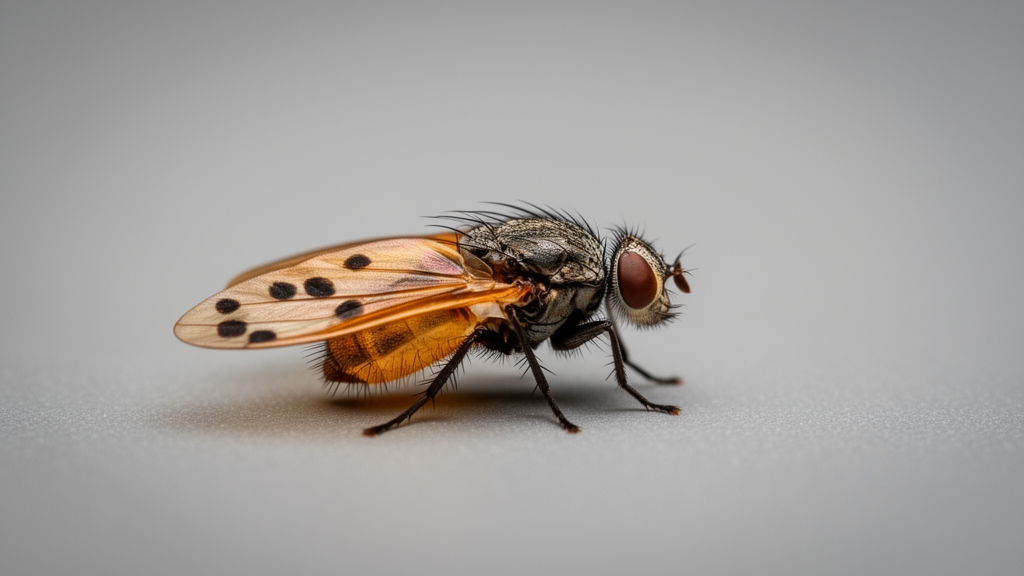
Researchers have demonstrated that the rearing temperature of Drosophila guttifera significantly influences the physical dimensions of their wings and the specific melanin spots located on them. Published in Development Genes and Evolution, the study reveals that while wing size generally increases at lower temperatures, the size of individual wing spots responds differently depending on their location. This finding highlights that the developmental mechanisms controlling wing size and spot size operate independently, offering new insights into how environmental factors shape animal color patterns.
The study, led by Yuichi Fukutomi, Aya Takahashi, and Shigeyuki Koshikawa, utilized the polka-dotted melanin pattern on the wings of D. guttifera as a model system. In this species, melanin spots are positioned around campaniform sensilla, and the area of these spots is specified by the wingless morphogen during the pupal period. The developmental process of wing pigmentation in Drosophila is divided into two distinct phases: prepattern specification during the pupal stage and the subsequent transportation of melanin precursors through wing veins after the fly emerges from the pupa. The researchers aimed to determine which of these two phases is susceptible to thermal changes.
To investigate this, the team reared flies at four different temperatures: 18 °C, 21 °C, 25 °C, and 28 °C. The flies were maintained on a malt-based food medium, and adult progeny were collected within 24 hours of eclosion. For the temperature-shift experiments, pupae were picked at stage P4 (i), a distinguishable stage that occurs just before the expression of the wingless gene begins in the polka-dotted pattern. The researchers then manipulated the temperature during specific pupal stages to identify the most sensitive periods for developmental plasticity.
The results showed a clear thermal plasticity in wing size. The centroid size of the wings, a standard metric for estimating insect wing size, became smaller as the rearing temperature increased. This trend was observed in both male and female flies, with wings reared at 18 °C being significantly larger than those reared at higher temperatures. This observation aligns with previous reports in other Drosophila species, where lower rearing temperatures typically result in larger body and wing sizes.
In contrast, the absolute size of the wing spots did not show a simple linear correlation with temperature. While statistical analysis detected significant differences in spot size between temperatures, the trend was complex. For instance, the size of the “Proximal” spots remained relatively stable in male flies across most temperatures, whereas in females, the size varied more noticeably. The “Middle” spots in males appeared to decrease in size at higher temperatures, but this pattern was not consistent in females. This complexity suggests that spot size is not merely a byproduct of overall wing size.
To account for the variation in wing size, the researchers adjusted the spot size by dividing it by the area of a specific polygon on the wing. After this adjustment, the ratio of spot size to wing size was found to be higher at higher temperatures. This indicates that while the wings themselves shrink at higher temperatures, the spots do not shrink proportionally. Furthermore, the ratio of the “Proximal” spot size to the “Middle” spot size increased with higher rearing temperatures, demonstrating that different spots have different reaction norms to temperature changes.
The temperature-shift experiments provided further clarity on the timing of these developmental responses. Wing size was most sensitive to temperature changes during the early pupal stages, specifically before stage P4 (i). Flies reared at 18 °C until P4 (i) and then moved to 25 °C had the largest wings, indicating that the early pupal period is critical for determining final wing size. This finding is consistent with studies in D. melanogaster, which show that earlier developmental stages are more sensitive to rearing temperature than later pupal stages.
For spot size, the most sensitive period was from P4 (i) to P14-15. When flies were exposed to 18 °C during this specific window, the spots became the smallest, and the “Proximal” spot became smaller than the “Middle” spot. This phenotype was not observed when the temperature was changed before P4 (i) or after P14-15. The fact that the most sensitive periods for wing size and spot size are different supports the hypothesis that independent mechanisms regulate the thermal plasticity of these two traits.
The study also suggests that the transportation of melanin precursors through wing veins after eclosion does not play a major role in the thermal plasticity of wing spots. When flies were exposed to 18 °C from stage P14-15 onwards, a period that includes the post-eclosion transportation phase, there was no significant difference in adjusted spot size compared to flies exposed to 18 °C before P4 (i). This implies that the prepattern specification process during the pupal period, rather than the post-eclosion transportation, is the primary driver of thermal plasticity in spot size.
The researchers propose that the rearing temperature may affect the distribution of the Wingless morphogen, which specifies the area of the wing spots. The extracellular distribution of morphogens is known to be plastic to surrounding temperature in other systems. If the response of Wingless distribution to temperature differs between the “Proximal” and “Middle” spots, it could explain the different reaction norms observed. However, the authors note that other genetic mechanisms could also be responsible for these differences, and further research is needed to fully elucidate the molecular basis of this plasticity.
This study contributes to the broader understanding of phenotypic plasticity in animal color patterns. By identifying the specific developmental stages and mechanisms involved, the researchers provide a framework for investigating how environmental factors like temperature influence the formation of complex patterns. The findings also highlight the importance of considering different traits separately, as they may be regulated by distinct developmental pathways even when they are part of the same structure.
The data from this study are available through figshare, allowing other researchers to verify and build upon these findings. The use of D. guttifera as a model system continues to offer valuable insights into the developmental biology of color patterns.
The study utilized a wild-type strain of Drosophila guttifera, stock number 15130–1971.10, obtained from the Drosophila species stock center at the University of California, San Diego. Flies were reared on a malt-based food medium containing cornmeal, malt, sugar, yeast, and agar. To prevent food desiccation at higher temperatures, vials were placed in plastic bags with moist tissue paper. For the temperature-shift experiments, pupae were collected at stage P4 (i), a distinguishable stage that occurs immediately before the expression of the wingless gene begins in the polka-dotted pattern. This specific timing allowed the researchers to isolate the developmental window during which the prepattern is specified, distinct from later stages of pupal development.
Wing size was quantified using centroid size, a metric defined as the square root of the sum of squared distances from the centroid to specific landmark points on the wing. The landmarks used for this calculation were the intersection points of wing veins. To measure spot size, digital images of the wings were binarized using Otsu’s method, which automatically determines a threshold to separate the melanin spots from the background. The areas of two specific spots, labeled “Proximal” and “Middle,” were calculated from these binarized images. To account for the difference in units between spot area and wing centroid size, the spot size was divided by the area of a predetermined polygon defined by the vein landmarks, rather than the total wing area, to ensure higher reproducibility in the measurements.
Statistical analyses were conducted using R version 4.2.1. For unadjusted wing and spot sizes, one-way ANOVA and Tukey’s honest significant differences test were employed. For adjusted spot sizes and the ratio of Proximal to Middle spot sizes, non-parametric Kruskal–Wallis rank sum tests and pairwise Wilcoxon rank sum tests with Bonferroni correction were used. To further detail the effect of temperature on spot size relative to wing size, the researchers performed analyses of covariance (ANCOVA), regressing the logarithm of spot size against the logarithm of polygon area. This approach allowed them to test for homogeneity of regression slopes and determine if temperature significantly affected spot size independent of wing size variations.
The results indicated that the thermal plasticity of wing size and spot size are regulated by independent mechanisms. Wing size was most sensitive to temperature changes during developmental stages before P4 (i), with flies reared at 18 °C until this stage producing the largest wings. In contrast, spot size was most sensitive during the period from P4 (i) to P14-15. When flies were exposed to 18 °C during this specific window, the spots became the smallest, and the Proximal spot became smaller than the Middle spot.
The findings suggest that the transportation of melanin precursors through wing veins after eclosion does not significantly contribute to the thermal plasticity of wing spots. Exposure to 18 °C from stage P14-15 onwards, a period encompassing the post-eclosion transportation phase, did not result in significant differences in adjusted spot size compared to flies exposed to 18 °C before P4 (i). This implies that the prepattern specification process during the pupal period, specifically the stages where wingless is expressed, is the primary driver of thermal plasticity in spot size. The robustness of the transportation process to thermal changes may be a conserved trait among Drosophila species, as similar thermal robustness in spot size relative to wing size was previously reported in D. suzukii.
The researchers propose that temperature may influence the extracellular distribution of the Wingless morphogen, which is known to be plastic to surrounding temperature in other developmental systems. If the response of Wingless distribution to temperature varies between the Proximal and Middle spots, it could account for the different reaction norms observed. However, the authors acknowledge that other genetic mechanisms may also be responsible for these differences. The data from this study are available through figshare, providing a resource for further investigation into the developmental biology of color patterns and the specific mechanisms underlying phenotypic plasticity in Drosophila.
Subject of Research: Thermal plasticity of wing size and spot size in Drosophila guttifera
Article Title: Thermal plasticity of wing size and wing spot size in Drosophila guttifera
Article References: Fukutomi, Y., Takahashi, A., & Koshikawa, S. (2023). Thermal plasticity of wing size and wing spot size in Drosophila guttifera. Development Genes and Evolution, 233(2), 77-89. https://doi.org/10.1007/s00427-023-00705-x
Image Credits: AI Generated
DOI: 10.1007/s00427-023-00705-x
Keywords: Drosophila guttifera, Thermal plasticity, Wing size, Wing spots, Phenotypic plasticity, Developmental biology, Wingless morphogen, Pupal stages, Melanin pigmentation, Reaction norms, Thermal, plasticity
News Source: Drew Townsend. (November 8, 2026). Temperature Shapes Wing Size and Spot Patterns in Fruit Flies. Scienmag.