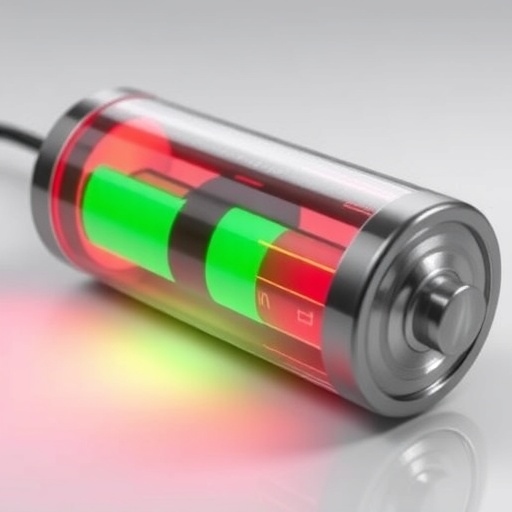
Researchers at the forefront of battery technology have recently proposed an innovative methodology for estimating the state of charge (SoC) of lithium-ion batteries, taking into account the intricate effects of temperature variations. This groundbreaking research, titled “Dual time-scale state of charge estimation for lithium-ion batteries under temperature effects on the equivalent circuit model and available capacity,” published in the prestigious journal Ionics, marks a significant advancement in battery management systems vital for electric vehicles, portable electronic devices, and renewable energy storage solutions.
The quest for efficient and accurate state of charge estimation has long posed significant challenges for the electronics and automotive industries. Traditional methods often fall short when it comes to adapting to external temperature changes, resulting in decreased performance and inaccurate battery status reporting. The research team led by Huaibin Gao, Jiangwei Yang, and Meng Wang sought to bridge this gap by utilizing a dual time-scale approach. This method is aimed specifically at addressing the temperature’s impact on battery behavior, thus improving reliability and effectiveness in real-world applications.
At the heart of their approach lies an equivalent circuit model, which simulates battery dynamics by incorporating various electrical components that represent different electrochemical processes within the battery. By refining this model to account for temperature-related changes, the researchers have created a more accurate tool for understanding how lithium-ion batteries operate under varying conditions. This is particularly essential as temperature fluctuations can significantly affect a battery’s capacity and its discharge characteristics.
Central to the study is the development of a dual time-scale estimation framework. This framework distinguishes between fast and slow dynamics within the battery system. Fast dynamics involve rapid changes in SoC due to high power demands, such as during acceleration in electric vehicles. Conversely, slow dynamics pertain to longer-term effects, such as self-discharge and capacity fade over time. The researchers utilized this distinction to tailor their estimation algorithms, thereby enhancing the model’s responsiveness to sudden changes while maintaining accuracy over extended periods.
Moreover, the researchers incorporated a comprehensive dataset, reflecting various temperature conditions and battery chemistries, to validate their model extensively. By rigorously testing their dual time-scale estimation approach against this dataset, they demonstrated its superiority over traditional methods that often employ a single time-scale estimation. The results indicated a marked improvement in the precision of SoC estimates, particularly under challenging thermal conditions.
One of the critical aspects of battery management is ensuring that lithium-ion batteries operate within safe temperature ranges. The implications of temperatures that exceed or fall below specified thresholds can lead to thermal runaway or diminished efficiency. The researchers’ model addresses these safety concerns directly by providing accurate real-time data regarding the SoC, ensuring that safeguarding mechanisms can be employed when necessary.
In practical applications, the integration of this dual time-scale approach is expected to provide electric vehicle manufacturers with a competitive edge. With accurate SoC data, vehicle systems can optimize energy usage more effectively, thereby extending driving range and enhancing overall performance. Furthermore, this research supports the ongoing development of smarter battery management systems equipped with adaptive algorithms that anticipate battery behavior under diverse operational scenarios.
Additionally, the research has broader implications for energy storage systems used in renewable energy applications. As society moves toward cleaner energy sources, the efficient management of battery storage solutions becomes crucial. The ability to accurately estimate the SoC in these systems will not only help in maximizing the energy utilization from renewable sources but also in grid stability.
The dual time-scale model developed by Gao, Yang, and Wang highlights the intersection of advanced modeling techniques with practical engineering solutions. Their research paves the way for additional investigations into the effects of other environmental factors on battery performance, including humidity and pressure variations. By continuing to refine the understanding of these factors, future studies may lead to even more robust battery management systems.
Importantly, this research underscores the significance of interdisciplinary collaboration in addressing contemporary challenges. By combining insights from materials science, electrical engineering, and data analytics, the research exemplifies how complex issues can be approached systematically. The seamless integration of these disciplines not only enhances battery technology but also fosters innovation in other fields where battery applications are paramount.
The findings of this research are poised to challenge the status quo of battery management and pave the way for advancements in intelligent energy solutions that are responsive to environmental changes. As lithium-ion batteries continue to dominate various markets, the need for sophisticated, accurate, and adaptable estimation methodologies will become increasingly critical. Future work will undoubtedly build on these findings, with researchers exploring further optimization techniques and the extension of this dual time-scale framework to newer battery chemistries.
The potential for commercialization is immense, and stakeholders across industries can look forward to the advent of more reliable, efficient, and long-lasting battery systems. As electric mobility and renewable energy solutions proliferate globally, this research stands out as a key driver in enabling sustainable technologies that are not only functional but also environmentally conscious.
In conclusion, the exploration of dual time-scale state of charge estimation offers a promising avenue for enhancing the reliability and efficiency of lithium-ion batteries. By providing a more nuanced understanding of how temperature influences battery dynamics, this study lays the groundwork for future innovations in battery technology. The result is an encouraging signal that sophisticated engineering solutions can now harness the potential of emerging technologies to meet the growing demands of modern society.
Subject of Research: State of charge estimation of lithium-ion batteries
Article Title: Dual time-scale state of charge estimation for lithium-ion batteries under temperature effects on the equivalent circuit model and available capacity
Article References:
Huaibin, G., Jiangwei, Y., Meng, W. et al. Dual time-scale state of charge estimation for lithium-ion batteries under temperature effects on the equivalent circuit model and available capacity. Ionics (2025). https://doi.org/10.1007/s11581-025-06897-8
Image Credits: AI Generated
DOI: 10.1007/s11581-025-06897-8
Keywords: Lithium-ion batteries, state of charge, dual time-scale, temperature effects, equivalent circuit model, energy storage, battery management systems.
Tags: accurate battery status reporting techniquesadvancements in renewable energy storage solutionsbattery management systems for electric vehicleschallenges in state of charge estimationdual time-scale methodology for battery managementequivalent circuit model for battery dynamicsimpact of temperature on battery capacityimproving reliability in battery applicationsinnovative battery technology researchresearch on lithium-ion battery behaviorstate of charge estimation in lithium-ion batteriestemperature effects on battery performance