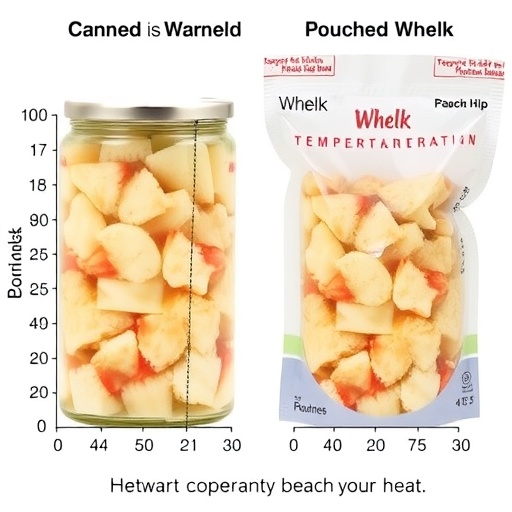
In an era where food safety and processing efficiency are paramount, understanding the nuances of thermal sterilization methods remains critical. Recently, a pioneering study led by Hwang, Lee, and Chung has shed new light on the comparative temperature distribution and heat penetration characteristics of canned versus pouched whelk (Buccinum striatissimum) during steam–air retort sterilization. Published in the esteemed journal Food Science and Biotechnology, this research unveils comprehensive technical insights with potential profound implications for the food sterilization industry.
The process of steam–air retort sterilization is widely utilized for its efficacy in eliminating microbial hazards in foods while preserving nutritional content and sensory attributes. However, the physical configuration of the food packaging, alongside its thermal conductivity, heavily influences heat transfer kinetics. The current study specifically contrasts traditional metal can packaging with flexible pouch packaging, examining how each medium impacts heat penetration upon industrial-scale processing of whelk, a marine mollusk highly valued in culinary markets.
To contextualize the investigation, it’s necessary to understand that whelk products pose unique sterilization challenges owing to their dense muscular tissue and significant size variations. Achieving uniform sterilization to meet safety standards without overprocessing is technologically demanding. Traditionally, canned products have been preferred because of their robustness and favorable heat conduction properties, whereas flexible pouches provide advantages in terms of reduced packaging weight and enhanced consumer appeal but may behave differently under thermal conditions.
The researchers meticulously mapped temperature profiles in both packaging types using advanced thermocouple arrays positioned strategically within the whelk samples. These measurements were collected throughout the entire retort sterilization cycle, notably under steam–air mixtures at defined temperature setpoints common in industry-scale operations. The resulting data unveiled noteworthy disparities in heat transfer dynamics between cans and pouches.
Analysis revealed that temperature distribution within the canned whelks was relatively homogeneous, suggesting efficient thermal conduction. The metallic nature of cans facilitated rapid heat transfer, minimizing thermal gradients which can otherwise lead to cold spots—zones vulnerable to insufficient sterilization. This homogeneity is critical to ensuring microbial reduction without unnecessary overexposure of the product to heat, which risks degrading texture and nutritional components.
In contrast, heat penetration in pouched products exhibited greater variability and slower thermal equilibration times. Flexible pouch materials, often multilayered polymers, possess lower thermal conductivity compared to metal, leading to uneven heating. The study highlighted that pouched whelks needed longer processing durations to reach sterilization-critical temperatures, calling attention to the potential risks of underprocessing if conventional time-temperature profiles are applied unmodified.
One of the scientific triumphs of this research lies in its exploration of the steam–air mixture dynamics inside retort chambers. The dual-phase medium promotes convective heat transfer efficiencies, but the interplay with packaging material thermal properties is complex. The authors’ in-depth quantitative analysis, supported by temperature-time integrals and lethality calculations, confirmed that thermal lethality was achieved in both packaging forms but required distinct processing parameters.
The implications of this research resonate beyond whelk sterilization alone. It underscores the imperative for food processors to tailor retort sterilization protocols specific to packaging architecture and product type. Employing a one-size-fits-all approach risks compromising either food safety or product quality. This is particularly pertinent as global markets increasingly favor sustainable flexible packaging options, encouraging further optimization of thermal processes.
Another salient aspect discussed relates to sterility assurance levels (SAL). While both packaging formats ultimately achieved the microbial lethality thresholds mandated by regulatory guidelines, the study advocates for comprehensive process validation whenever novel packaging configurations are introduced. Data-driven adjustments to retort time, temperature, and pressure profiles will be essential to maintain consumer protection and comply with stringent food safety frameworks.
Furthermore, the study contributes valuable methodology for industrial practitioners by demonstrating how thermal mapping techniques and predictive modeling can expedite process development. Detailed knowledge of heat kinetics and temperature uniformity aids in minimizing trial-and-error experiments, which are costly and time-consuming at scale. Such process intensification aligns with broader industry trends toward precision thermal processing.
From an environmental perspective, the contrast between the two packaging types also invites consideration of lifecycle impacts. While cans often require more material and energy for production and recycling, flexible pouches offer lighter alternatives but challenge sterilization uniformity. The authors’ findings encourage integrative approaches combining materials science with thermal engineering to strike optimal balances between safety, product quality, and sustainability.
The research team also discusses potential avenues for future work, including exploring novel pouch barrier materials with enhanced thermal properties, advanced retort cycle designs incorporating pulsed or staged heating, and real-time temperature monitoring driven by artificial intelligence for adaptive control. Such innovations could revolutionize steam–air sterilization, extending applicability to a broader array of seafood and other protein-rich foods.
Significantly, this study shines a spotlight on the delicate thermal thresholds necessary for whelk processing. Overheating risks to muscle proteins and bioactive compounds can detract from the prized sensory experience of this delicacy, while underprocessing threatens food safety. The duality faced by processors mandates fine-tuned control achievable only through comprehensive empirical investigations like the one presented here.
Overall, the research conducted by Hwang and colleagues represents a landmark in applied food science, merging industrial-scale experimentation with theoretical rigor. The knowledge generated from this comparison of temperature distribution and heat penetration enriches our understanding of steam–air retort sterilization and advances the field toward safer and more efficient manufacturing practices.
As consumer demand rises for minimally processed, safe, and sustainably packaged seafood products, such cutting-edge studies pave the way for technological breakthroughs. The steam–air retort remains a cornerstone in sterilization, and optimizing its performance through insights into packaging-thermal interactions is a critical frontier. This research thus not only addresses immediate industrial challenges but also catalyzes ongoing innovation within global food processing sectors.
In conclusion, the differential thermal behavior documented between canned and pouched whelk during sterilization elicits important reflections on existing packaging strategies and process control paradigms. It urges food technologists and equipment manufacturers alike to collaborate intensively, leveraging multidisciplinary expertise to push boundaries in food safety while elevating product integrity and consumer satisfaction.
This compelling investigation foregrounds the science of heat transfer in food sterilization while offering pragmatic guidance for real-world application. As industrial steam–air retort technology evolves, such foundational knowledge equips producers to navigate the complex interplay of materials, microbiology, and thermal engineering, ultimately enhancing the quality and safety of cherished seafood delicacies across diverse markets worldwide.
Subject of Research: Thermal kinetics and heat penetration characteristics in canned vs. pouched whelk during steam–air retort sterilization.
Article Title: Comparison of temperature distribution and heat penetration between canned and pouched whelk (Buccinum striatissimum) during industrial-scale steam–air retort sterilization.
Article References:
Hwang, HJ., Lee, GY. & Chung, MS. Comparison of temperature distribution and heat penetration between canned and pouched whelk (Buccinum striatissimum) during industrial-scale steam–air retort sterilization. Food Sci Biotechnol (2025). https://doi.org/10.1007/s10068-025-02080-x
Image Credits: AI Generated
DOI: 26 December 2025
Tags: canned vs pouched whelkflexible pouch packaging advantagesfood safety in canned productsheat penetration in food packagingindustrial-scale food processing challengesmicrobial hazard elimination in foodsnutritional preservation during sterilizationsteam-air retort sterilizationsterilization of dense food productsthermal conductivity in food processingthermal sterilization methodswhelk culinary applications