• HOME
  • NEWS
  • EXPLORE
    • CAREER
      • Companies
      • Jobs
    • EVENTS
    • iGEM
      • News
      • Team
    • PHOTOS
    • VIDEO
    • WIKI
  • BLOG
  • COMMUNITY
    • FACEBOOK
    • INSTAGRAM
    • TWITTER
Friday, April 3, 2026
BIOENGINEER.ORG
No Result
View All Result
  • Login
  • HOME
  • NEWS
  • EXPLORE
    • CAREER
      • Companies
      • Jobs
        • Lecturer
        • PhD Studentship
        • Postdoc
        • Research Assistant
    • EVENTS
    • iGEM
      • News
      • Team
    • PHOTOS
    • VIDEO
    • WIKI
  • BLOG
  • COMMUNITY
    • FACEBOOK
    • INSTAGRAM
    • TWITTER
  • HOME
  • NEWS
  • EXPLORE
    • CAREER
      • Companies
      • Jobs
        • Lecturer
        • PhD Studentship
        • Postdoc
        • Research Assistant
    • EVENTS
    • iGEM
      • News
      • Team
    • PHOTOS
    • VIDEO
    • WIKI
  • BLOG
  • COMMUNITY
    • FACEBOOK
    • INSTAGRAM
    • TWITTER
No Result
View All Result
Bioengineer.org
No Result
View All Result
Home NEWS Science News Chemistry

Teamwork in a molecule

Bioengineer by Bioengineer
January 21, 2021
in Chemistry
Reading Time: 2 mins read
0
IMAGE
Share on FacebookShare on TwitterShare on LinkedinShare on RedditShare on Telegram

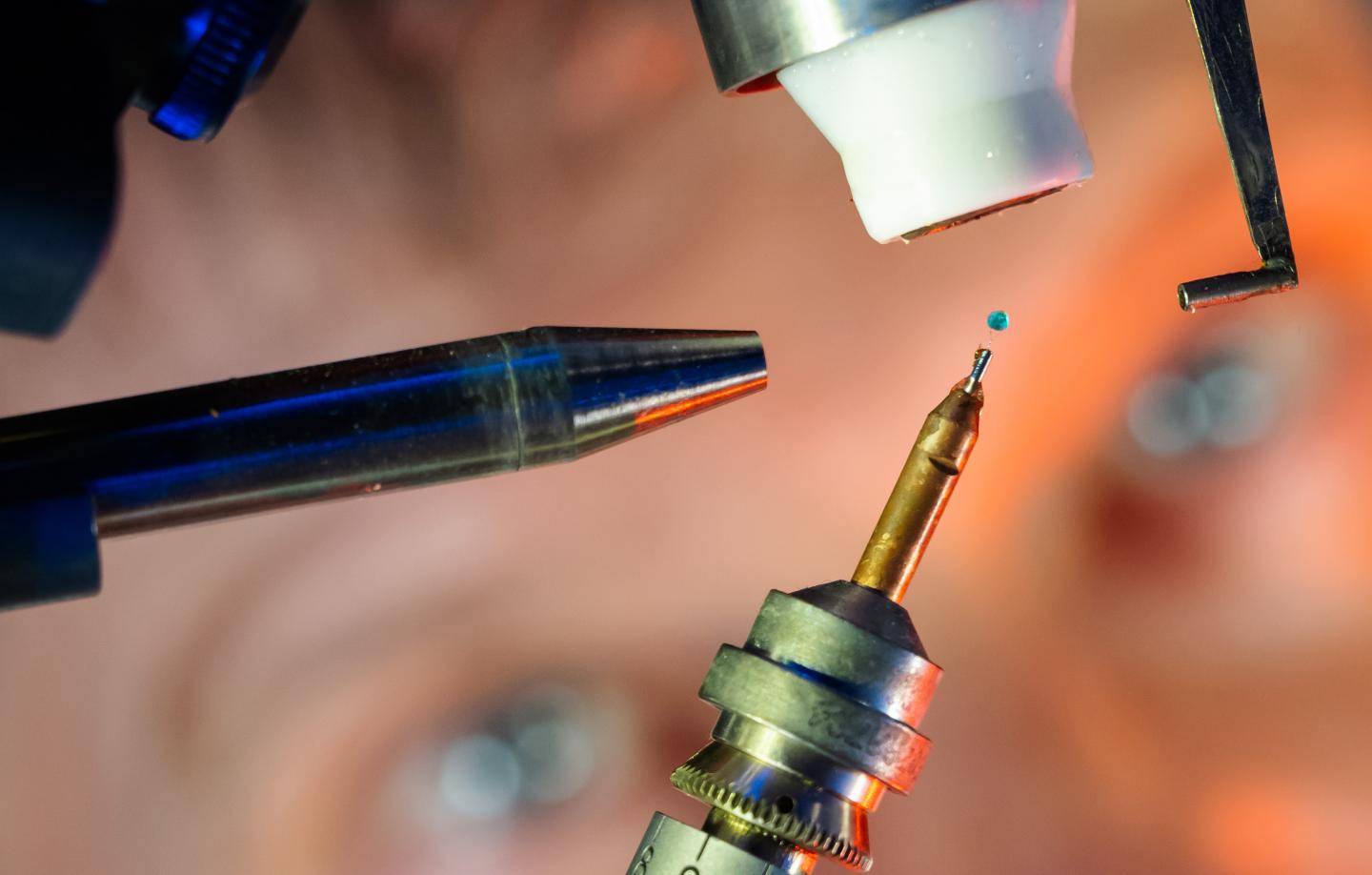
Chemists at University of Jena (Germany) harness synergy effect of gallium
IMAGE

Credit: Jens Meyer/University of Jena

“Such reactions are usually carried out using transition metals, such as nickel or iridium,” explains Prof. Robert Kretschmer, Junior Professor of Inorganic Chemistry at the University of Jena, whose work has been published in the prestigious Journal of the American Chemical Society. “However, transition metals are expensive and harmful to the environment, both when they are mined and when they are used. Therefore, we are trying to find better alternatives.” That two metals can do more than one is already known in the case of transition metals. “However, there has been hardly any research on the more sustainable main-group metals of the periodic table,” Kretschmer adds.

Hand in hand

“Our compound contains two chemically identical gallium atoms,” says Kretschmer. “In tests with a series of fluorine-containing hydrocarbon compounds, we saw that these two atoms together are capable of removing a fluorine atom. Using X-ray structure analysis, we were able to prove that one gallium atom binds the fluorine and the other binds the other part of the hydrocarbon compound.” This is the first step needed for catalysis.

“Now that this step has been achieved, we can consider how to develop this concept further,” explains Kretschmer. “It would of course be desirable if, at the end, the reaction could be continued to achieve a complete catalytic cycle.” However, this will probably involve a different metal. Kretschmer notes: “Gallium as an element was a first step here. Our goal is ultimately to harness the metal that occurs most frequently on earth: aluminium.”

###

Original publication

Oleksandr Kysliak, Helmar Görls and Robert Kretschmer, „Cooperative Bond Activation by a Bimetallic Main-Group Complex”, Journal of the American Chemical Society, 2021, (143:1), 142-148. DOI: 10.1021/jacs.0c12166

Contact:

Robert Kretschmer

Junior Professorship of Anorganic Chemistry of Catalysis

Institute for Inorganic and Analytical Chemistry of Friedrich Schiller University Jena

Humboldtstraße 8, 07743 Jena, Germany

Phone: +49 3641 9-48 911

Email: [email protected]

Media Contact
Ute Schoenfelder
[email protected]

Original Source

https://www.uni-jena.de/en/210120_Teamarbeit_im_Molekuel

Related Journal Article

http://dx.doi.org/10.1021/jacs.0c12166

Tags: Chemistry/Physics/Materials Sciences
Share12Tweet8Share2ShareShareShare2

Related Posts

Engineered Biochar Harnesses Soil Chemistry to Degrade Antibiotic Pollution

Engineered Biochar Harnesses Soil Chemistry to Degrade Antibiotic Pollution

April 2, 2026
From Coffee Waste to Cutting-Edge Biodegradable Insulation: A Green Innovation

From Coffee Waste to Cutting-Edge Biodegradable Insulation: A Green Innovation

April 2, 2026

Study Uncovers Early Origins of Atypical Alterations in Dalí’s The Temptation of St. Anthony (1946), Highlighting Crucial Roles of Amber and Zinc White

April 2, 2026

Racetrack-Shaped Lasers Revolutionize Bright and Stable Frequency Combs

April 2, 2026
Please login to join discussion

POPULAR NEWS

  • blank

    Revolutionary AI Model Enhances Precision in Detecting Food Contamination

    96 shares
    Share 38 Tweet 24
  • Imagine a Social Media Feed That Challenges Your Views Instead of Reinforcing Them

    1007 shares
    Share 398 Tweet 249
  • Promising Outcomes from First Clinical Trials of Gene Regulation in Epilepsy

    51 shares
    Share 20 Tweet 13
  • Popular Anti-Aging Compound Linked to Damage in Corpus Callosum, Study Finds

    44 shares
    Share 18 Tweet 11

About

We bring you the latest biotechnology news from best research centers and universities around the world. Check our website.

Follow us

Recent News

Revolutionary Magnetic Biochar Gel Tackles Arsenic and Antimony Pollution in Rice Cultivation

Engineered Biochar Harnesses Soil Chemistry to Degrade Antibiotic Pollution

Leading Cancer Scientist Thales “PapaG” Papagiannakopoulos Joins Salk Institute

Subscribe to Blog via Email

Enter your email address to subscribe to this blog and receive notifications of new posts by email.

Join 78 other subscribers
  • Contact Us

Bioengineer.org © Copyright 2023 All Rights Reserved.

Welcome Back!

Login to your account below

Forgotten Password?

Retrieve your password

Please enter your username or email address to reset your password.

Log In
No Result
View All Result
  • Homepages
    • Home Page 1
    • Home Page 2
  • News
  • National
  • Business
  • Health
  • Lifestyle
  • Science

Bioengineer.org © Copyright 2023 All Rights Reserved.