Credit: Photo by L. Brian Stauffer
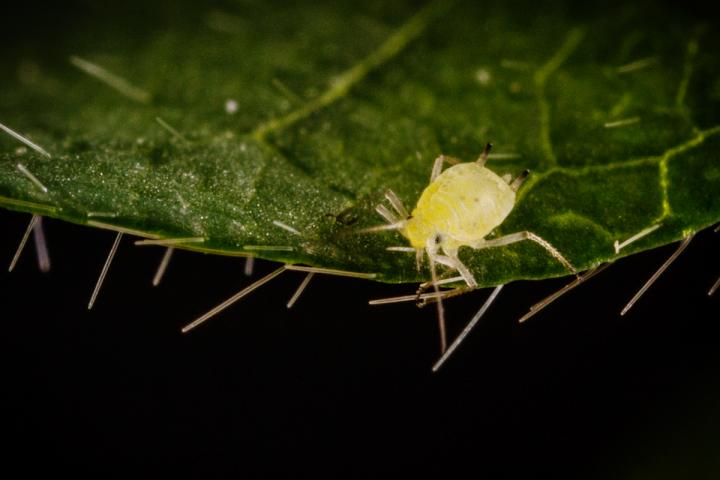
CHAMPAIGN, Ill. — Researchers are nebulizing soybean aphids with RNA, which, when incorporated into the body, can hinder the expression of specific genes. The new method of delivering "interfering RNA" in a mist will likely speed the process of discovering the function of many mystery genes in insects, the researchers report in the journal Insect Molecular Biology.
The new technique, first tried in a separate study of honey bees using a slightly different protocol, is a vast improvement over other approaches – for example, injecting the RNA, which is quite challenging when working with a creature the size of a pollen grain, the researchers said. Understanding the function of genes is a key to developing new approaches to controlling the pest, they said.
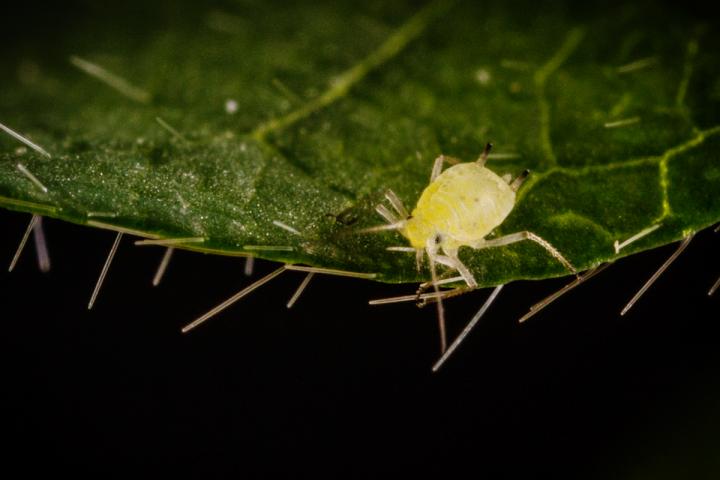
The soybean aphid, Aphis glycines, is a relative newcomer to the U.S. from its native territory in eastern and southeastern Asia. First found in 2000 in Wisconsin, the aphid quickly spread throughout much of the Midwest United States and into eastern Canada. Heavy infestations can cause yield losses of 40 percent or more, studies have found.
"There are different populations of the soybean aphid that differ in their ability to overcome soybean defenses," said University of Illinois entomology professor Allison Hansen, who led the new study with graduate student Margaret Thairu. "If you can knock down certain genes – cause them to express less of a certain protein, for example – it is easier to discover their function," Hansen said. "This can provide information that will aid in the development of new pest-control systems."
Introducing RNA into an animal's body can dampen the expression of specific genes. This is sometimes preferable to knocking out the gene altogether, which could kill the animal, Hansen said.
Interrupting the protein-building machinery helps scientists understand what individual genes do, Thairu said. She compares it to figuring how a car, truck or train engine works by systematically pulling out engine parts and observing the results.
"We take out the spark plug and see what happens," she said. "Does the car run? Does the train move anymore?"
But getting RNA into an aphid's body is no easy task. Common techniques involve injecting the RNA, or engineering a plant in the laboratory to produce the RNA in its tissues and getting the insect to feed on it. In the latter case, the RNA is often degraded in the insect's gut, minimizing its effectiveness.
Both methods are tedious, expensive and inefficient. As a result, the process of gene discovery in many sap-sucking insects like aphids has slowed to a crawl, Hansen said.
"We have all this genomic data we don't know what to do with," she said. "People are just desperate to get something that will work."
"By aerosolizing the RNA, we can deliver it directly to the target tissues," Thairu said.
The researchers nebulized the aphids with tiny droplets of RNA bound to nanoparticles. They put the insects in a small chamber and doused them with the mixture.
"They don't look happy after this, because they don't like water," Hansen said. "They look like sad, wet dogs."
The aphids perked up when returned to their host plants, the researchers said.
Nebulizing soybean aphids with RNA bound to nanoparticles appeared to block the function of a specific targeted gene, known as "bcat," the researchers found. This gene plays a role in degradation – and perhaps also the synthesis – of branch-chain amino acids. Adult insects exposed to the RNA for bcat were significantly smaller than their unexposed peers and smaller than insects exposed only to the nanoparticles, the researchers found. Using nanoparticles coated in RNA appeared to improve the uptake of RNA through tiny breathing tubes in the insects' bodies called tracheoles.
The same technique did not appear to work in other aphid species, however. It also failed to produce a change when targeting a different gene.
Hansen calls the new findings a proof of concept that the nebulizing technique can succeed – at least in some sap-sucking insects like aphids, which are notoriously difficult to work with.
"This method is going to propel our field forward, especially for insects where other techniques fall short," she said.
###
Editor's notes:
To reach Allison Hansen, call 217-244-5889; email [email protected].
To reach Margaret Thairu, email [email protected].
The paper "Efficacy of RNA interference knockdown using aerosolized short interfering RNAs bound to nanoparticles in three diverse aphid species" is available and from the U. of I. News Bureau. DOI: 10.1111/imb.12301
Media Contact
Diana Yates
[email protected]
217-333-5802
@NewsAtIllinois
http://www.illinois.edu
############
Story Source: Materials provided by Scienmag