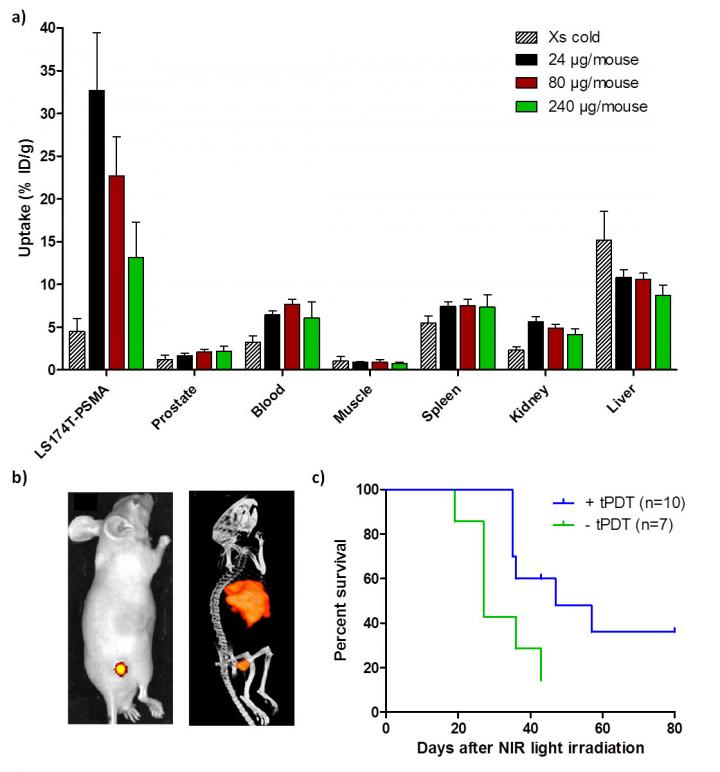
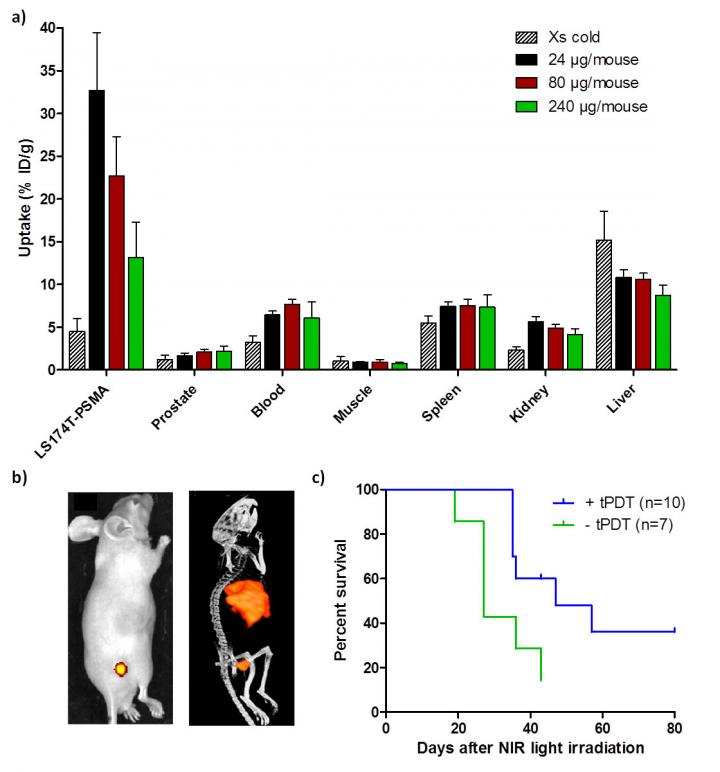
Credit: Department of Radiology and Nuclear Medicine at Radboud University Medical Center in Nijmegen, the Netherlands, and the Clinic for Nuclear Medicine at University Hospital Essen, Germany.
DENVER, Colo. – Researchers presenting a preclinical study at the 2017 Annual Meeting of the Society of Nuclear Medicine and Molecular Imaging (SNMMI) demonstrated the efficacy and optimal dose for targeted photodynamic therapy (tPDT) to treat prostate cancer before and during surgery. Prostate-specific membrane antigen (PSMA) was targeted with an anti-PSMA antibody radiolabeled with the tracer indium-111 (111In) and coupled with specialized photosensitizers that cause cell destruction upon exposure to near-infrared (NIR). The combined formula is 111In-DTPA-D2B-IRDye700DX.
"Coupling the photosensitizer to an imaging agent that targets PSMA on the tumor surface makes it possible to selectively and effectively destroy prostate tumor remnants and micrometastases while surrounding healthy tissues remain unaffected," said Susanne Lütje, MD, PhD, lead author of the study from the Department of Radiology and Nuclear Medicine at Radboud University Medical Center in Nijmegen, the Netherlands, and the Clinic for Nuclear Medicine at University Hospital Essen, Germany.
This technique optimizes prostate cancer care by allowing visualization of tumors prior to surgery, by providing real-time guidance to surgeons in the operating room, and by priming tumors for photodynamic therapy when surgery isn't enough or risks damage to sensitive structures.
A gamma probe is used to detect PSMA-expressing tumor cells. Photosensitizers can then be activated with light in the near-infrared wavelength, which causes them to emit fluorescence, or oxygen radicals, that damage PSMA over-expressing tumor tissues.
Study results showed effective localization of the drug at the site of tumors, as well as effective imaging and photodynamic therapy via near-infrared exposure in mice. Further study in humans is needed before this procedure could be made available for prostate cancer patients.
"In the future, this novel approach to prostate cancer could significantly improve the effectiveness of treatment, reduce recurrent disease and ultimately prolong survival and protect quality of life for patients," said Lütje.
Prostate cancer is the most common cancer in American men, apart from skin cancer, according to the American Cancer Society. About 161,360 new cases of prostate cancer are estimated for 2017, and 26,730 men in the U.S. are expected to die from the disease.
###
Scientific Paper 7: "Characterization of an 111In-labeled anti-PSMA antibody-photosensitizer conjugate for targeted photodynamic therapy of PSMA-expressing tumors," Susanne Lütje, Ken Herrmann, Clinic for Nuclear Medicine, University Hospital Essen, Essen, Germany; Sandra Heskamp, Gerben M. Franssen, Marlene Hekman, Mark Rijpkema, Martin Gotthardt, Otto C. Boerman, Radboud University Medical Center, Nijmegen, Netherlands; Giulio Fracasso, University of Verona, Verona, Italy, SNMMI's 64th Annual Meeting, June 10-14, 2017, Denver, Colo.
LINK TO ABSTRACT
Please visit the SNMMI Media Center for more information about molecular imaging and personalized medicine. To schedule an interview with the researchers, please contact Laurie Callahan at (703) 652-6773 or [email protected]. Current and past issues of The Journal of Nuclear Medicine can be found online at http://jnm.snmjournals.org.
About the Society of Nuclear Medicine and Molecular Imaging
The Society of Nuclear Medicine and Molecular Imaging (SNMMI) is an international scientific and medical organization dedicated to raising public awareness about nuclear medicine and molecular imaging, a vital element of today's medical practice that adds an additional dimension to diagnosis, changing the way common and devastating diseases are understood and treated and helping provide patients with the best health care possible.
SNMMI's more than 17,000 members set the standard for molecular imaging and nuclear medicine practice by creating guidelines, sharing information through journals and meetings and leading advocacy on key issues that affect molecular imaging and therapy research and practice. For more information, visit http://www.snmmi.org.
Media Contact
Laurie Callahan
[email protected]
@SNM_MI
http://www.snm.org
Original Source
http://www.snmmi.org/NewsPublications/NewsDetail.aspx?ItemNumber=24264
############
Story Source: Materials provided by Scienmag