• HOME
  • NEWS
  • EXPLORE
    • CAREER
      • Companies
      • Jobs
    • EVENTS
    • iGEM
      • News
      • Team
    • PHOTOS
    • VIDEO
    • WIKI
  • BLOG
  • COMMUNITY
    • FACEBOOK
    • INSTAGRAM
    • TWITTER
Saturday, December 27, 2025
BIOENGINEER.ORG
No Result
View All Result
  • Login
  • HOME
  • NEWS
  • EXPLORE
    • CAREER
      • Companies
      • Jobs
        • Lecturer
        • PhD Studentship
        • Postdoc
        • Research Assistant
    • EVENTS
    • iGEM
      • News
      • Team
    • PHOTOS
    • VIDEO
    • WIKI
  • BLOG
  • COMMUNITY
    • FACEBOOK
    • INSTAGRAM
    • TWITTER
  • HOME
  • NEWS
  • EXPLORE
    • CAREER
      • Companies
      • Jobs
        • Lecturer
        • PhD Studentship
        • Postdoc
        • Research Assistant
    • EVENTS
    • iGEM
      • News
      • Team
    • PHOTOS
    • VIDEO
    • WIKI
  • BLOG
  • COMMUNITY
    • FACEBOOK
    • INSTAGRAM
    • TWITTER
No Result
View All Result
Bioengineer.org
No Result
View All Result
Home NEWS Science News Chemistry

Targeted coating improves graphene oxide membranes for nanofiltration

Bioengineer by Bioengineer
January 22, 2021
in Chemistry
Reading Time: 2 mins read
0
IMAGE
Share on FacebookShare on TwitterShare on LinkedinShare on RedditShare on Telegram

IMAGE

Credit: LI Sushuang

Nanofiltration (NF) is an advanced technology for treating wastewater containing organic micropollutants (OMPs).

Recently, a research group led by Prof. WAN Yinhua from the Institute of Process Engineering (IPE) of the Chinese Academy of Sciences developed a stable graphene oxide nanofiltration membrane with uniform pore size to remove OMPs.

The study was published in Chemical Engineering Journal on Jan. 20.

It proposes combining signal amplification strategy and defect chemistry to reduce membrane pore size distribution, thus offering a promising method for preparing highly selective NF membranes.

Graphene oxide (GO) shows great potential in molecular sieving for use in NF. GO membranes are generally prepared by stacking GO nanosheets on a porous support layer. However, the use of GO membranes is limited due to their low stability in aqueous environments.

In addition, large defects resulting from non-uniform deposition of GO nanosheets can cause membranes to have low retention capacity and can also cause serious membrane fouling.

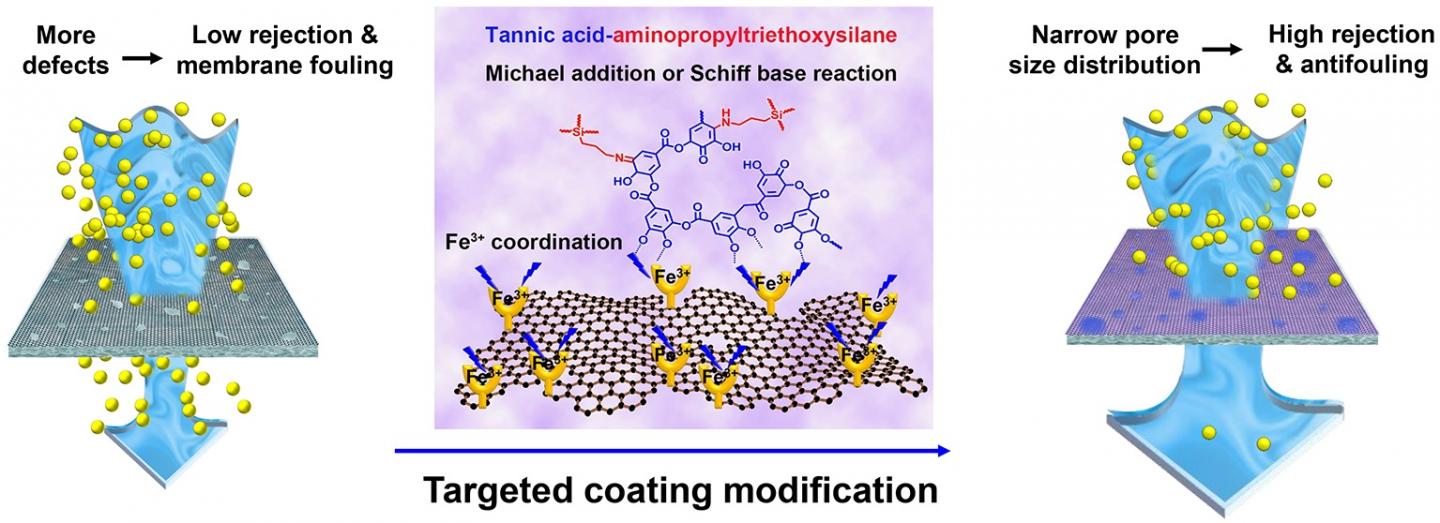
In their study, the researchers proposed a targeted modification strategy to simultaneously enhance the antifouling capacity of GO membranes and regulate their nanochannels.

Ferric ions (Fe3+) are first added to the GO solution to prepare a stable GO membrane (GO-Fe). “The added Fe3+ can amplify the signal of the defects on the GO-Fe membrane where larger transverse defects form due to the repulsive interaction between the adjacent GO nanosheets,” said Prof. LUO Jianquan from IPE.

The GO-Fe membrane surface is subsequently modified by a targeted coating layer consisting of tannic acid-aminopropyltriethoxysilane (TA-APTES), and the larger membrane defects with more Fe3+ are then patched by the thicker TA-APTES coating. Such a “speckled” TA-APTES coating can simultaneously improve the antifouling capacity and narrow the pore size distribution of the Fe3+-mediated GO membrane.

“Compared to the commercially available polyamide NF membranes, our GO membrane with targeted coating shows higher and more stable rejections on various OMPs, even in long-term operation, cross-flow filtration or under high pressure,” said Prof. LUO.

###

Media Contact
LI Xiangyu
[email protected]

Original Source

http://english.cas.cn/

Related Journal Article

http://dx.doi.org/10.1016/j.cej.2021.128587

Tags: Atomic/Molecular/Particle PhysicsChemistry/Physics/Materials SciencesNanotechnology/Micromachines
Share12Tweet8Share2ShareShareShare2

Related Posts

Cutting Electrolyte Reduction Boosts High-Energy Battery Performance

Cutting Electrolyte Reduction Boosts High-Energy Battery Performance

December 19, 2025
Microenvironment Shapes Gold-Catalysed CO2 Electroreduction

Microenvironment Shapes Gold-Catalysed CO2 Electroreduction

December 11, 2025

Photoswitchable Olefins Enable Controlled Polymerization

December 11, 2025

Cation Hydration Entropy Controls Chloride Ion Diffusion

December 10, 2025
Please login to join discussion

POPULAR NEWS

  • Robotic Waist Tether for Research Into Metabolic Cost of Walking

    NSF funds machine-learning research at UNO and UNL to study energy requirements of walking in older adults

    71 shares
    Share 28 Tweet 18
  • Nurses’ Views on Online Learning: Effects on Performance

    70 shares
    Share 28 Tweet 18
  • Exploring Audiology Accessibility in Johannesburg, South Africa

    51 shares
    Share 20 Tweet 13
  • Unraveling Levofloxacin’s Impact on Brain Function

    54 shares
    Share 22 Tweet 14

About

We bring you the latest biotechnology news from best research centers and universities around the world. Check our website.

Follow us

Recent News

Baby Oil Eases Itch and Sleep in Uremic Patients

Impact of Vegan Diet and Resistance Exercise on Muscle Volume

Long Non-Coding RNAs: Key Players in NSCLC Immunity

Subscribe to Blog via Email

Enter your email address to subscribe to this blog and receive notifications of new posts by email.

Join 71 other subscribers
  • Contact Us

Bioengineer.org © Copyright 2023 All Rights Reserved.

Welcome Back!

Login to your account below

Forgotten Password?

Retrieve your password

Please enter your username or email address to reset your password.

Log In
No Result
View All Result
  • Homepages
    • Home Page 1
    • Home Page 2
  • News
  • National
  • Business
  • Health
  • Lifestyle
  • Science

Bioengineer.org © Copyright 2023 All Rights Reserved.