Göttingen research team reveals strengths and shortcomings of different concepts
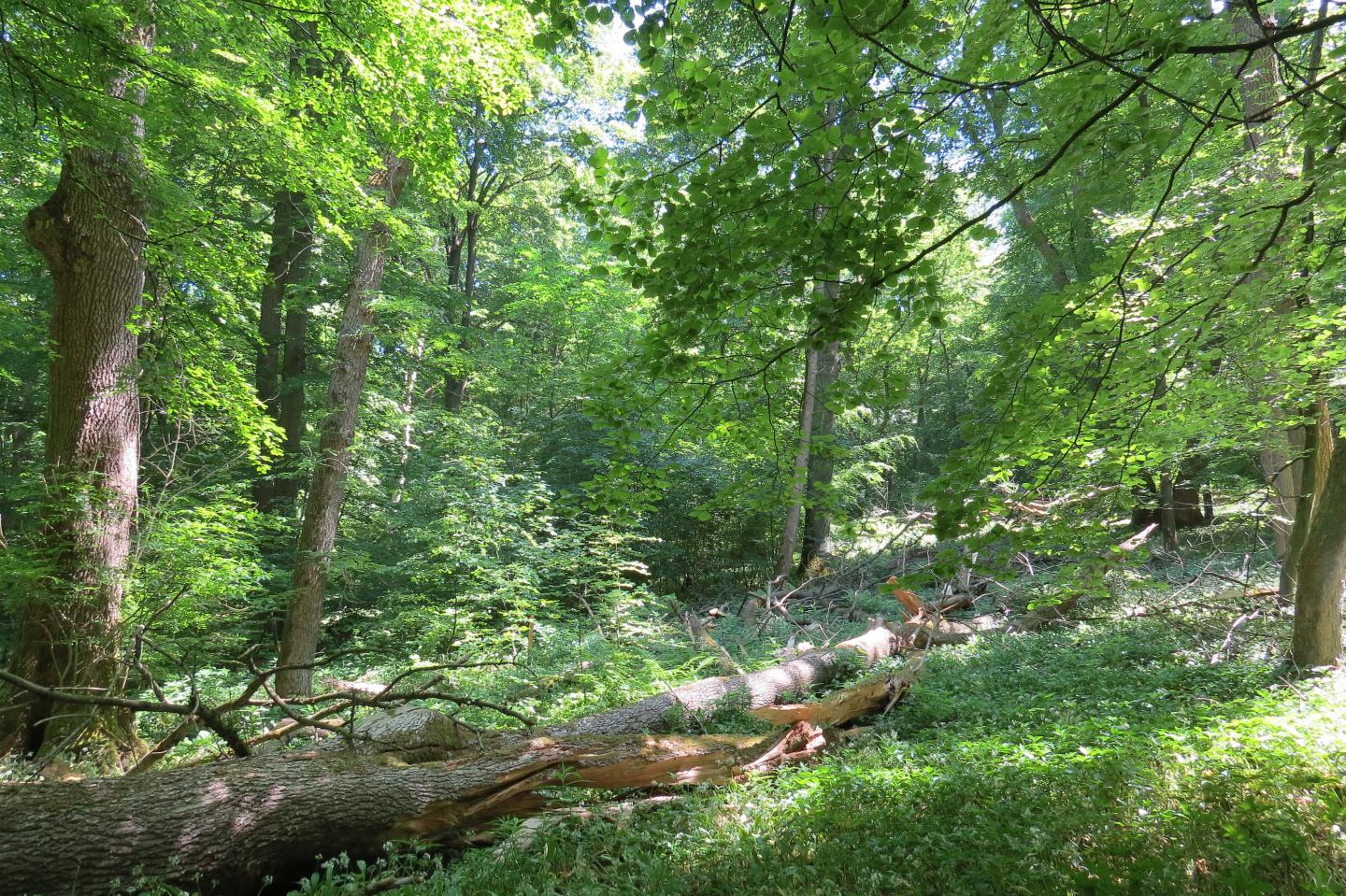
Credit: Laura Demant
Forest conservation can be a source of tension between competing priorities and interests from forestry, science, administration and nature conservation organisations. The different stakeholders can create the public impression of disagreement with regard to the objectives and measures in forest conservation. Scientists from the University of Göttingen, the HAWK University of Applied Sciences and Arts Hildesheim/Holzminden/Göttingen and the Northwest German Forest Research Institute have developed a framework of conservation objectives whereby targets for nature conservation can be compared and analysed. The study was published in Nature Conservation.
The research team developed a reference framework to systematically classify conservation objectives. It considered the following: “living” biotic natural resources such as genes, species, ecosystems and landscapes; and “non-living” abiotic natural resources such as soil, water and climate; in addition to social factors such as recreation, tourism and awareness-raising. The suitability of the conceptual framework was applied to 79 biodiversity and forest conservation concepts. The researchers assigned the stakeholders to three reference areas – international, Germany-wide and regional – in order to search for commonalities and differences with regard to the transfer of knowledge and conservation objectives across stakeholders and reference areas.
“There is a broad consensus concerning forest conservation amongst di?erent stakeholders in Germany,” says first author Laura Demant, PhD student in the Department of Vegetation Analysis and Phytodiversity at the University of Göttingen and research associate at the Northwest German Forest Research Institute. Stakeholders agree that the protection and preservation of diverse and self-sustaining structures in forest ecosystems should be a key objective in forest conservation. The protection of species, deadwood and habitat trees, all of which provide special habitats for other living organisms, are also without doubt recognised as important objectives in forest conservation.
“Nevertheless, there are shortcomings and a need for improvement regarding the conservation of abiotic natural resources, genetic diversity, landscape conservation and the consideration of socio-cultural targets. In these areas, forest conservation concepts should be improved and harmonised,” says Professor Erwin Bergmeier, Head of Department. The authors write that the existing trade-offs between objectives in forest conservation point to a lack of coordination, across both institutions and reference areas, and between the stakeholders. “Nature conservation concepts should integrate the concerns of various stakeholders, instruments and scales into conservation practices, taking into account their specific needs and requirements,” Demant says, “so that forest conservation can be successful.”
###
Original publication: Laura Demant, Peter Meyer, Holger Sennhenn-Reulen, Helge Walentowski, Erwin Bergmeier. Seeking consensus in German forest conservation: An analysis of contemporary concepts. Nature Conservation (2019). https:/
Contact:
Laura Demant
University of Göttingen
Department of Vegetation Analysis and Phytodiversity
Untere Karspüle 1, 37073 Göttingen, Germany
Email: [email protected]
Professor Erwin Bergmeier
University of Göttingen
Department of Vegetation Analysis and Phytodiversity
Tel: +49 (0) 551 395700
Email: [email protected]
Media Contact
Melissa Sollich
[email protected]
Original Source
https:/
Related Journal Article
http://dx.