


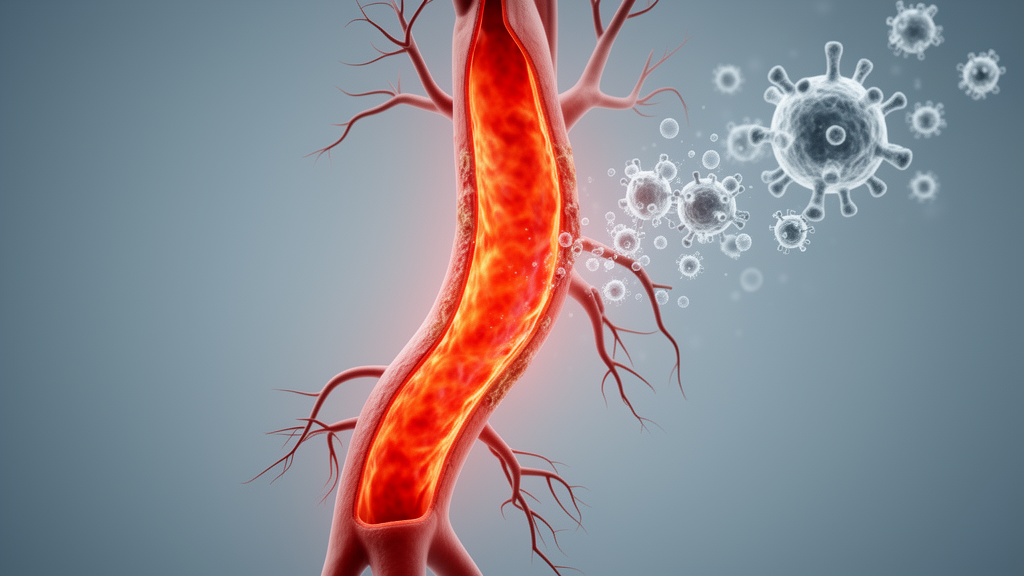
Takayasu arteritis, a rare chronic inflammation of the aorta and its major branches that strikes mainly young women, has long been treated as an isolated vascular disease. A new narrative review argues that this view deserves revision. Published in Egyptian Rheumatology and Rehabilitation, the review gathers evidence that Takayasu arteritis can, uncommonly, coexist with other systemic autoimmune diseases, and that the shared immune machinery behind this clustering may also shape the disease’s cardiovascular toll and its response to treatment.
The authors, led by Muneeb Saifullah and colleagues, searched PubMed, Google Scholar, and the Cochrane Library for studies published since 2002, using MeSH terms and keywords covering Takayasu arteritis, polyautoimmunity, and cardiovascular manifestations. They drew on international registries, meta-analyses, and retrospective cohorts, and organized their synthesis around the 2022 ACR/EULAR classification criteria and the Numano angiographic types. As a narrative review rather than a meta-analysis, the work synthesizes existing literature; the authors themselves note that most supporting evidence comes from case reports and small observational studies, precluding any quantitative pooling of outcomes.
Polyautoimmunity is defined as the coexistence of two or more autoimmune diseases in one individual, distinct from multiple autoimmune syndrome, which requires three or more, and from autoimmune overlap, which refers to shared clinical or serological features that may not meet full classification criteria for more than one disease. Clinical clustering of autoimmune disorders is thought to reflect common genetic susceptibility, environmental triggers, and overlapping immune pathways. In a 2021 study cited in the review, Rojas and colleagues found that latent polyautoimmunity, meaning the presence of autoantibodies without clinical criteria, occurred far more often than overt polyautoimmunity among 146 rheumatoid arthritis, 45 systemic lupus erythematosus, and 29 Sjögren’s syndrome patients, who clustered into three immunological phenotypes. The review stresses, however, that such data derive from other autoimmune diseases and have not been confirmed in Takayasu arteritis.
What does the evidence show specifically for Takayasu arteritis? According to the review, coexistence with other autoimmune diseases has been reported most consistently with spondyloarthritis-spectrum disorders, and less frequently, largely in isolated case reports, with systemic lupus erythematosus, rheumatoid arthritis, Behçet disease, and inflammatory bowel disease. The authors graded the strength of these associations qualitatively, from very low, indicating uncertain diagnostic overlap, to moderate, reflecting multiple case series, observational cohorts, or registry-based studies with generally consistent findings. Overall, they conclude that the associations support a model of shared immune susceptibility and convergent inflammatory pathways rather than identical disease mechanisms.
That shared machinery has a genetic anchor. HLA-B52 is the most consistently replicated risk allele for Takayasu arteritis, and it is also implicated in HLA-B51-associated Behçet’s disease, with both alleles altering antigen presentation to CD8-positive T cells and impairing peripheral tolerance. Beyond genetics, many of the immune processes implicated in Takayasu arteritis are not unique to the disease. Th1/Th17 polarization, dendritic cell activation, macrophage-driven granuloma formation, and regulatory T cell failure are all shared across rheumatoid arthritis, Behçet disease, and inflammatory bowel disease. The review describes how vascular dendritic cells, which normally maintain immunotolerance, become activated during systemic inflammation and secrete proinflammatory cytokines; IL-17 and interferon-gamma then recruit further inflammatory cells and drive macrophages toward tissue-degrading forms, while vascular smooth muscle cells migrate into the intima, transform into myofibroblasts, and produce matrix-forming proteins that narrow the vessel.
Cytokines provide the converging link between vascular and systemic autoimmunity. Interleukin-6 drives hepatic CRP production and, when produced predominantly by M1 macrophages, activates fibroblasts within the vessel wall, promoting collagen deposition, fibrosis, and arterial narrowing. Tumor necrosis factor-alpha induces endothelial cell death and stimulates matrix metalloproteinases, particularly MMP-9, degrading the extracellular matrix and basement membrane. Meanwhile, failure of regulatory T cells removes an essential immune checkpoint, creating a permissive environment for persistent vascular inflammation. The review notes that patients with giant cell arteritis, a related large-vessel vasculitis, show quantitative and functional regulatory T cell deficiencies along with impaired PD-1/PD-L1 checkpoint signaling; although those findings come from giant cell arteritis, the shared large-vessel involvement, overlapping histopathology, and common Th1/Th17 signatures support their relevance to Takayasu arteritis.
The cardiovascular consequences are the clinical heart of the argument. Takayasu arteritis affects an estimated 1 to 2 people per million annually, occurs more frequently in Asian populations, and can cause arterial stenosis, occlusion, aneurysm formation, and ischemic complications. Cardiovascular manifestations follow the anatomical distribution of lesions: aortic regurgitation arises from ascending aortic inflammation and root dilatation, coronary involvement often remains clinically silent despite substantial angiographic burden, and renovascular hypertension is among the most prevalent phenotypes, frequently requiring vascular intervention in addition to immunosuppression. Pulmonary artery disease, aneurysms, and cerebrovascular involvement mark high-risk complications. The Numano classification, which assigns six angiographic patterns (Types I through V, with coronary and pulmonary involvement designated C+ and P+), remains clinically useful because specific phenotypes cluster within particular patterns: Type II disease is associated with greater cardiac involvement, Types III and IV with hypertension, and Type III with increased aneurysm risk. A cluster analysis of 806 Takayasu patients using the K-means method similarly identified three patterns, including one dominated by abdominal aortic, renal, and mesenteric involvement and another by bilateral carotid and subclavian disease.
Does coexisting autoimmune disease change the course of the vasculitis itself? The evidence is limited but suggestive. In one single-center cohort cited in the review, a figure the authors caution may overestimate coexistence in unselected populations, roughly one-third of patients had at least one concurrent inflammatory or autoimmune disease, and those with autoimmune comorbidity required biologic therapy more often than patients without overlap disease. Limited observational data likewise suggest that coexisting autoimmune disease may be linked to a more treatment-resistant course. The review frames this cautiously: polyautoimmunity may identify a more treatment-resistant phenotype characterized by persistent immune activation rather than incidental coexistence, but this remains an observational signal, not a demonstrated causal relationship.
Treatment implications follow the shared-pathway logic, with important caveats. Corticosteroids remain the cornerstone of initial therapy, typically high-dose prednisone at 0.5 to 1 mg/kg/day tapered over months, though relapse rates during tapering reach up to 50 percent, prompting steroid-sparing agents. Conventional DMARDs such as methotrexate, azathioprine, leflunomide, and mycophenolate mofetil show partial efficacy in maintaining remission but have not been shown to reliably prevent vascular progression; their selection in overlap settings can be individualized, with methotrexate and leflunomide established in rheumatoid arthritis and azathioprine or mycophenolate favored in lupus. Among biologics, the pivotal TAKT trial found a trend toward prolonged relapse-free survival with tocilizumab, an IL-6 receptor antagonist, that did not reach statistical significance in the intention-to-treat analysis (HR 0.41, 95% CI 0.15 to 1.10, P = 0.0596), though a pre-specified per-protocol analysis was significant (HR 0.34, 95% CI 0.11 to 1.00, P = 0.0345). TNF inhibitors have shown efficacy in refractory disease in observational studies and offer dual coverage for inflammatory bowel disease and spondyloarthritis. JAK inhibitors are an emerging avenue supported only by early case reports in Takayasu arteritis. By contrast, a randomized controlled trial of abatacept showed no benefit over placebo, and secukinumab lacks Takayasu-specific trial data. No clinical trials have specifically enrolled patients with Takayasu arteritis and overlapping autoimmune conditions, a gap the authors call critical.
The review’s bottom line is measured. Coexistence of Takayasu arteritis with other autoimmune diseases is uncommon and the supporting evidence is limited, but recognizing the possibility may help clinicians evaluate for coexisting conditions at diagnosis and during follow-up, guide individualized immunomodulatory treatment, and, where appropriate, use a single agent against overlapping diseases. Vascular intervention, whether angioplasty, stenting, or surgical bypass, should ideally be performed during clinical and biochemical remission, since active inflammation raises the risk of restenosis and postoperative complications. The authors call for prospective multicenter registries, biomarker-guided immunophenotyping studies, and clinical trials that stratify for polyautoimmunity, and they emphasize a multidisciplinary approach spanning rheumatology, cardiology, vascular surgery, and clinical immunology. Until stronger data arrive, the practical message is a low threshold for suspecting a second autoimmune disease in patients whose manifestations are not fully explained by established Takayasu activity, not a claim that the overlap is common or that shared pathways have been proven to operate differently in these patients.
Subject of Research: The coexistence of Takayasu arteritis with other autoimmune diseases and its shared immunopathogenesis and cardiovascular implications
Article Title: Takayasu arteritis in the context of polyautoimmunity: clinical clustering, shared immunopathogenesis, and cardiovascular phenotypes
Article References: Saifullah, M., Fatima, U., Usman, M. A., Riaz, M., Rizvi, G. S., Khan, M. A., Attiq, Z., Saleemi, A., Tariq, Y., Ayub, Z., Sabir, A., Madni, A., Noor, A., Ali, S., & Rana, I. (2026). Takayasu arteritis in the context of polyautoimmunity: clinical clustering, shared immunopathogenesis, and cardiovascular phenotypes. Egyptian Rheumatology and Rehabilitation, 53(1), Article 87. https://doi.org/10.1186/s43166-026-00458-1
Image Credits: AI Generated
DOI: 10.1186/s43166-026-00458-1
Keywords: Takayasu arteritis, polyautoimmunity, large-vessel vasculitis, HLA-B52, Th1/Th17, interleukin-6, TNF-alpha, aortic regurgitation, renovascular hypertension, tocilizumab, TNF inhibitors, autoimmune overlap
News Source: Ophelia Keating. (October 28, 2026). Takayasu Arteritis May Rarely Cluster With Other Autoimmune Diseases, Review Finds. Scienmag.



