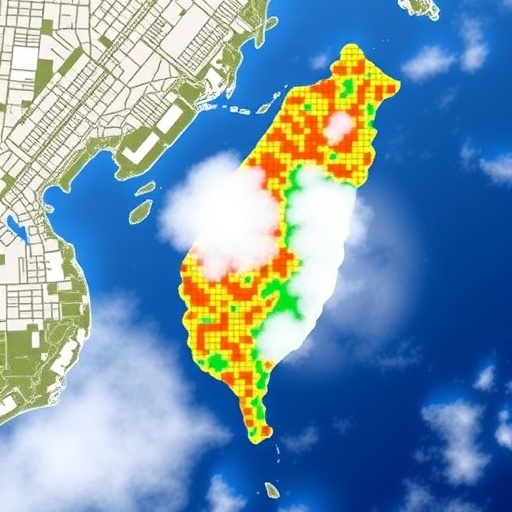
Air pollution forecasts are often limited by an inconvenient reality: fixed air-quality monitoring stations are sparse and unevenly distributed. In many regions, that leaves large gaps in the data needed to understand where fine particulate matter—especially PM2.5—concentrations rise and fall. While official monitors are reliable, their geography can blur local pollution hotspots that matter for public health.
A new study addresses this blind spot by blending multiple data sources, including low-cost air quality sensors and satellite observations, to build a higher-resolution picture of PM2.5 across Taiwan. The approach is designed to complement traditional networks rather than replace them, using inexpensive instruments to expand spatial coverage where conventional monitors are lacking.
The researchers focus on integrating sensor measurements with satellite-derived aerosol information. Satellites can observe broad areas, but translating their signals into ground-level PM2.5 requires careful modeling to account for atmospheric conditions and calibration differences. Low-cost sensors, meanwhile, can capture local variation but may drift or underperform in complex environments unless corrected.
To overcome these limitations, the team developed a high-resolution PM2.5 model that fuses data streams into a unified framework. The method leverages the satellites’ wide-area perspective while using ground-based low-cost sensors to anchor predictions at finer spatial scales. By doing so, the model aims to reduce uncertainty caused by both monitoring gaps and satellite retrieval biases.
High resolution matters because urban pollution patterns can change dramatically over short distances due to traffic, industry, and meteorology. Capturing that variability can improve exposure assessment, helping researchers and decision-makers identify areas at greater health risk rather than relying on citywide averages.
Importantly, the study highlights a practical path for countries with limited monitoring infrastructure. As low-cost sensing networks become more common, their value increases when paired with satellite data and robust statistical correction. The result is a modeling system that is both data-rich and scalable.
With PM2.5 linked to respiratory and cardiovascular outcomes, better spatial accuracy could support earlier warnings and more targeted interventions. The framework demonstrated in Taiwan may offer a template for other regions facing similar constraints in monitoring coverage.
Subject of Research: Development of a high-resolution PM2.5 model using integrated low-cost sensors and satellite observations.
Article Title: Development of a high-resolution PM2.5 model in Taiwan using integrated low-cost air quality sensors and satellite observations.
Article References: Jung, CR., Chuang, WH., Chen, WT. et al. J Expo Sci Environ Epidemiol (2026). https://doi.org/10.1038/s41370-026-00953-9
Image Credits: AI Generated
DOI: 10.1038/s41370-026-00953-9
Keywords:
Tags: air pollution monitoring technologyair quality monitoringatmospheric aerosol measurementenvironmental health risk assessmentground-level particulate matter estimationhigh-resolution pollution mappinginnovative air quality forecastingintegrated remote sensing and sensor datalow-cost air quality sensorsPM2.5 pollution modelingsatellite-based air quality observationTaiwan air pollution data