
Graph Shortest Distance Heuristic Optimizes Cloud Workflow Scheduling and Load Balancing
A graph shortest distance heuristic significantly reduces makespan and improves load balancing for scientific workflows in cloud computing platforms.
A graph shortest distance heuristic significantly reduces makespan and improves load balancing for scientific workflows in cloud computing platforms.

A comprehensive survey of Dutch reconfigurable computing reveals how field-programmable gate arrays achieve substantial performance and energy efficiency advantages across ...

A deep learning framework combining residual networks with bio-inspired optimization achieved 95 percent fault prediction accuracy and reduced recovery power ...
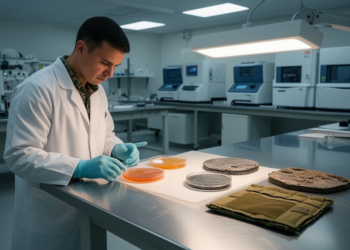
Scientists at the Tri-Service Microbiome Consortium Symposium detailed findings on pathogen tracking, environmental pollution, operational stress, and microbial approaches to ...

BHBench-CR is a new benchmark suite that compares the performance and accuracy of C++ and Rust implementations of two-dimensional Barnes-Hut ...

Trasgu is a new open-source Python package that automates the exhaustive fitting of vine copulas using high-performance computing, enabling systematic ...

A graph neural network trained on about 2.1 million PanDA job records predicts job turnaround time with an R-squared of ...

Researchers report distributed-memory implementations of the WCC and CM algorithms that post-process network clusterings for edge connectivity at scales up ...
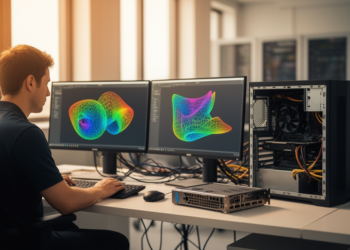
A new Kokkos-based extension brings GPU acceleration to the MOOSE multiphysics framework, reporting up to 27-fold faster finite element assembly ...

Researchers report a matrix-free finite element formulation that evaluates bases at arbitrarily located quadrature points on GPUs, matching the asymptotic ...

A simulation of German electricity data suggests dynamically idling research computing clusters can cut carbon emissions by up to 8 ...

ENflorA is a new set of scripts that automates and standardizes the upload of sequencing data and metadata to the ...

Lanzhou University researchers published a review in PhotoniX Synergy outlining six core dimensions for advancing high-performance optoelectronic computing chips in ...

A decade-long effort at ETH Zurich and TU Darmstadt has distilled empirical performance modeling into a Python tool that finds ...
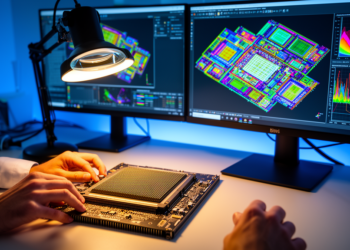
Researchers have turned the gem5 processor simulator into a performance engineering workbench, adding time-binned counters and automatic code region detection ...

Researchers at Argonne and Oak Ridge national laboratories have built Mofka, a persistent event-streaming framework that exploits RDMA networks, massively ...

Researchers have created the first unified taxonomy of I/O semantics, revealing that high-performance computing storage stacks lose critical meaning about ...

Researchers at Emory University and Sandia National Laboratories have released a curated dataset of 77,890 OpenMP-annotated C and C++ source ...

A hybrid wavelet-Fourier analysis in the FTIO tool pinpoints when periodic I/O phases are actually valid, cutting prediction error and ...

Researchers have integrated two energy-monitoring libraries into a single runtime system that measures and optimizes power consumption for MPI applications ...