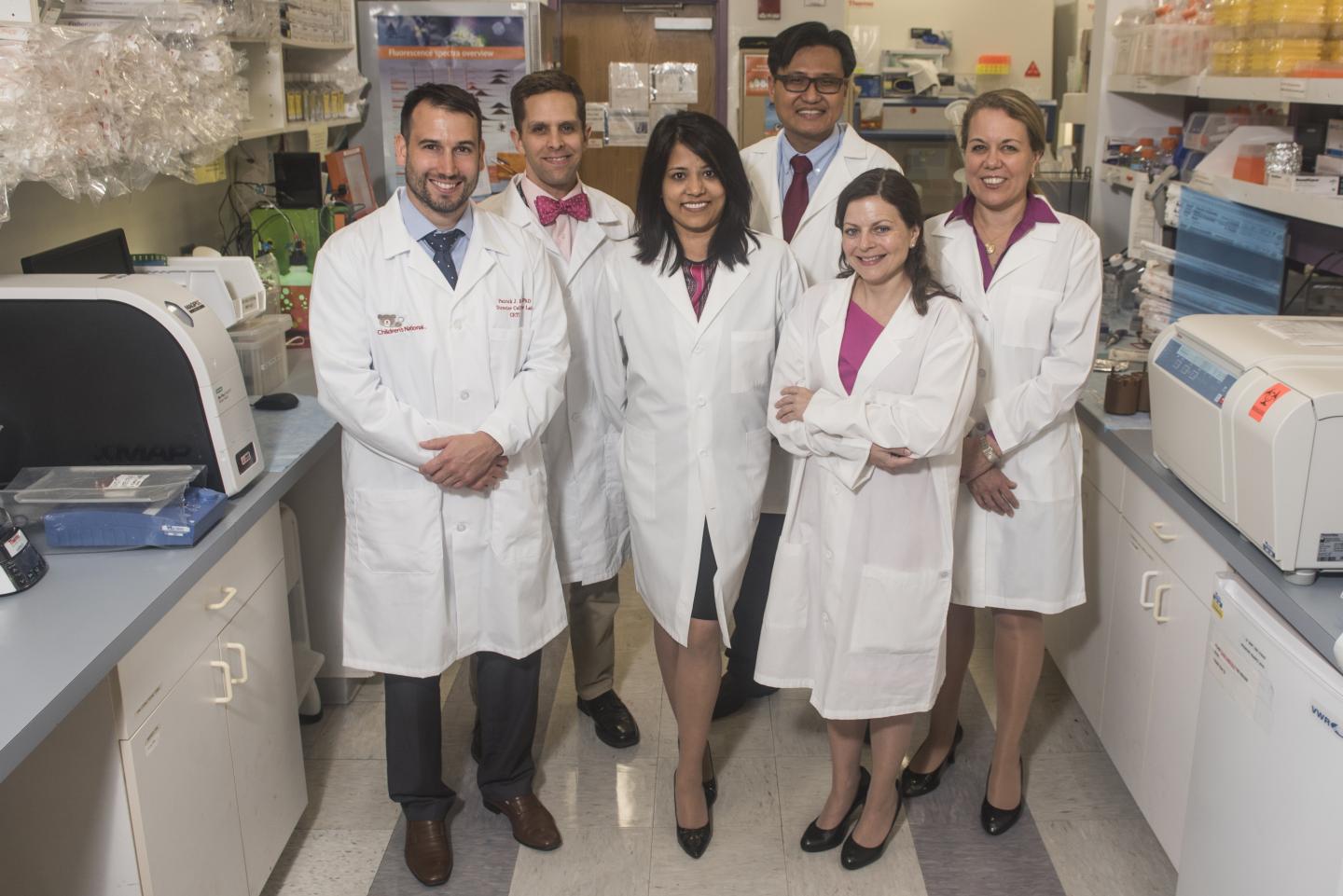
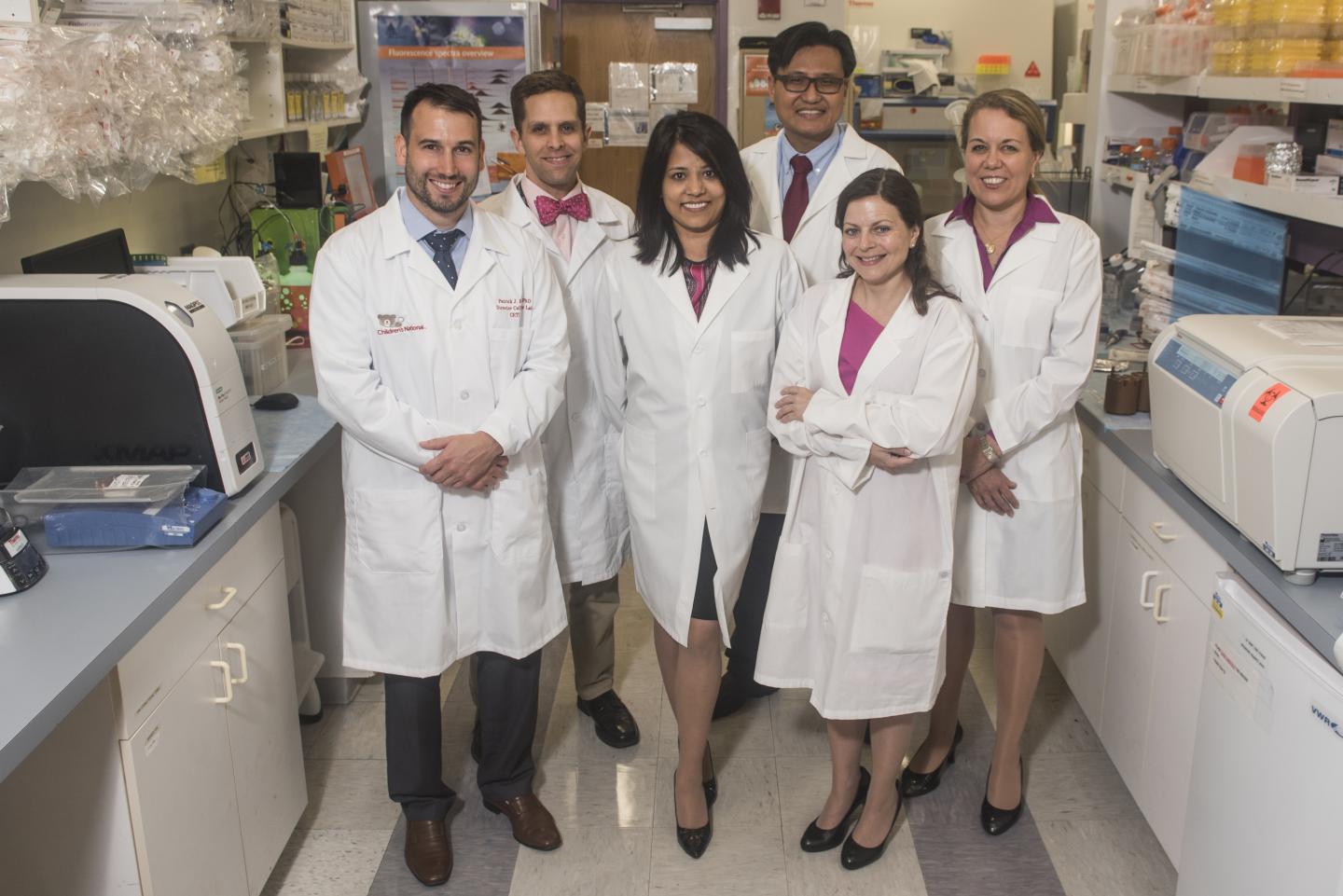
Credit: Children's National Health System
WASHINGTON-(Jan. 16, 2018)-Tumors have come up with ingenious strategies that enable them to evade detection and destruction by the immune system. So, a research team that includes Children's National Health System clinician-researchers has validated a way to outfox the tumors. They engineered T-cells, essential players in the body's own immune system, to strip tumors of their self-preservation skill and were able to hold Hodgkin lymphoma at bay in patients with relapsed disease for more than four years. What's more, they infused patients with the tumor-directed T-cells without requiring "pretreatment" chemotherapy.
Results of the small study were published online Jan. 9, 2018, in the Journal of Clinical Oncology.
"These results come 18 years after this revolutionary approach was first conceptualized. While the study is small, its findings are incredibly encouraging for our families and for the cancer field," says Catherine "Cath" M. Bollard, M.D., M.B.Ch.B., director of the Children's Research Institute's Center for Cancer & Immunology Research and lead study author.
"I started work in this area in 2000," says Dr. Bollard. "At that time, the oncology community had little enthusiasm for the use of T-cell therapies to treat cancer. Even then, when T-cell therapy was in its relative infancy, some research institutions began to see more than 90 percent complete responses and cure rates in some settings. This most recent study points to the potential of specialized T-cells to fight even more types of immune-evading tumors."
T-cells seek out and destroy proteins expressed by cancer cells or virus-infected cells, protecting the body from infection and malignancy.
In the dose-escalation study, eight patients with Epstein Barr virus-positive Hodgkin lymphoma received as few as 2 and as many as 12 doses of between 2 × 10⁷ and 1.5 × 10⁸ cells/m2 of specially engineered T-cells. Production of transforming growth factor-β in the immediate vicinity of tumors thwarts tumor-directed therapies by having devastating effects on T-cell function in vivo.
So, the research team forced expression of a dominant-negative TGF-β receptor type 2 (DNRII) onto LMP-specific T-cells (DNRII-LSTs) that were specially designed to seek out and destroy proteins derived from the Epstein Barr virus expressed by the tumor cells. The DNRII expressed by the T-cells allowed the cells to resist the hostile tumor environment and seek out and kill the tumor cells. Seven of the eight patients treated had active disease at the time of T-cell infusion.
"DNRII-LSTs were resistant to otherwise inhibitory concentrations of TGF-β in vitro and retained their ability to kill the cancer cells. After infusion, the signal from the genetically modified T-cells in the peripheral blood increased up to 100-fold," writes Dr. Bollard and colleagues, adding that "DNRII-LSTs persisted for up to four years. Four of the seven patients with active disease achieved clinical responses that were complete and ongoing in two patients for more than four years, including in one patient who achieved only a partial response to unmodified tumor-directed T-cells."
The study team writes that their findings underscore the potential utility of expressing DNRII when battling other tumors that have learned to evade the immune system.
###
Study co-authors include Conrad Russell Y. Cruz, M.D., Ph.D., and Cecilia Barese, M.D., Ph.D., Children's National; Gianpietro Dotti, UNC; Stephen Gottschalk, St. Jude Children's Research Hospital; Tamara Tripic, Vicky Torrano, Olga Dakhova, George Carrum, Carlos Almeida Ramos, Hao Liu, Meng Fen Wu, Andrea N. Marcogliese, Adrian P. Gee, Malcolm K. Brenner, Helen E. Heslop and Cliona M. Rooney, study senior author, Baylor College of Medicine; Youli Zu and Daniel Y. Lee, Houston Methodist; and Owen A. O'Connor, Columbia University Medical Center.
Media Contact
Diedtra Henderson
[email protected]
443-610-9826
http://www.childrensnational.org/
Related Journal Article
http://dx.doi.org/10.1200/JCO.2017.74.3179