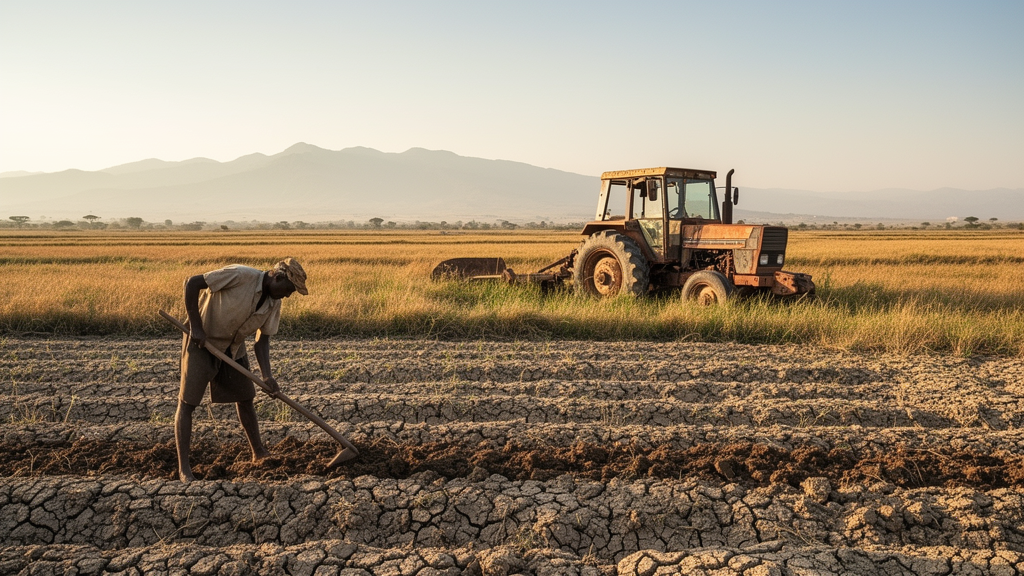
An original three-dimensional analytical framework examining national agricultural mechanization innovation systems shows that farming equipment outcomes in low- and middle-income countries depend directly on complex stakeholder configurations, institutional arrangements, and local agroecological contexts rather than simple technology supply. In a comparative investigation published in Agronomy for Sustainable Development, researchers Chloé Bouvard and Teatske Bakker evaluated how mechanization pathways evolve and generate diverse socio-economic and agro-environmental effects. Their synthesis focused on the operational realities of farm motorization, excluding post-harvest and irrigation tasks, to evaluate how equipment type, access mode, government strategies, and support infrastructure interact across disparate farming environments.
Agricultural mechanization, defined within the research as replacing manual labor with machinery powered by non-human energy, has resurfaced as a primary policy focus across low- and middle-income regions. This interest is driven by mounting development challenges, including food insecurity that affected 9.1 percent of the global population in 2023 compared to 7.5 percent in 2019, compounded by climate disruptions, biodiversity loss, and the severe physical drudgery of manual farm work. Although North American agricultural value added per worker remains 66 times higher than that of sub-Saharan Africa, historic state-led mechanization initiatives in Africa faltered during the 1980s and 1990s due to rigid bureaucratic management, unsuited equipment, and poor maintenance networks, demonstrating that technology alone cannot resolve productivity constraints.
To overcome past analytical limitations that typically focused on micro-level farm plots or purely technical criteria, the authors constructed an integrated model combining an agricultural mechanization innovation system, or AMIS, a defined mechanization model, and a theory-of-change framework tracing causal outcomes. The AMIS perspective analyzes the interacting networks of actors across research, education, extension, policy, and private sectors who generate, share, and apply mechanical knowledge. Within this institutional setting, national mechanization models crystallize around four structural pillars: machinery specifications, operational access modes, state policy strategies, and supporting infrastructure including repair workshops, financial mechanisms, and operator training programs.
The study tested the framework through an empirical comparative analysis of four distinct low- and middle-income countries: Benin, Ghana, Kenya, and Bangladesh. This investigation triangulated scientific publications, institutional reports, policy frameworks, and trade publications with semi-structured interviews of 13 mechanization experts from development organizations such as GIZ, Hello Tractor, and FERT, public administration, and research bodies including CIRAD, IDDRI-Sciences Po, and the University of Gothenburg. Bangladesh was incorporated alongside the three sub-Saharan African nations as an established benchmark of equitable smallholder mechanization and a foundational historical reference for appropriate technology adoption.
Across all four national contexts, the findings established that mechanization access is overwhelmingly dominated by service provision rather than direct machine ownership. Due to substantial capital acquisition costs, only a minority of wealthy or large-scale landowners purchase equipment, while the vast majority of smallholders hire machinery and operators for designated tasks and specific time windows. This dynamic mirrors historical European practices, such as in France where equipment rental and service contracts remain common alongside collective ownership groups known as CUMAs, which have also been adapted in Benin since the late 1990s to pool mechanical investments among local producers.
The structural configurations of equipment and field operations revealed stark technical contrasts across the investigated territories. In Benin, Ghana, and Kenya, national strategies heavily prioritize medium to large four-wheel tractors, predominantly ranging between 35 and 60 horsepower and equipped with disc ploughs for land preparation. In contrast, Bangladesh shifted decisively in the late 1980s toward smaller two-wheel power tillers following draught animal losses and the removal of import barriers on Asian machinery. These two-wheel power tillers covered roughly 80 percent of cultivated land in Bangladesh by the late 2010s, though even there, only 30 percent of farm households own equipment, with the remaining 70 percent relying on private custom-hiring services.
The comparative data demonstrated that motorized operations remain heavily concentrated in primary tillage and land preparation, especially in cereal cropping systems that lend themselves readily to machine intervention. Only Bangladesh showed widespread mechanization extending into subsequent operational steps, such as motorized pesticide and herbicide distribution. In the African case studies, mechanizing land preparation without mechanizing downstream tasks frequently created severe secondary labor bottlenecks, shifting intense manual workloads onto unmechanized cropping stages or inducing farmers to expand their use of chemical herbicides to manage expanded cultivated acreage.
Institutional analysis revealed an ongoing transition away from historically failed state-run tractor hire schemes, such as Kenya’s Agricultural Mechanization Services established in 1981, toward privatized or hybrid delivery systems. In Ghana, semi-private Agricultural Mechanization Service Centres introduced under national food and agriculture sector development policies struggled with low machine versatility, poor operator loan recovery, and unmet district expansion goals, accelerating smallholder reliance on informal private service providers. Furthermore, while digital booking platforms like Hello Tractor in Kenya and TroTro Tractor in Ghana have emerged to link tractor operators with farmers, their viability remains strictly constrained to zones with dependable rural digital connectivity.
The synthesis underlined major structural risks associated with unchecked privatization in the absence of public coordination. Because private machinery contractors operate without price regulation, they systematically favor larger, contiguous, and easily accessible fields during tight seasonal planting windows, frequently marginalizing remote smallholders or resource-constrained farmers who depend on credit. Moreover, task-specific mechanization reinforces social and gender inequalities: because public and commercial programs concentrate on land preparation tasks traditionally undertaken by men, manual weeding and harvesting operations performed disproportionately by women remain unmechanized, leaving systemic labor burdens unaddressed.
Applying the four-dimensional theory-of-change lens highlighted profound empirical blind spots in current global research. While immediate direct effects such as time and labor savings during tillage are thoroughly documented, medium- and long-term socio-economic, nutritional, and agro-environmental outcomes remain largely unquantified. Long-term environmental consequences, including soil compaction, erosion from continuous disc ploughing, and tree clearance on newly expanded plots, are rarely tracked. By demonstrating that agricultural machinery models cannot be directly transposed between nations—exemplified by the failure of Bangladesh’s two-wheel tiller model to achieve widespread uptake in Kenya despite success in Zimbabwe—the authors conclude that policy must shift from distributing hardware to reinforcing local training, maintenance infrastructure, and context-specific agroecological systems.
National economic structures and farming realities further illustrate why equipment pathways diverge across low- and middle-income regions. In Benin, agriculture accounts for 30 to 35 percent of national gross domestic product and employs 70 percent of the active labor force, with production focused on crops such as maize, cassava, cotton, soy, cashew nuts, and rice. To support mechanization, Benin established seven Agricultural Development Poles alongside SoNaMA, a state-owned enterprise that assembles farm equipment with technical collaboration from the Indian manufacturer Mahindra. By comparison, primary agriculture generates 18.5 percent of gross domestic product in Ghana, where over half of rural households participate in farming, predominantly managing holdings under two hectares. In Kenya, the agricultural sector contributes 25 percent of gross domestic product, with more than 66 percent of farmers cultivating parcels smaller than five hectares.
Geopolitical alignments and South-South bilateral financing programs also play a decisive role in shaping machinery supply chains and technical options. While Bangladesh imported two-wheel tillers from China and India following policy deregulation, West African governments have largely relied on concessional bilateral loans from partners such as India and Brazil to supply four-wheel motorized units. However, researchers noted that public procurement through concessional arrangements frequently restricts domestic administrative control over the imported models. This lack of oversight complicates national spare parts inventories and mechanic training, creating chronic maintenance bottlenecks when machines break down in rural districts lacking dedicated service networks.
The study also emphasizes that mechanization policy must systematically address ecological transitions and soil management practices. In Kenya, conservation agriculture expanded partly because larger farms exchanged technical practices with foreign farmers, enabling the introduction of specialized direct-seeders, rippers, and two-wheel tractor implements through private commercial networks. In contrast, environmental priorities rarely appear in formal mechanization strategies across other studied nations. When mechanization operates without soil conservation measures, conventional disc tillage risks causing severe long-term land degradation, including subsurface soil compaction and erosion. Expanding tractor use can also accelerate deforestation and land clearing on fragile fallows as producers seek to maximize cultivated acreage.
Ultimately, the researchers argue that the definition of appropriate mechanization must expand well beyond hardware size to encompass repairability, environmental impact, social inclusivity, and institutional support. A mechanization model functions not as an isolated mechanical tool, but as a socio-technical configuration whose success depends on the alignment of local machinery markets, operational training, financing arrangements, and agronomic systems. Public policies should therefore focus on strengthening extension services, tractor driver instruction, and maintenance infrastructure rather than simply financing tractor shipments, ensuring that agricultural modernization aligns with local smallholder realities.
Subject of Research: Agricultural mechanization innovation systems and agrarian development outcomes
Article Title: Assessing agricultural mechanization innovation systems and their effects in sub-Saharan Africa
Article References: Bouvard, C., & Bakker, T. (2026). Assessing agricultural mechanization innovation systems and their effects in sub-Saharan Africa. Agronomy for Sustainable Development, 46(6), Article 86. https://doi.org/10.1007/s13593-026-01159-x
Image Credits: AI Generated
DOI: 10.1007/s13593-026-01159-x
Keywords: Agricultural Mechanization, Innovation Systems, Sub-Saharan Africa, Farm Motorization, Appropriate Mechanization, Tractor Services, Service Provision, Tillage, Smallholder Agriculture, Agroecology, Benin, Ghana, Kenya, Bangladesh, Labor Productivity
News Source: Alan Morgan. (November 22, 2026). Systemic Analysis Reveals Key Gaps in Agricultural Mechanization Across Developing Nations. Scienmag.