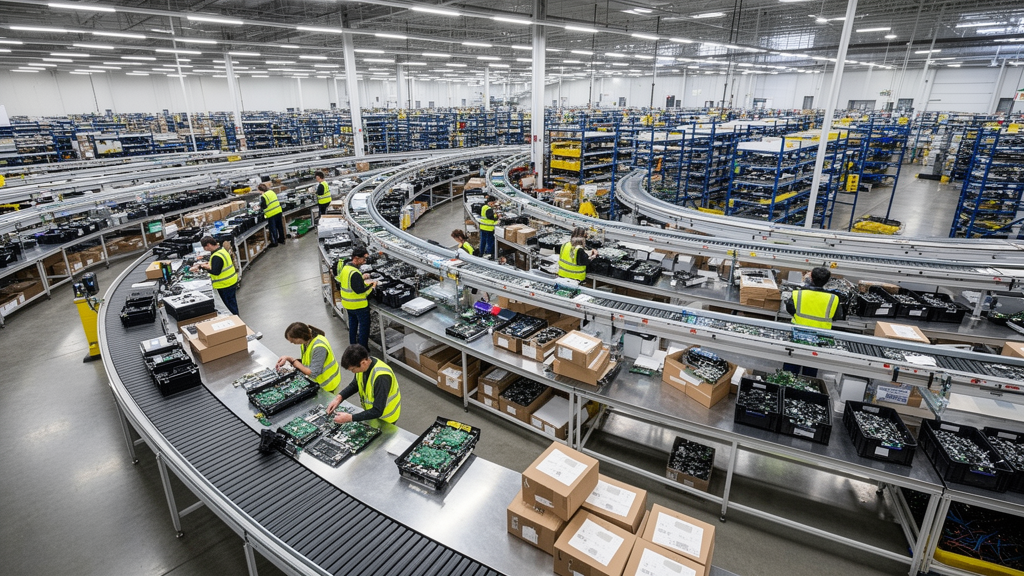
A systematic literature review published in Discover Analytics has established an organic, six-layer classification system termed the Reverse Logistics Onion to unify the fragmented operational, tactical, and strategic dimensions of modern return networks. Developed by researchers Ebenezer Adaku, Raphael Aryee, Abigail Ampomah Adaku, Sarah Quayson, and Israel Kpekpena, the framework maps how foundational organizational motivations radiate outward through expected benefits, practical recovery pathways, operational risks, system network designs, and boundary-level resources or barriers. While business operations face increasing pressure to adopt sustainable practices and manage reverse product flows, prior academic inquiry has largely examined reverse logistics through isolated components such as drivers, capabilities, decision modeling, or performance measurement without an overarching structural synthesis. The authors addressed this conceptual gap by gathering and analyzing the literature to establish an organic architecture capable of functioning as an analytical decision-support system for operational managers and providing theoretically grounded propositions for subsequent empirical investigations.
Reverse logistics operates as a core element of green logistics, gaining heightened commercial and academic significance as expanding global trade, rapid technological evolution, and electronic commerce drive heightened consumerism, rapid product obsolescence, and expanding waste streams. The study anchors its conceptual foundation in established definitions, citing the formulation by Rogers and Tibben-Lembke that identifies reverse logistics as the process of planning, implementing, and controlling the cost-effective flow of raw materials, in-process inventory, finished products, and related information from the point of consumption to the point of origin to recapture value or execute proper disposal. The researchers observe that reverse logistics extends beyond the final consumer endpoint, frequently originating upstream at distributors and retailers or operating directly within focal manufacturing facilities where production by-products are captured and recirculated. Through this broader perspective, reverse logistics is conceptualized as an integrated process of material collection across organizational boundaries that improves economic positioning, enhances corporate reputation, and mitigates environmental degradation.
To build the framework rigorously, the authors executed a systematic literature review following an established three-stage search and evaluation protocol comprising journal identification, target paper selection, and detailed examination. Searching across the Scopus database with supplementary records identified through Web of Science and Google Scholar, the team applied a deductive search string focused on reverse logistics combined with drivers, barriers, risks, disposition strategies, product recovery, resources, and waste management. The initial query captured 1,522 peer-reviewed journal articles published between 2010 and mid-November 2024. The authors applied sequential inclusion and exclusion filters, requiring that papers specifically address reverse logistics concepts or associated operational practices while excluding conference papers, grey literature, and non-English publications to ensure peer-reviewed quality. Applying these multi-stage filters reduced the core Scopus corpus to 53 articles, which was supplemented through snowball sampling with eight papers from Web of Science and five papers from Google Scholar, yielding a final analytical sample of 66 peer-reviewed studies.
The synthesis of the 66 selected studies relied on iterative content analysis executed by three independent coders to categorize findings into consistent thematic dimensions without imposing an initial predefined scheme. Each coder evaluated the sampled papers independently to generate initial codes, after which the team convened in structured reconciliation meetings to compare coding lists, examine diverging categorizations, resolve conceptual ambiguities, and remove redundancies. When discrepancies emerged, the coders evaluated the underlying logic of conflicting interpretations and calibrated their assessments until a unified consensus was reached. Through this iterative reconciliation process, documented rents were categorized under benefits, adoption impediments were coded under barriers, and required capabilities were aggregated under implementational resources. These reconciled categories formed the distinct concentric structural layers of the resulting framework, making the research design methodologically transparent, traceable, and replicable.
The structural design of the Reverse Logistics Onion draws a conceptual parallel to Saunders’ established research methodology onion while remaining functionally distinct. While the Saunders framework operates as a methodological decision roadmap guiding scholars through successive stages of research design, the Reverse Logistics Onion functions as a thematic classification model that positions components based on their functional interactions and mutual dependencies. The authors designate the outermost boundary of the model as the exo-layer and classify the remaining interior levels as endo-layers. The model posits that reverse logistics activity originates at the innermost motivational core, where economic, technological, regulatory, and market forces energize organizational commitment. These internal driving forces justify operational investment, and their strategic effects propagate progressively outward through operational choices, risk assessments, structural network configurations, and surrounding resource constraints.
At the innermost core, the first layer captures the primary drivers that compel organizations to initiate reverse logistics, which the authors categorize into economic factors, technological capabilities, government policies, market pressures, and supply chain partner dynamics. Economic drivers encompass direct value creation, value recovery, and raw material cost reduction, while technological drivers reflect the adoption of eco-design principles, green technology, and specialized information systems. Market drivers stem from competitive dynamics and green consumer demand, whereas partner drivers involve managerial commitment and supply chain integration. The authors incorporate institutional theory to highlight that these forces exert coercive, normative, and mimetic isomorphic pressures that evolve into organizational value systems.
Surrounding the driver core, the second layer delineates reverse logistics benefits, conceptualized as the anticipated economic, environmental, and social returns that encourage enterprises to recapture value. Economic benefits encompass operational cost savings, secondary revenue streams, improved inventory control, enhanced competitiveness, and expanded market share, offering vital industrial stability particularly within manufacturing sectors that drive employment and economic expansion in developing regions. Environmental accruals include substantive waste diversion, conservation of virgin natural resources, and lowered ecological contamination, reinforcing corporate environmental citizenship. Social benefits focus on worker health and safety standards in rework facilities, product safety compliance, service accessibility, consumer trust, and transparent return infrastructure. By providing products with extended life cycles, companies capture distinct brand value that differentiates them from commercial rivals while systematically curbing industrial effluents that damage ecosystems.
The third layer addresses practical reverse logistics practices, illustrating how firms translate motivations and expected benefits into concrete operational activities. The study integrates a hierarchical pyramid of eight distinct disposition practices identified in the literature: reuse, donation or auction, repair, refurbishment, remanufacturing, recycling, cannibalism or energy generation from waste, and final disposal via landfill or incineration. At the apex of the hierarchy, reuse and auction options retain maximum functional, economic, and material value with minimal resource intervention. Intermediate practices such as repair, refurbishment, and remanufacturing require progressive mechanical disassembly, cleaning, component replacement, and performance testing to restore used goods to functional condition. Lower tiers comprise recycling and energy recovery, which destroy physical product integrity to reclaim raw materials or residual energy. Final disposal via high-temperature incineration or landfilling sits at the base as an uninspired last resort that yields zero value retention and creates environmental burdens.
Beyond operational execution, the fourth layer highlights reverse logistics risks that constrain and shape strategic decisions. Organizations evaluating reverse logistics must navigate strategic, decision, information, technical, market, and financial risks. Strategic risk emerges when reverse logistics outsourcing creates misalignment with overarching corporate objectives or exposes firms to conflicting partner agendas. Decision risk involves operational errors, such as contracting with incapable third-party logistics providers due to inadequate performance data. Information risk arises when logistics intermediaries conceal operational metrics, inflate service pricing, or degrade service quality. Technical risk involves the potential disclosure of proprietary product compositions, structural designs, and patented blueprints during disassembly, or the exposure of confidential customer databases to competitors. Market risk reflects volatile secondary demand and fluctuating consumer acceptance of recovered goods, while financial risk encompasses hidden infrastructure costs and uncertain capital returns, particularly in developing regions with underdeveloped commercial supply networks.
The fifth layer articulates the reverse logistics system or network configuration, structured across three essential logistical functions: gatekeeping, collection, and inspection or sorting. Gatekeeping represents the initial product acquisition checkpoint, where retailers determine whether returned items qualify for reverse processing or must be returned to consumers, thereby regulating the volume, timing, and quality of incoming inventory. The subsequent collection phase consolidates items across channel partners through centralized or decentralized collection centers, designated return depots, or door-to-door schemes, such as municipal programs that enhanced biodegradable waste recycling in India. Network efficiency relies on enabling technologies such as Radio Frequency Identification tags to track item quality and Internet of Things architectures linked with Kanban signals to schedule pickup intervals. Collected goods then undergo inspection and sorting, utilizing automated household presorting or industrial separation techniques, including gravity, electrostatic, magnetic, floatation, eddy current, and sensory separation to isolate viable recovery streams.
The sixth and outermost layer represents implementational resources and barriers, which define the external environment that enables or constrains internal operational layers. The authors identify four distinct resource categories: knowledge-based resources such as consumer behavioral insights, reverse tracking data, and leadership commitment; human resources comprising qualified reverse logistics engineers, specialized operations managers, and operational staff; physical and material resources encompassing capital reserves, processing equipment, facilities, and technical infrastructure; and socio-organizational resources including organizational culture, collaborative inter-firm relationships, and geographic proximity. Deficiencies across any of these dimensions act as operational barriers that impede adoption. Because these resource limitations and external policy gaps reside largely outside the firm’s immediate control, they sit at the structural boundary of the Reverse Logistics Onion, dictating the feasibility of the inner operational layers.
Synthesizing these layered relationships through institutional, contingency, resource-based view, and network theories, the authors formulate two core theoretical propositions to guide future empirical research. The first proposition states that the nature of a firm’s reverse logistics motivation determines its choice of reverse logistics strategy or practice. Grounded in contingency theory, this proposition illustrates that firms driven by external regulatory compliance adopt conservative, satisficing recovery practices to achieve legitimacy, whereas firms driven by internal environmental volition implement advanced source reduction, recycling, and circular strategies. The second proposition asserts that decisions on reverse logistics operational strategy and risk influence network reconfiguration and resource requirements. Drawing upon the resource-based view and network theory, the authors argue that choosing complex remanufacturing pathways demands sophisticated network coordination, specialized sorting facilities, and heightened capital investments, proving that reverse logistics networks function as dynamic strategic assets rather than static, exogenous constraints.
The study highlights practical implications for industrial managers, policymakers, and academic educators. Senior corporate executives can utilize the onion framework as an integrated diagnostic tool to assess current return operations, identify structural deficiencies, and optimize resource allocations. For emerging enterprises and small to medium-sized enterprises seeking to implement reverse logistics, the model serves as an actionable reference outlining necessary capabilities and risk profiles. The framework also provides a structured foundation for developing physical or web-based simulation serious games for practitioner training. For policymakers, the hierarchical pyramid offers a systematic rationale for drafting regulations and economic incentives that actively promote high-value reuse and remanufacturing while penalizing landfilling. The authors acknowledge key study limitations, including the restriction to English-language publications and reliance on Scopus, Web of Science, and Google Scholar, calling on future research to examine non-English literature, incorporate newer databases such as Dimensions, and empirically test the proposed theoretical relationships across specific industries such as automotive, construction, and pharmaceuticals.
Subject of Research: Systematic review and anatomical modeling of reverse logistics systems and operational practices
Article Title: Unpacking the reverse logistics onion
Article References: Adaku, E., Aryee, R., Adaku, A. A., Quayson, S., & Kpekpena, I. (2026). Unpacking the reverse logistics onion. Discover Analytics, 4(1), Article 9. https://doi.org/10.1007/s44257-026-00058-5
Image Credits: AI Generated
DOI: 10.1007/s44257-026-00058-5
Keywords: Reverse logistics, Supply chain management, Systematic literature review, Content analysis, Reverse Logistics Onion, Circular economy, Product recovery, Waste management, Hierarchical pyramid, Institutional theory, Contingency theory, Resource-based view, Network reconfiguration, Gatekeeping, Inspection and sorting, Extended producer responsibility
News Source: Denise Maddox. (November 13, 2026). Systematic Review Structures Reverse Logistics Operations Into Six Layer Onion Framework. Scienmag.