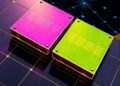
Light’s Dance in a Microcosm: Creating Optical Tornadoes with Liquid Crystal Torons
Can light twist and swirl like a whirlwind? Recent groundbreaking research from a collaborative team at the University of Warsaw, the Military University of Technology, and Université Clermont Auvergne has revealed that light can indeed behave like a miniature tornado. This remarkable phenomenon, birthed within synthetic magnetic fields in liquid crystal structures known as torons, fundamentally expands our ability to engineer light sources capable of carrying orbital angular momentum. Such advances proffer transformative potential for photonic devices in quantum communication, nanophotonics, and beyond.
The genesis of the research lies in a novel marriage of concepts spanning quantum mechanics, optical physics, and materials science. Traditionally, electrons are understood to occupy discrete energy states within atomic and condensed matter systems, their behaviors often influenced by real magnetic fields. The researchers analogously approached photons as particles confined inside light traps that mimic these electronic energy landscapes. By developing optical microcavities hosting torons—intricate self-organizing defect structures within liquid crystals—they engineered environments where light adopts swirling phase profiles reminiscent of tornado vortices.
Drilling into the physics, these torons emerge as microscopic spirals in liquid crystals, twisted tightly as if following DNA-like helices, but closing to form looped doughnut-shaped structures. Crucially, these torons act as tiny potential wells, trapping and guiding light in ways conventional nanophotonic components struggle to replicate. What pushes this discovery to the forefront of optical physics is the introduction of a synthetic magnetic field. Unlike electrons, photons are generally insensitive to magnetic fields; however, spatial variations in birefringence within the liquid crystal torons generate effects mathematically analogous to magnetic forces, bending light’s trajectory and shaping its oscillatory polarization into a rotating, vortex-like pattern.
Embedding the torons inside optical microcavities composed of highly reflective mirrors amplified this synthetic field’s influence. Photons bounce repeatedly within the cavity, enhancing their interaction with the twisted liquid crystal molecules. Such confinement effectively strengthens the synthetic magnetic effects and allows external control over the light trap dimensions via applied electric voltages. The result is tunable vortex light modes that carry intrinsic orbital angular momentum, a property associated with the light’s phase winding around its propagation axis.
Perhaps the most striking advancement is the generation of orbital angular momentum light not in an excited state, as is common, but in the ground state—the system’s lowest energy level. This state is notably the most stable and presents minimal loss, characteristics that greatly facilitate lasing, or coherent light amplification. The team introduced a laser dye to their toron-based microcavity system, confirming that the ground-state vortex modes could indeed sustain laser action. This means the resulting light not only swirls but also exhibits the coherence, directionality, and well-defined energy characteristic of conventional lasers, but now with the added complexity of orbital angular momentum embedded intrinsically in the fundamental emission.
This pivotal realization has resonance well beyond academic novelty. Traditional methods for creating structured laser light with orbital angular momentum often demand elaborate nanofabricated structures or large-scale optical setups. Here, nature’s own self-organization within liquid crystals simplifies the manufacturing challenge immensely, offering a pathway towards more scalable, adaptable photonic devices. Quantum communication, where control over light’s quantum states is paramount, stands to gain substantially from such compact on-chip light sources. Similarly, microscopic manipulation tasks—such as optical tweezers—could gain new degrees of freedom by harnessing these naturally emergent optical vortices.
The research also strides into sophisticated theoretical terrain by invoking parallels to vectorial charge concepts, borrowing from particle physics. One of the theorists involved remarked that photons in this system do not merely imitate electrons but mirror more exotic entities like quarks, subatomic particles possessing color charge. Such an analogy underscores the depth of the synthetic magnetic field analogy and the exotic topological nature of the light trapped inside torons.
Technical mastery underpins every step of this work. The creation of uniform, stable toron formations required precise assembly of liquid crystal samples, expertly orchestrated by researchers at the Military University of Technology and the University of Warsaw. Concurrently, theoretical insights into photon behavior in synthetic fields were developed through quantum optics and solid-state physics models by international collaborators. The synergy between experimental rigor and theoretical modeling led to robust confirmation of lasing action emerging directly from these ground-state vortex modes.
Looking forward, this research unlocks a blueprint for photonic devices that harness self-assembling materials to achieve functionalities once accessible only with the most sophisticated fabrication techniques. Imagine compact quantum light sources embedded within flexible displays, or low-power integrated photonic circuits leveraging orbital angular momentum states for multiplexing data channels, dramatically increasing communication bandwidth without enlarging device footprints. Such possibilities stem directly from these optical tornadoes swirling within their liquid crystal microdomains.
The fundamental insight—that light can be manipulated to twist, turn, and lase coherently in its ground state within naturally formed liquid crystal torons—redefines the horizon of photonics research. By circumventing the need for complex lithographic nanostructures and instead exploiting synthetic magnetic effects engineered from material anisotropies, the research team has charted a uniquely elegant path forward for next-generation laser technologies.
This study not only stands as a landmark in contemporary optics but also exemplifies the power of interdisciplinary science—drawing from quantum physics, condensed matter, materials engineering, and laser technology—to unlock new states of light-matter interaction. As the researchers continue to refine tunability, stability, and integration strategies, the impact of their discovery is poised to ripple across scientific domains, catalyzing innovation from fundamental physics to practical technology.
The toron-based vortex lasers may soon transition from the laboratory to real-world devices, heralding a future where light’s whirlwinds become everyday instruments of information and manipulation at microscopic scales. The collaboration’s success story at the confluence of synthetic magnetic fields and self-organizing liquid crystals will surely inspire further breakthroughs, lighting the way toward an era of photonic tornadoes harnessed for science and industry.
Subject of Research: Physics of light-matter interaction in synthetic magnetic fields; orbital angular momentum in laser light; liquid crystal torons; photonic microcavities.
Article Title: Ground-state orbital angular momentum lasing from liquid crystal torons embedded in a microcavity
News Publication Date: 13 March 2026
Web References: Website of the Faculty of Physics, University of Warsaw; Press service of the Faculty of Physics, University of Warsaw
References: Marcin Muszyński et al., “Ground-state orbital angular momentum lasing from liquid crystal torons embedded in a microcavity,” Science Advances 12, eaeb6167 (2026). DOI: 10.1126/sciadv.aeb6167
Image Credits: Visualization by Marcin Muszyński, Faculty of Physics, University of Warsaw
Keywords: optical vortex, orbital angular momentum, laser light, liquid crystals, toron, synthetic magnetic field, microcavity, photonic devices, quantum communication, self-organizing materials
Tags: engineered light traps for photonslaser-generated optical tornadoeslight phase vortices in microstructuresliquid crystal torons structurenanophotonics light manipulationoptical microcavities with toronsorbital angular momentum of lightphotonic devices for quantum communicationquantum mechanics in photonic materialsself-organizing defect structures in liquid crystalsswirling phase profiles in opticssynthetic magnetic fields in photonics