


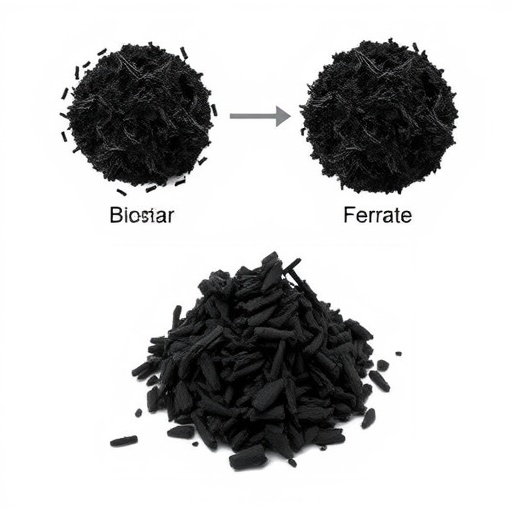
In a groundbreaking advancement that could revolutionize sustainable waste management and bioenergy production, researchers have unveiled a novel process that dramatically enhances the generation of medium-chain fatty acids (MCFAs) from waste activated sludge. This innovative approach, which employs a staged modulation technique combining alkaline biochar and ferrate treatments, promises to transform a problematic waste product into a valuable resource with vast environmental and industrial applications.
Waste activated sludge, a byproduct of wastewater treatment plants, has long posed challenges due to its volume, complex composition, and environmental risks. Traditional disposal methods, including landfilling and incineration, are costly and environmentally detrimental. However, this sludge is rich in organic compounds that, if effectively converted, could serve as a feedstock for producing medium-chain fatty acids—compounds with significant utility in biofuels, specialty chemicals, and pharmaceuticals.
The research team, headed by Wang, Ji, Luo, and colleagues, demonstrated that by applying a synergistic alkaline biochar-ferrate treatment in a staged manner, the biochemical processes within sludge are fine-tuned to maximize MCFA yield. The alkaline biochar acts as a structural and chemical modulator, enhancing microbial activity and substrate availability, while ferrate introduces strong oxidative conditions that selectively degrade recalcitrant compounds, liberating fermentable substrates for subsequent bioconversion.
This staged modulated strategy differentiates itself from conventional pretreatment methods through its ability to balance oxidative degradation with microbial fermentative processes. Initially, the alkaline biochar elevates the pH and introduces a robust microbial habitat rich in conductive materials. This microenvironment facilitates electron transfer and stabilizes microbial consortia, critical for medium-chain fatty acid biosynthesis paths. Subsequently, ferrate’s powerful oxidative potential breaks down complex organic molecules, enhancing the bioavailability of shorter-chain molecules that serve as precursors for MCFA fermentation.
One of the most remarkable aspects of this synergy is the targeted enhancement of medium-chain fatty acid production, a class of compounds notoriously challenging to synthesize at high yields through biological means. MCFAs such as caproic, caprylic, and capric acids have carbon chain lengths ranging from six to ten atoms and serve as essential commodities in biofuel formulations and biochemical manufacturing.
The team’s experiments showed that integrating the alkaline biochar-ferrate treatment led to substantially higher concentrations of MCFAs compared to traditional anaerobic digestion or single pretreatment methods. By carefully modulating the chemical environment and microbial interactions, the staged approach mitigated common process limitations like acid inhibition and substrate recalcitrance, resulting in sustained MCFA production rates over extended periods.
Moreover, alkaline biochar derived from agricultural residues not only provided a cost-effective and sustainable component but also contributed valuable surface functional groups that facilitate electron transfer reactions. The presence of biochar enhanced the sludge’s physical structure, preventing microbial washout and enabling stable reactor operation, essential factors for scaling up the technology for industrial applications.
The use of ferrate is particularly innovative due to its eco-friendly profile. As a powerful oxidant, ferrate decomposes into non-toxic ferric ions, effectively minimizing secondary pollution risks often associated with chemical pretreatments. Its oxidative actions create reactive intermediates that degrade complex organic matter without generating harmful byproducts, a critical consideration for downstream microbial processes.
From a biochemical standpoint, the process leverages key metabolic pathways involving fermentative bacteria that convert liberated substrates into MCFAs through chain elongation mechanisms. The modulation of environmental factors such as pH, redox potential, and substrate availability by the alkaline biochar and ferrate creates optimal conditions for these microbial communities, enhancing their efficiency and stability.
The implications of this discovery are far-reaching. By converting waste activated sludge, an abundant and problematic waste material, into valuable medium-chain fatty acids, the technology aligns closely with circular economy principles, reducing waste footprints while generating revenue streams for wastewater treatment facilities. Additionally, MCFAs can serve as precursors for next-generation biofuels, biodegradable plastics, and even health-related products, opening new market opportunities.
This research also addresses pressing environmental concerns by providing an alternative to sludge disposal methods that often lead to greenhouse gas emissions and soil or water contamination. The staged alkaline biochar-ferrate approach prioritizes process sustainability, aiming for zero-waste outputs and minimal ecological impact.
The study’s authors emphasize the importance of integrating multidisciplinary scientific insights—from environmental engineering to microbiology and materials science—to optimize and tailor this technology further. Ongoing work aims to refine the operational parameters, explore different biomass-derived biochars, and evaluate real-world wastewater sludge samples for commercial scalability.
While further pilot-scale and economic feasibility studies are warranted, the results signal a paradigm shift toward harnessing complex biological waste streams as feedstocks for high-value biochemical products. This approach not only enhances the sustainability of wastewater treatment operations but also contributes to broader efforts to decarbonize chemical manufacturing and bioenergy industries.
In sum, the staged modulation technique utilizing synergistic alkaline biochar and ferrate represents a novel, efficient, and eco-friendly strategy for valorizing waste activated sludge into medium-chain fatty acids. Its successful demonstration could catalyze innovative pathways for sustainable biochemical production and resource recovery, marking a significant milestone in environmental engineering and green chemistry.
As the global population grows and urbanization intensifies, the volume of waste activated sludge will only increase, making such sustainable valorization technologies indispensable. This breakthrough thus offers both immediate technological benefits and long-term environmental solutions, facilitating a cleaner, greener future powered by science and smart waste management.
With its strong emphasis on process synergy, sustainability, and scalability, this discovery is poised to capture the attention of researchers, policymakers, and industries alike. It encapsulates the best of modern scientific innovation—turning a liability into an asset while treading lightly on the planet.
Subject of Research:
Medium-chain fatty acid production from waste activated sludge through a synergistic treatment using alkaline biochar and ferrate.
Article Title:
Staged modulation using synergistic alkaline biochar-ferrate enhances medium-chain fatty acid production from waste activated sludge.
Article References:
Wang, Y., Ji, Y., Luo, X. et al. Staged modulation using synergistic alkaline biochar-ferrate enhances medium-chain fatty acid production from waste activated sludge. Commun Eng (2025). https://doi.org/10.1038/s44172-025-00558-4
Image Credits: AI Generated
Tags: biochar-ferrate synergybiochemical processes optimizationbioenergy from wasteenvironmental applications of biocharfatty acids in biofuelsindustrial applications of MCFAsinnovative wastewater treatment solutionsmedium-chain fatty acids productionmicrobial activity enhancementsustainable waste management techniquestransformative waste resource managementwaste activated sludge conversion



