Researchers from a collaborative team including Kanisorn Sangchai, Methasit Boonpun, Withawin Kraipetchara, and Paulo Garcia have demonstrated that large action models for robotics can achieve high reliability without massive end-to-end training. Published in Discover Robotics, the study presents a prototype system that integrates off-the-shelf foundation models with symbolic validation layers. This neuro-symbolic approach aims to resolve the longstanding tension between the flexibility of neural networks and the strict safety requirements of physical robotic systems. By constraining the output of large language models to verifiable symbolic representations, the system effectively mitigates the risk of action hallucinations, where a robot might execute invalid or dangerous movements.
The central challenge addressed by this research is the integration of environment perception, reasoning, and action in intelligent robots. Classic symbolic artificial intelligence techniques offer strong guarantees on correctness and interpretability but often fail to scale to complex, real-world environments due to high computational costs. Conversely, neural approaches, particularly large language models and vision-language models, excel at perception and generalization but struggle with controllability and reliability. The authors propose that large action models, which extend language model capabilities to physical task completion, can be constructed by composing smaller, efficient models rather than training a single opaque neural network from scratch.
The proposed architecture is modular and hierarchical, designed to bridge the gap between abstract natural language instructions and precise motor control. The system utilizes a three-tier planning hierarchy: high-level cognitive reasoning, medium-level task orchestration, and low-level motion control. At the top, a cognitive agent interprets user commands using either a neural approach, where a large language model directly generates action sequences, or a neuro-symbolic approach, where the model translates requests into formal problem definitions. This high-level reasoning is grounded in valid physical capabilities, ensuring that abstract plans are executable by the robot.
A key innovation in this work is the implementation of symbolic wrapping, a strategy that restricts the large language model from generating executable robot code directly. Instead, the model is constrained to produce intermediate symbolic representations, such as structured plans or formal logic definitions in the Planning Domain Definition Language. These artifacts serve as a verification layer before any physical motion occurs. In the neuro-symbolic pipeline, the robot’s constraints and capabilities are hard-coded in a static symbolic framework, while the large language model generates only the dynamic problem state at runtime. This hybrid representation is then solved by a deterministic symbolic planner, ensuring that the output is logically solvable and syntactically correct.
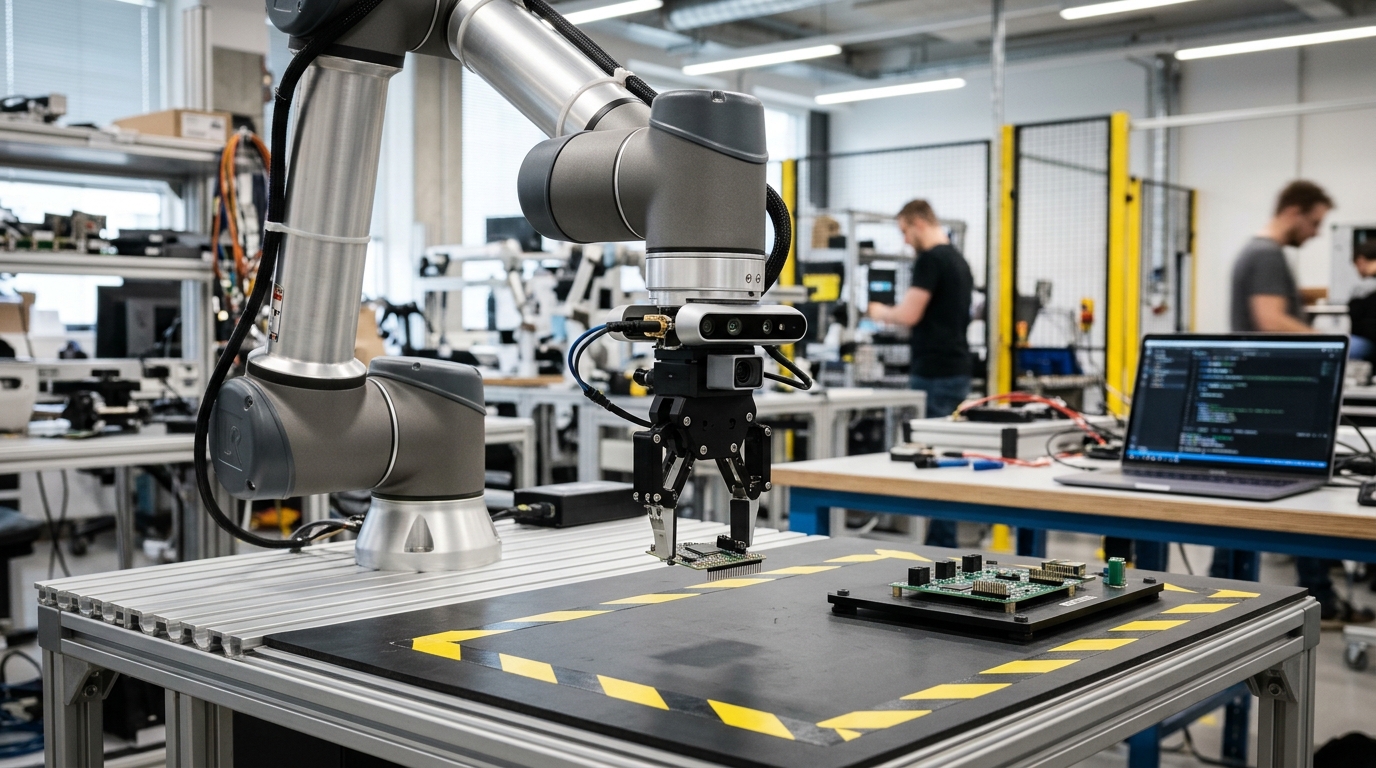
To validate this architecture, the researchers developed a prototype fully integrated within the Robot Operating System 2 framework. The system was tested in both simulation and on physical hardware, specifically a Universal Robots UR3e arm equipped with a Robotiq HandE gripper. The perception module employs open-vocabulary foundation models to perform object segmentation, classification, and grasp synthesis. This converts raw pixel data into useful semantic and geometric information without requiring task-specific training. The speech module utilizes a neural speech-to-text engine to capture user intent, including a symbolic override mechanism where specific safety keywords bypass reasoning layers to trigger immediate hardware halts.
Experimental results demonstrated that the composite approach successfully grounds natural language commands into safe, interpretable physical actions. In a comparative evaluation of 13 tasks across 65 total trials, the neural-direct approach achieved a 100% success rate, leveraging its flexibility to handle abstract instructions. The neuro-symbolic approach achieved a 91% success rate and was slightly faster, providing rigorous mathematical guarantees on plan validity. The 9% failure rate in the neuro-symbolic pipeline was primarily caused by logical hallucinations, where the generated problem specification described an internally inconsistent task. Crucially, all failures were safely contained at the planning layer, and no invalid or unsafe action was ever executed by the robot.
The study also evaluated the safety and responsiveness of the system, a critical requirement for large action models operating in human-centric spaces. The researchers measured the latency in processing an emergency stop voice command during active motion. The system achieved an average stop latency of 1.41 seconds, with a standard deviation of 0.14 seconds. This performance confirms that the hierarchical architecture successfully decouples high-level artificial intelligence planning from low-level safety protocols. The emergency stop mechanism operates independently of the planning pipeline, ensuring that human intervention remains preemptive regardless of the complexity of the current artificial intelligence task or the latency of large language model inference.
Perception module performance was quantified using standard computer vision metrics adapted for robotic tasks. The system demonstrated high geometric fidelity, with the pixel-to-real service achieving a root mean square error of 0.054 meters. This margin is considered acceptable for the targeted application, as it represents a minor fraction of the object’s total dimensions and falls within the gripper’s mechanical compliance range. The scene understanding module achieved a 0.98 success rate in correctly identifying relative spatial predicates, validating the high-level planner’s ability to construct reliable mental models of the environment. Classification accuracy reached 85%, suggesting that the semantic layer is sufficiently robust to support natural language grounding in subsequent planning phases.
Speech recognition performance was evaluated using 30 task-related voice commands executed by three participants, who were authors of the paper and considered expert users. The automatic speech recognition system achieved a mean accuracy of 0.9791, with a 95% confidence interval ranging from 0.919 to 1.000. The system exhibited consistently low end-to-end transmission latency, with a mean communication latency of 1.61 milliseconds between the speech node and the planning node. This lightweight overhead reflects the efficiency of the Robot Operating System 2 message passing once a transcription is available. The results indicate that the speech module provides accurate command interpretation and reliable safety handling for real-time human-robot manipulation tasks.
Limitations of the current system include the reliance on network connectivity for the speech transcription backend and the brittleness of neuro-symbolic translation. The authors note that the reliability of generating formal symbolic structures remains a bottleneck, particularly in longer or sequential tasks where action preconditions are incorrectly modeled. Future research must address these challenges by developing methods for the iterative self-correction of generated code and moving towards dynamic domain generation. This would allow robots to autonomously expand their symbolic understanding of the world based on novel perceptual inputs, rather than relying on static, hand-coded domain definitions. The study highlights that while neural-direct approaches offer greater flexibility, the neuro-symbolic approach provides superior mathematical guarantees on plan validity, making it a critical component for safety-critical robotic applications.
The implications of this research extend to the broader field of embodied artificial intelligence, where the integration of perception, reasoning, and action is essential for fluid human-robot collaboration. By demonstrating that large action model intelligence can be achieved through the integration of efficient perception models with a logic-driven core, the authors provide a pathway for practitioners to design and develop robotic systems across novel industries. The work sheds light on the ongoing challenges that must be addressed to ensure safety in the field, emphasizing that the generation of an intermediate, human-readable symbolic plan is essential for preventing action hallucinations. This approach not only avoids the costs of end-to-end training but also makes the system’s perceptual capabilities more extendable and interpretable.
The study concludes that the capabilities of large action models can be effectively realized through a modular, neuro-symbolic architecture. By wrapping stochastic large language models with deterministic symbolic constraints, the system bridges the gap between open-ended reasoning and the rigorous safety requirements of physical actuation. The experiments verify that this composite approach enables critical human-in-the-loop intervention, allowing operators to review and revise plans prior to execution. This architecture ensures that the stochasticity of the large language model is confined to the reasoning phase, while the execution phase remains transparent and bounded by the robot’s defined capabilities. The findings support the design of robotic large action models that are computationally efficient, safe, and explainable without the resource-intensive training of massive new sequence models.
Subject of Research: Symbolic wrappers enable precise human in the loop operation for large action models
Article Title: Symbolic wrappers enable precise human in the loop operation for large action models
Article References: Sangchai, K., Boonpun, M., Kraipetchara, W., & Garcia, P. (2026). Symbolic wrappers enable precise human in the loop operation for large action models. Discover Robotics, 2(1), Article 8. https://doi.org/10.1007/s44430-026-00023-7
Image Credits: AI Generated
DOI: 10.1007/s44430-026-00023-7
Keywords: Symbolic, wrappers, enable, precise, human, loop, operation, large, action, models, scientific research
News Source: Denise Maddox. (November 8, 2026). Symbolic Wrappers Enhance Safety in Robotic Action Models. Scienmag.