SAN ANTONIO — Sept. 26, 2022 — A Southwest Research Institute-developed technology has won a prestigious R&D 100 Award. R&D World Magazine recognized SwRI and Hanwha Power Systems’ Integrally Geared Supercritical CO2 Compander as being among the 100 most significant innovations for 2022.
“Southwest Research Institute is committed to exploring energy solutions that will benefit humankind,” said SwRI President and CEO Adam Hamilton, P.E. “I’m very proud that this work has been recognized as one of the most important innovations of the year.”
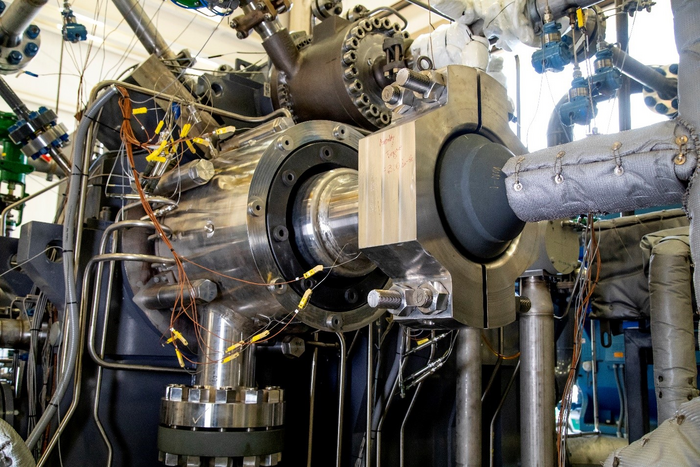
The Integrally Geared Supercritical CO2 Compander was created by SwRI in collaboration with Hanwha for a 10 MW-scale concentrated solar power (CSP) supercritical carbon dioxide (sCO2) plant application. It converts thermal energy from a heat generation source, such as CSP, to electrical energy. This technology was developed by a team led by SwRI’s Dr. Jason Wilkes and Dr. Tim Allison, and Hanwha’s Dr. Karl Wygant, Rob Pelton, and Jon Bygrave, with the support of the U.S. Department of Energy Office of Energy Efficiency and Renewable Efficiency.
The new compander operates in a high-efficiency power cycle that aims to make diverse, non-hydrocarbon-based power sources widely available and affordable. Closed-loop sCO2 power cycles are more cost-effective and efficient and use equipment that is a fraction of the size of conventional turbomachinery. These cycles can utilize heat from CSP, nuclear power, stored energy and waste heat recovery to generate electricity.
The compander uses multiple pinion shafts interacting through a single bull gear to create a compact package, and utilizes a low-cost, low-speed driver. In addition, the integrally geared architecture allows each pinion to operate at different rotational speeds to optimize performance and easily allow for interstage cooling and turbine reheating to enhance both stage and cycle efficiency. The close integration of all turbomachinery elements into a single integrally geared design lends itself to power-block modularization, which makes it suitable for a variety of applications such as CSP, waste heat recovery, and carbon neutral fossil-fuel power plants.
The compander operates in the first functional MW-scale sCO2-compressor-driven turbine power cycle loop operating at temperatures up to 720°C and has already achieved several noteworthy records for turbomachinery, including the highest-pressure sCO2 dry-gas seal, integrally geared expander, and integrally geared compressor in the world. It also features the highest-density integrally geared expander, radial expander and integrally geared compressor as well as the highest temperature radial expander at pressures above 100 bar.
The R&D 100 Awards are among the most prestigious innovation awards programs, honoring the top 100 revolutionary technologies each year since 1963. Recipients hail from research institutions, academic and government laboratories, Fortune 500 companies and smaller organizations. Since 1971, SwRI has won 51 R&D 100 Awards. This year’s winners will be recognized at an awards banquet in San Diego on November 17, 2022.
This material is based upon work supported by the Department of Energy, Office of Energy Efficiency and Renewable Energy (EERE), under Award Number DE-0007114.
For more information, visit https://www.swri.org/industries/advanced-power-systems.
Credit: Southwest Research Institute
SAN ANTONIO — Sept. 26, 2022 — A Southwest Research Institute-developed technology has won a prestigious R&D 100 Award. R&D World Magazine recognized SwRI and Hanwha Power Systems’ Integrally Geared Supercritical CO2 Compander as being among the 100 most significant innovations for 2022.
“Southwest Research Institute is committed to exploring energy solutions that will benefit humankind,” said SwRI President and CEO Adam Hamilton, P.E. “I’m very proud that this work has been recognized as one of the most important innovations of the year.”
The Integrally Geared Supercritical CO2 Compander was created by SwRI in collaboration with Hanwha for a 10 MW-scale concentrated solar power (CSP) supercritical carbon dioxide (sCO2) plant application. It converts thermal energy from a heat generation source, such as CSP, to electrical energy. This technology was developed by a team led by SwRI’s Dr. Jason Wilkes and Dr. Tim Allison, and Hanwha’s Dr. Karl Wygant, Rob Pelton, and Jon Bygrave, with the support of the U.S. Department of Energy Office of Energy Efficiency and Renewable Efficiency.
The new compander operates in a high-efficiency power cycle that aims to make diverse, non-hydrocarbon-based power sources widely available and affordable. Closed-loop sCO2 power cycles are more cost-effective and efficient and use equipment that is a fraction of the size of conventional turbomachinery. These cycles can utilize heat from CSP, nuclear power, stored energy and waste heat recovery to generate electricity.
The compander uses multiple pinion shafts interacting through a single bull gear to create a compact package, and utilizes a low-cost, low-speed driver. In addition, the integrally geared architecture allows each pinion to operate at different rotational speeds to optimize performance and easily allow for interstage cooling and turbine reheating to enhance both stage and cycle efficiency. The close integration of all turbomachinery elements into a single integrally geared design lends itself to power-block modularization, which makes it suitable for a variety of applications such as CSP, waste heat recovery, and carbon neutral fossil-fuel power plants.
The compander operates in the first functional MW-scale sCO2-compressor-driven turbine power cycle loop operating at temperatures up to 720°C and has already achieved several noteworthy records for turbomachinery, including the highest-pressure sCO2 dry-gas seal, integrally geared expander, and integrally geared compressor in the world. It also features the highest-density integrally geared expander, radial expander and integrally geared compressor as well as the highest temperature radial expander at pressures above 100 bar.
The R&D 100 Awards are among the most prestigious innovation awards programs, honoring the top 100 revolutionary technologies each year since 1963. Recipients hail from research institutions, academic and government laboratories, Fortune 500 companies and smaller organizations. Since 1971, SwRI has won 51 R&D 100 Awards. This year’s winners will be recognized at an awards banquet in San Diego on November 17, 2022.
This material is based upon work supported by the Department of Energy, Office of Energy Efficiency and Renewable Energy (EERE), under Award Number DE-0007114.
For more information, visit https://www.swri.org/industries/advanced-power-systems.