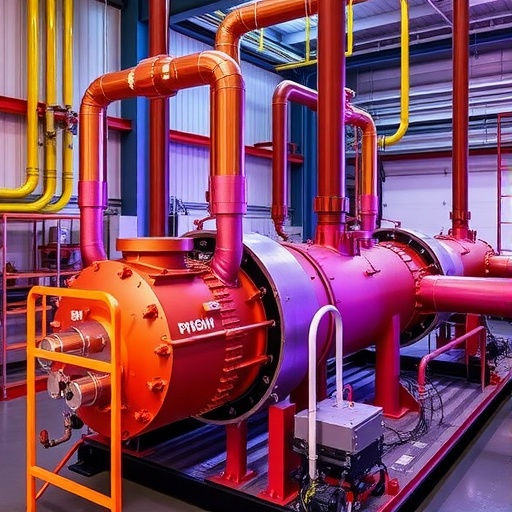
Southwest Research Institute Unveils Groundbreaking Joule Hive™ Thermal Battery, Pioneering Zero-Emission Industrial Heat Production
In a significant leap toward decarbonizing industrial energy systems, Southwest Research Institute (SwRI) proudly hosts the pioneering full-scale Joule Hive™ Thermal Battery, a revolutionary approach to industrial heat generation and storage. This novel system, developed under the leadership of Electrified Thermal Solutions and backed by the U.S. Department of Energy, represents a watershed moment in the quest to replace fossil fuel-dependent heating processes with scalable, electrically driven, and renewable-powered solutions. Located on SwRI’s sprawling San Antonio campus, this installation marks the first time such technology has been realized at a commercial scale, promising to reshape industrial heat production across multiple sectors.
Industrial heat generation is notoriously challenging to decarbonize due to the extremely high temperatures required in processes like steelmaking, cement production, and chemical manufacturing. Traditionally, these sectors have depended heavily on burning fossil fuels, releasing substantial volumes of carbon dioxide and intensifying the global climate crisis. The Joule Hive™ Thermal Battery circumvents this by leveraging a purely electric heating method capable of reaching temperatures up to 1,800 degrees Celsius, suitable for a broad spectrum of industrial applications. This breakthrough enables industries to eliminate combustion-based heat sources, thereby significantly reducing associated carbon emissions.
At the core of this innovative technology lies a modular array of specialized fire bricks engineered to endure intense thermal stress and temperature extremes characteristic of industrial processes. These fire bricks are enhanced with conductive constituents, enabling them to generate heat through electrical resistance and simultaneously function as a robust thermal energy storage medium. By electrically passing current through the bricks at medium voltages — specifically 13.2 kV — the system generates resistive heat, which the bricks absorb and retain until needed. This dual capability allows for temporal decoupling of energy input and heat output, a critical advancement for integrating variable renewable energy sources with industrial processes.
The operational principle of the Joule Hive™ Thermal Battery is both elegant and efficient. During periods of excess renewable electricity availability — for instance, on sunny or windy days — the system charges by electrically heating the bricks, effectively storing thermal energy akin to a battery but in heat form. When industrial heating is required, this thermal energy is discharged by directing hot air or relevant process gases across the heated bricks, transferring the stored heat directly into the industrial processes. This modality not only conserves energy but also confers tremendous flexibility in energy management and process scheduling, allowing industries to mitigate reliance on fluctuating grid conditions or the volatility of natural gas markets.
SwRI’s commitment to advancing this technology extended beyond conceptual design into extensive infrastructure enhancement. To accommodate the high-power requirements of the Joule Hive™, SwRI augmented its High-Temperature Energy Conversion and Storage laboratory with a heavy-duty outdoor facility spanning 12,000 square feet. This expansion includes the installation of a 600-amp, 13.2 kV electrical supply system capable of supporting megawatt-scale thermal loads. Such infrastructure is vital to validating the system’s performance under realistic industrial conditions and demonstrates SwRI’s strategic foresight in fostering low-carbon technology adoption at scale.
The thermal capacity of the SwRI Joule Hive™ installation is particularly noteworthy, boasting an impressive 20 megawatt-hours of stored heat energy. This capacity enables the thermal battery to supply large-scale industrial processes with high-temperature heat on demand, representing a meaningful step towards the electrification of sectors historically reliant on fossil combustible fuels. The system’s ability to provide steady, high-temperature heat with rapid response times offers a pathway to streamline industrial decarbonization efforts that have previously been constrained by technological limitations.
In addition to engineering the thermal battery, SwRI has pioneered advances in ancillary system components vital for effective operation. The design and construction of innovative air transport, mixing, and exhaust management systems ensure precise delivery of heat to industrial processes with minimal losses. These complementary technologies are crucial in achieving both operational efficiency and regulatory compliance by managing temperature profiles and emissions within tightly controlled parameters. By addressing these system-level challenges, SwRI demonstrates the comprehensive nature of its approach in transitioning industrial heating away from carbon-intensive fuels.
The successful construction timeline of the Joule Hive™ Thermal Battery was notably swift, with project initiation in August 2025 and system commissioning completed by December 2025. This rapid deployment underscores both the feasibility and urgency of scaling clean thermal solutions as industries worldwide pursue net-zero targets. It also reflects the maturity of the enabling technologies and SwRI’s operational expertise in integrating cutting-edge concepts into functional industrial assets.
Josh Schmitt, one of the project leaders at SwRI, emphasizes that the Joule Hive™ technology offers not only environmental benefits but also economic ones. By allowing operators to produce process heat using electricity when natural gas prices are elevated or unavailable, the system provides industrial entities with a hedge against fuel price volatility and potential supply disruptions. This economic flexibility, paired with zero-emission operation, positions the thermal battery as a commercially attractive alternative for industries aiming to modernize their heat generation portfolios.
Furthermore, the project exemplifies a scalable solution that can extend beyond a single site. The modular construction and medium-voltage design enable relatively straightforward integration into diverse industrial settings, making it adaptable to various heat-intensive applications across the manufacturing landscape. SwRI continues to conduct ongoing assessments of the system’s output and integration pathways, refining performance profiles and determining operational best practices to maximize adoption potential.
The Joule Hive™ Thermal Battery project solidifies SwRI’s reputation as a leader in thermal energy storage and conversion, combining fundamental research with applied engineering to overcome one of the most intractable challenges in industrial decarbonization. By pioneering a thermal storage system capable of supporting multi-megawatt thermal loads and compatibility with renewable electricity inputs, SwRI contributes critical technologies needed to realize ambitious climate goals. As industries worldwide strive to reduce greenhouse gas emissions, systems like the Joule Hive™ offer hope and practical pathways toward sustainable, zero-carbon heat generation.
SwRI invites the broader industrial community and energy sector stakeholders to explore the potential of this transformative technology, with detailed information available through dedicated project web portals. Continued collaboration between government, industry, and research institutions will be essential to scale such innovations globally and catalyze the transition towards a cleaner industrial future.
Subject of Research: Industrial thermal energy storage and zero-emission heat production technology
Article Title: Southwest Research Institute Unveils Joule Hive™ Thermal Battery: Transforming Industrial Heat with Zero-Carbon Electricity
News Publication Date: March 30, 2026
Web References:
https://www.swri.org/markets/energy-environment/power-generation-utilities/conventional-power-generation/thermal-energy-storage?&utm_medium=referral&utm_source=eurekalert!&utm_campaign=joule-hive-pr
Image Credits: Southwest Research Institute
Keywords: Renewable energy, Mechanical engineering, Fossil fuels, Carbon dioxide, Carbon emissions, Thermal energy
Tags: chemical industry heat decarbonizationclean cement production methodselectrically driven industrial heatingfossil fuel replacement in manufacturinghigh-temperature electric heating solutionsindustrial heat decarbonizationJoule Hive thermal battery technologyrenewable energy for high-temperature processesscalable thermal energy storage systemssustainable steelmaking heat technologyU.S. Department of Energy clean energy projectszero-emission industrial heat production