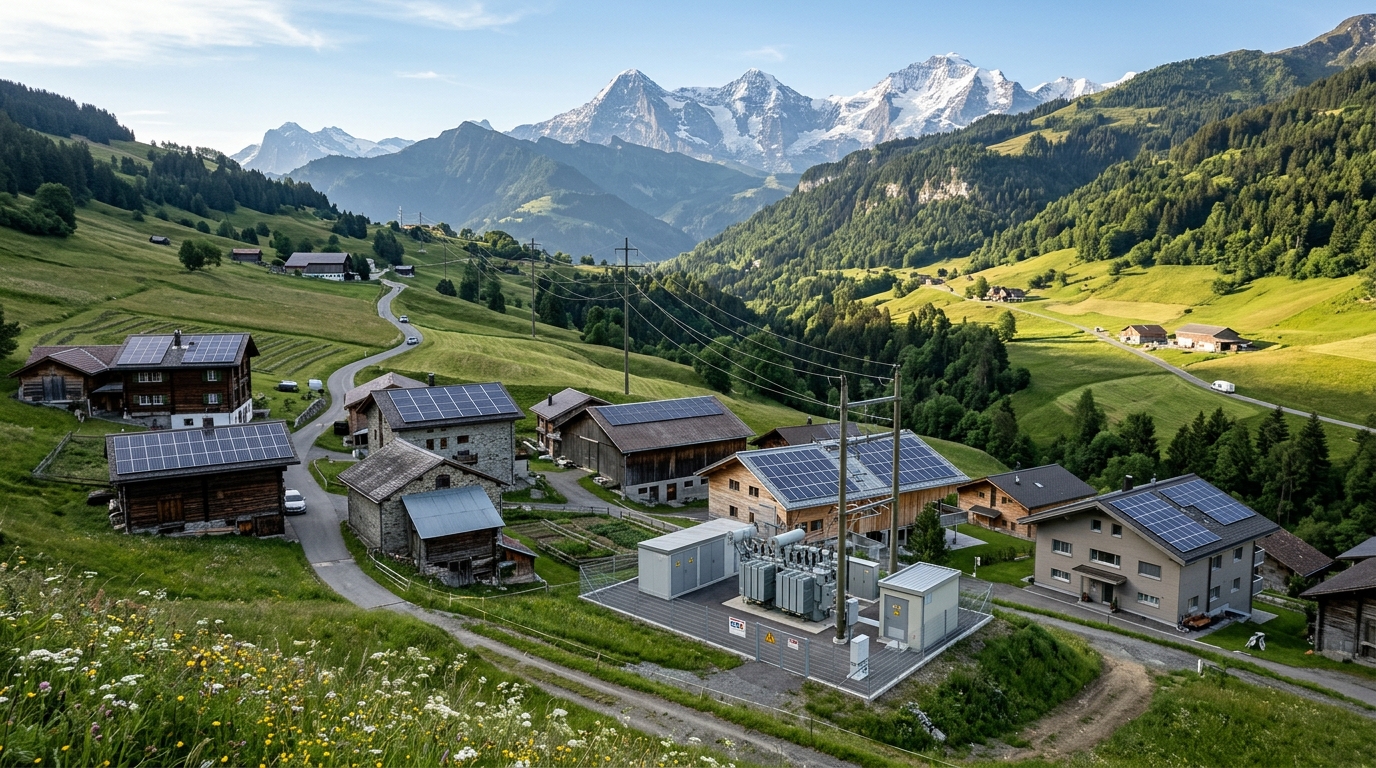
A new qualitative study published in Energy, Sustainability and Society reveals that stakeholders across Switzerland’s electricity sector broadly agree on the need for a highly decentralized and flexible grid powered largely by renewable energy. The research, conducted by Vanja Djinlev, BinBin J. Pearce, and Michael Stauffacher, investigates how various actors envision the future of the Swiss electricity grid and the coordination mechanisms required to support the ongoing energy transition. By applying the socio-technical imaginaries framework, the authors identify a consensus on the ultimate goal of national decarbonization while maintaining grid stability, yet they also uncover significant divergences regarding the specific roles of local electricity communities and distribution system operators.
Switzerland’s electricity sector presents a unique case for examining these dynamics due to its highly fragmented structure. The country is home to over 600 distribution system operators, nearly 200 energy cooperatives, and a single transmission system operator, Swissgrid. This decentralized landscape is further complicated by a federalist structure where cantons and municipalities hold key roles in implementing energy policies. A new Electricity Act, passed by popular vote in 2024 and effective in 2025, formally recognizes local electricity communities as active grid participants, allowing them to market self-generated electricity through the public grid. This legal shift aligns with European concepts of citizen energy communities and introduces new complexities for coordination among system operators and policymakers.
The study addresses a critical gap in understanding the institutional and social dimensions of the energy transition, which are often overlooked in quantitative techno-economic modeling. The researchers posed a central question: to what extent do stakeholders in Switzerland’s electricity sector share a common vision for the future grid, and what are the key cross-sectoral challenges that must be addressed to realize this vision? To answer this, the team conducted semi-structured interviews with eight key stakeholders, including representatives from the Swiss Federal Office of Energy, the national transmission system operator, three distribution system operators from different language regions, two of the largest energy companies, and an aggregator operating outside Switzerland. The interviews were conducted in English between January and September 2024, with some participants re-interviewed after the public referendum supporting the new Electricity Act to capture updated perspectives on the changing regulatory environment.
The analysis of these interviews reveals that a shared vision for a future energy system is characterized by decentralized energy production and flexibility. Across all interviews, stakeholders emphasized that demand will shift closer to end users, with localized control and increased reliance on distributed energy resources, particularly solar photovoltaics. However, this localized shift does not eliminate the need for centralized coordination. Critical elements such as grid stability remain imperative and must be managed at higher levels by transmission and distribution system operators to ensure system reliability. Some interviewees highlighted the need for hybrid systems that combine both decentralized and centralized elements to maximize efficiency, particularly in managing the fluctuations inherent in renewable energy generation and consumption.
A significant focus in the stakeholders’ visions is the evolving role of citizens in the energy transition. Although citizens currently have a limited role in the Swiss electricity market, where households are not part of the liberalized market and cannot choose their supplier, the future system is envisioned as increasingly citizen-centric. Prosumer models, where citizens both consume and produce energy, are seen as becoming more common. Tools such as smart meters and the development of energy communities are viewed as essential enablers of this transition. Public education and engagement activities are recognized by several stakeholders as crucial for raising awareness and ensuring public acceptance, with a perceived need for more inclusive policymaking that involves informed citizens in decision-making processes.
Despite the shared aspirations, the study identifies several challenges that could hinder the realization of this vision. The lag between regulatory developments and the pace of technological innovation is cited as a serious obstacle, alongside overall regulatory uncertainties and changes in regulation. Societal acceptance of energy infrastructures, often influenced by Not In My Back Yard attitudes, may also present barriers. Furthermore, making complex energy decisions through popular vote can introduce challenges such as fragmented regional efforts and policy delays, which may hinder timely and coordinated progress. These findings suggest that while the technical feasibility of a low-carbon transition is well-modeled, the implementation remains challenging due to conflicting visions and institutional constraints.
The operational goals of the stakeholders are structured around ensuring efficient grid management and energy security. Interviewees emphasized the need for enhancing grid efficiency by incorporating advanced control systems and strategies that optimize the management of distributed energy resources and prevent losses. Balancing intermittent renewable sources with a stable energy supply requires innovations in storage, demand response, and flexibility. Grid operators aim to maintain voltage and frequency within certain limits while enabling the connection of more distributed energy resources through sophisticated control technologies such as Supervisory Control and Data Acquisition and Distributed Energy Resource Management Systems. Market liberalization for households is seen as an opportunity by some stakeholders, as it could introduce competition and encourage distribution system operators to concentrate on innovation and dynamic pricing models.
The roles of system operators are undergoing a significant transformation in this new landscape. The transmission system operator’s role is evolving from simply operating the high-voltage grid to that of a system integrator, coordinating various aspects of the energy system including the activities of market actors, distributed energy resources, and advanced control technologies. Distribution system operators are expanding their responsibilities to include energy innovation, public engagement, and the management of decentralized energy systems. This shift is driven by the increasing complexity of energy networks, with more renewables and distributed energy resources being connected to the low and medium-voltage grids. The integration of these technologies places significant pressure on distribution system operators to manage coordination, planning, and investment decisions to fulfill the technical requirements of the grid and ensure reliability.
Opinions on the viability and potential role of local electricity communities are mixed. Some stakeholders are optimistic, emphasizing the potential of these communities to decentralize energy production and enhance public engagement. They view these communities as a promising way to increase local renewable energy generation and encourage citizen participation. However, other stakeholders express skepticism, highlighting the lack of information and understanding, limited financial incentives, and the administrative complexity these initiatives impose on distribution system operators. The integration of energy communities into the grid may bring additional challenges, particularly for smaller distribution system operators with limited resources. The study notes that while energy communities may provide grid balancing services, they can also lead to higher energy losses and worsened voltage profiles if not properly managed.
The study concludes that the Swiss electricity sector’s transition is not solely a technical undertaking but also a deeply institutional and social challenge. Coordinating system actors requires attention to differing expectations, governance structures, and resource capabilities. The authors highlight the importance of fostering shared visions through structured dialogue, intermediary platforms, and capacity-building measures, especially for local actors and smaller distribution system operators. They suggest that policymakers should push for improved coordination across the grid, establish clear regulatory frameworks to guide investments, and provide targeted support for energy communities and citizen engagement. While grounded in the Swiss context, the insights are relevant to other decentralized energy systems, particularly considering the ongoing European efforts to support energy communities. The study underscores the need for a socio-technical perspective that goes beyond static policy analysis to understand the complexities of imagining and realizing a sustainable energy future.
Subject of Research: Evolving roles and shared futures: challenges and visions for Switzerland’s electricity sector transition
Article Title: Evolving roles and shared futures: challenges and visions for Switzerland’s electricity sector transition
Article References: Djinlev, V., Pearce, B. J., & Stauffacher, M. (2026). Evolving roles and shared futures: challenges and visions for Switzerland’s electricity sector transition. Energy, Sustainability and Society, 16(1), Article 46. https://doi.org/10.1186/s13705-026-00592-w
Image Credits: AI Generated
DOI: 10.1186/s13705-026-00592-w
Keywords: Evolving, roles, shared, futures, challenges, visions, Switzerland, electricity, sector, transition, scientific research
News Source: Sloane Callahan. (November 7, 2026). Swiss Grid Stakeholders Share Vision for Decentralized Energy Future. Scienmag.