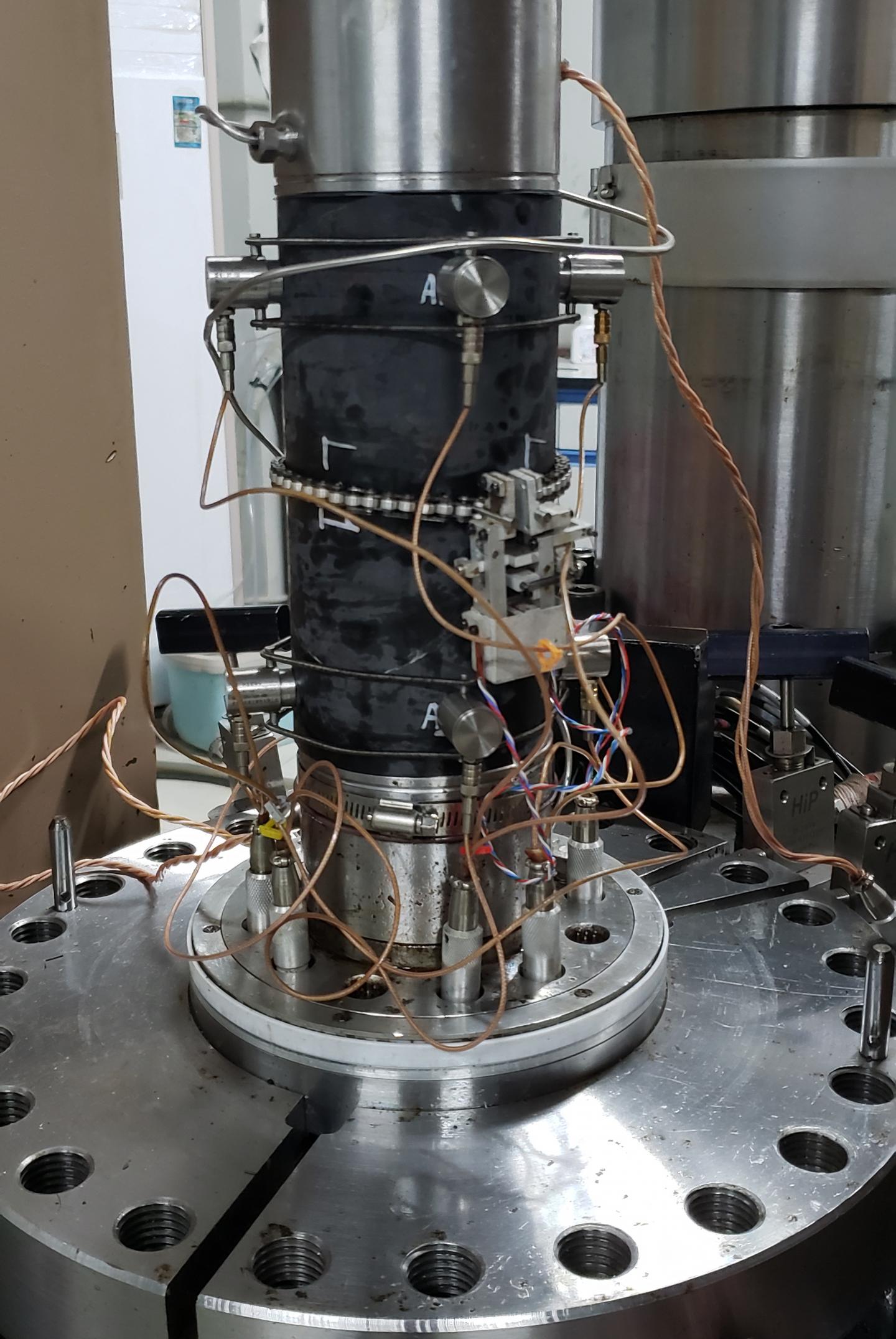
Credit: Xuehang Song
Scientists at the Chinese Academy of Sciences and China University of Petroleum (Beijing) have demonstrated that CO2 may make a better hydraulic fracturing (fracking) fluid than water. Their research, published May 30 in the journal Joule, could help pave the way for a more eco-friendly form of fracking that would double as a mechanism for storing captured atmospheric CO2.
Fracking is a technique used to extract resources from unconventional reservoirs in which fluid (usually water mixed with sand, foaming agents, biocides, and other chemicals) is injected into the rock, fracturing it to release the resources within. Of the approximately 7-15 million liters of fluid injected, 30%-50% remains in the rock formation after extraction ends. Its high water consumption, environmental risks, and frequent production issues have led to concerns about fracking among both industry experts and environmental advocates.
“Non-aqueous fracturing could be a potential solution to circumvent these issues,” says Nannan Sun, a researcher in the Shanghai Advanced Research Institute at the Chinese Academy of Sciences. “We chose CO2 fracturing from a range of options because the process includes multiple benefits. However, we were still lacking a fundamental understanding of the technology, which is greatly important for its further development and deployment.”
Benefits of CO2 fracturing include eliminating the need for a hefty water supply (which would make fracking viable in arid locations), reducing the risk of damage to reservoirs (as often happens when aqueous solutions create blockages in the rock formation), and providing an underground repository for captured CO2.
However, CO2 is not likely to become commonly used as a fracking fluid unless it is more effective than water at resource production. To investigate the differences between CO2 and water as fracturing fluids on a microscopic level, Sun and his team collected shale outcrops from Chongqing, China and fractured them with both fluids. They found that CO2 outperformed water, creating complex networks of fractures with significantly higher stimulated volumes.
“We demonstrated that CO2 has higher mobility than water, and, therefore, the injection pressure can be better delivered into the natural porosity of the formation,” says Sun. “This changes the mechanism by which the fractures are created, generating more complex fracture networks that result in more efficient shale gas production.”
While the researchers believe this hydraulic fracturing technology will be scalable, its large-scale development is currently limited by CO2 availability. The cost of CO2 captured from emission sources is still prohibitively expensive to make CO2 an industry-wide fracking fluid replacement.
The team also notes that once CO2 has been injected into the fracture, it acquires a low viscosity that inhibits it from effectively transporting sand to the fractures. Since the sand is intended to prop open the fractures while shale gas is harvested, it is critical that scientists learn to improve the fluid’s viscosity–but the team is not yet sure how to do so while keeping costs low and minimizing the environmental footprint.
As next steps, the researchers plan to study the limits of CO2 fracturing technology in order to better understand how it can be used. “Further investigations are needed to identify the effects of type of reservoirs, geomechanical properties and conditions, CO2 sensitivity of the formation, and so forth,” says Sun. “Additionally, cooperation with industries will be carried out to push forward the practical deployment of the technology.”
###
This work was supported by the Strategic Priority Research Program of the Chinese Academy of Sciences, CAS Key Lab for Low Carbon Conversion Science and Engineering, and National Natural Science Foundation of China.
Joule, Song, Guo, and Zhang et al.: “Fracturing with Carbon Dioxide: From Microscopic Mechanism to Reservoir Application” https://www.cell.com/joule/fulltext/S2542-4351(19)30216-8
Joule (@Joule_CP), published monthly by Cell Press, is a new home for outstanding and insightful research, analysis, and ideas addressing the need for more sustainable energy. A sister journal to Cell, Joule spans all scales of energy research, from fundamental laboratory research into energy conversion and storage up to impactful analysis at the global level. Visit: http://www.
Media Contact
Carly Britton
[email protected]
Related Journal Article
http://dx.