A comprehensive review of digital engineering literature published from 2000 through July 2026 establishes that surrogate modeling techniques have expanded from initial roles in aerodynamic wing optimization into pervasive computational tools spanning testing, manufacturing, and operational maintenance. Engineering evaluations in modern aviation rely heavily on high-fidelity numerical tools, including computational fluid dynamics and large-scale finite element analysis, which frequently require hours or days to evaluate a single design configuration. In response to the computational bottlenecks of repeated simulations across wide parameter spaces, surrogate models construct approximate mathematical mappings between input variables and system outputs. These low-cost approximations allow engineers to conduct multi-query analyses, explore complex parameter domains, evaluate candidate geometries, and execute real-time closed-loop assessments without incurring the prohibitive resource demands of continuous high-fidelity simulation.
To assess the historical trajectory and methodological distribution of surrogate modeling across the aerospace sector, researchers conducted a systematic bibliometric review utilizing the Web of Science and Scopus databases. The literature retrieval examined journal articles, conference papers, dissertations, and books published between 2000 and July 15, 2026, using search terms combining surrogate models with aircraft and aerospace applications across major academic publishers. An initial retrieval identified 2,058 candidate publications, which were subjected to abstract, introduction, and conclusion screening to exclude records lacking substantial connections to core surrogate modeling methodologies. A bibliometric co-occurrence analysis of 69 recurrent terms using VOSviewer revealed a marked temporal shift in research priorities. Earlier investigations concentrated primarily on classic design tasks, numerical optimization, and interpolation techniques, whereas recent investigations show heavy emphasis on deep neural networks, data-driven frameworks, and machine learning architectures, indicating that surrogate workflows are expanding across all phases of aircraft development.
The mathematical foundation of surrogate modeling encompasses classical algebraic approximations, probabilistic spatial formulations, deterministic interpolation schemes, and advanced deep learning paradigms. Polynomial response surface models employ least squares regression over algebraic basis functions, typically using second-order expansions to evaluate linear effects, nonlinear curvatures, and parameter interactions while filtering random test noise. Polynomial chaos expansions expand stochastic system responses across orthogonal polynomial bases within defined probability spaces, yielding direct analytical formulations for output means, variances, and Sobol global sensitivity indices. In parallel, Gaussian process regression, widely known in engineering as Kriging, models responses through a deterministic global trend combined with a stationary zero-mean Gaussian process governed by spatial covariance functions. Unlike deterministic regressors, Kriging outputs both a predictive mean that interpolates sample points and an explicit predictive variance that quantifies local estimation uncertainty, offering critical guidance for adaptive sampling algorithms.
Alternative interpolation and deep neural network architectures address higher-dimensional and nonlinear engineering spaces that challenge low-order polynomial models. Radial basis function networks express unknown system responses through linear combinations of radially symmetric Euclidean distance metrics, often augmented by polynomial tail terms and orthogonality constraints to guarantee interpolation exactness. Deep learning architectures, such as multilayer perceptrons, construct cascaded linear transformations and nonlinear activation layers capable of capturing intricate multidimensional response topologies, though standard fully connected configurations remain vulnerable to overfitting and poor extrapolation. When modeling time-dependent degradation or dynamic operational sequences, recurrent neural networks incorporate hidden feedback connections to maintain historical state memory. Specialized variants, notably long short-term memory networks and gated recurrent units, mitigate vanishing or exploding gradient phenomena across long temporal sequences by regulating information retention and updates through dedicated gating mechanisms.
Recent methodological developments integrate mechanistic principles directly into network architectures through physics-informed neural networks and infinite-dimensional neural operators. Physics-informed formulations embed governing differential equations, initial states, and boundary conditions directly into the objective loss function as penalty terms, training network weights to respect conservation laws and balance sparse empirical observations against physical residuals. When evaluating complex physical domains, neural operators, including DeepONet and Fourier neural operators, learn continuous mappings between infinite-dimensional function spaces rather than discrete finite-dimensional vectors. DeepONet accomplishes this through decoupled branch networks that encode input conditions and trunk networks that map continuous coordinate locations, whereas Fourier neural operators utilize fast Fourier transforms to parameterize integral kernels directly in the frequency domain, enabling rapid zero-shot field predictions across varied geometric boundaries and resolution meshes.
Within the aircraft design stage, surrogate models primarily function within iterative optimization loops to mitigate the severe computational cost of recurring physics-based solver executions. In aerodynamic shape design, models approximate complex mappings from geometric class-shape transformation parameters, angles of attack, and flight Mach numbers to critical lift, drag, and moment coefficients, as demonstrated by public aerodynamic benchmarks and hierarchical Kriging frameworks that fuse low-fidelity vortex-lattice methods with high-fidelity Reynolds-averaged Navier-Stokes data. In structural design, surrogates map composite layup sequences, skin thicknesses, and boundary loads to stress distributions, buckling eigenvalues, and fatigue failure probabilities, frequently employing ensemble learning and adaptive subset simulations to estimate small failure margins. In thermodynamic and aeroacoustic applications, surrogate-assisted workflows map heat exchanger geometries, cooling passage topologies, and propeller blade angles to core temperatures, radiated sound pressure levels, and far-field acoustic directivities, allowing engineers to construct Pareto frontiers that reconcile competing aeroacoustic and aerodynamic constraints.
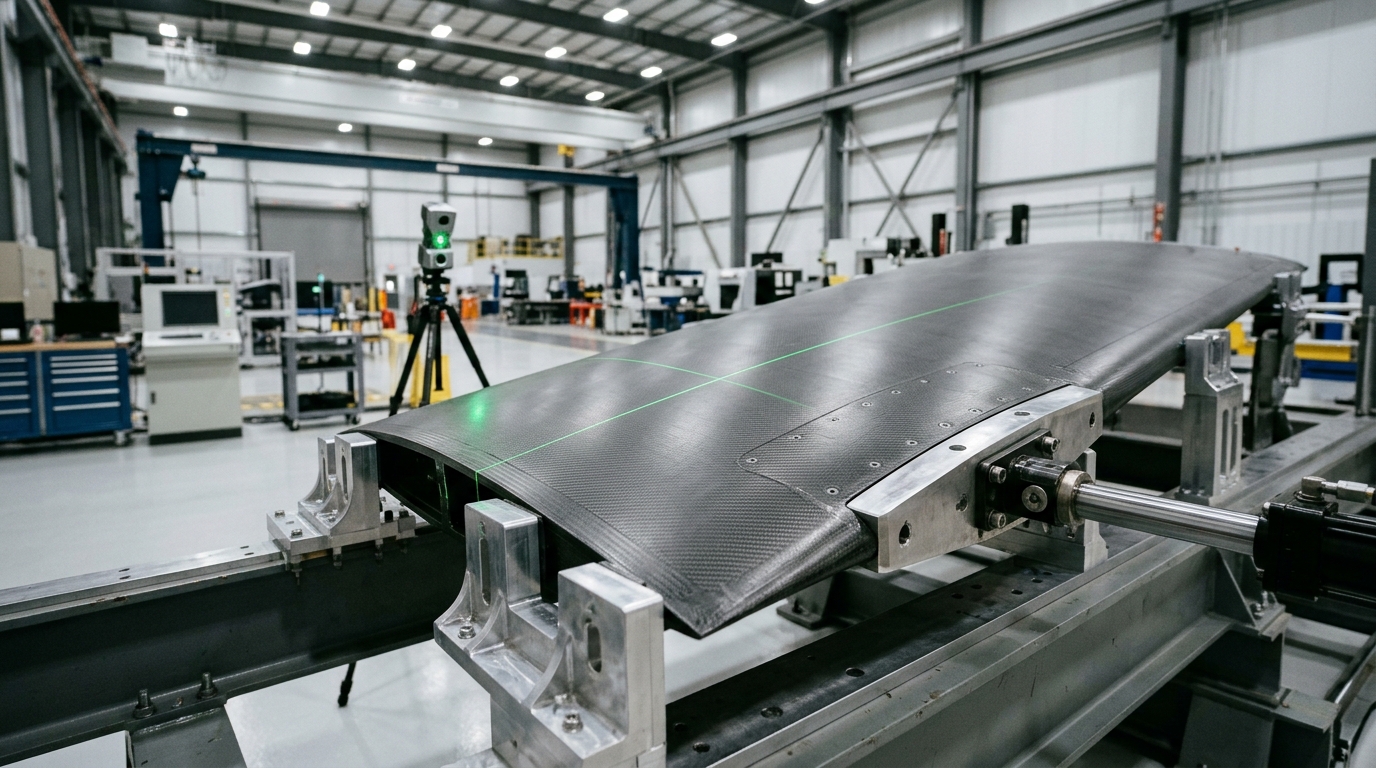
Surrogate applications in aircraft testing and manufacturing confront substantially different operational constraints, shifting focus from pure simulation speed to multi-source data fusion and real-time physical control. In flight and wind-tunnel testing, physical measurements are constrained by extreme expense, sensor noise, and sparse flight-envelope coverage. Multi-fidelity Gaussian processes, Bayesian neural networks, and physics-informed models fuse sparse wind-tunnel pressure tap readings with baseline aerodynamic simulations, optimizing flight-test planning, inferring untested extreme maneuvers, and supporting airworthiness certification frameworks. During manufacturing operations, surrogate models replace intensive thermomechanical process simulations across blank forming, composite autoclave curing, precision machining, and component assembly. Real-time surrogates predict blade stress concentrations during casting hundreds of times faster than finite element models, optimize drilling feed rates to prevent composite delamination, guide robotic positioning systems during flexible component assembly, and replace discrete-event evaluations to optimize production scheduling.
During the operational maintenance stage, surrogate models provide rapid computational evaluation for condition-based maintenance, remaining useful life estimation, and fleet-wide structural health monitoring. Surrogates map multi-axial strain and vibration sensor data to specific structural damage states, replacing iterative crack-growth algorithms with fast online predictive routines to monitor wing-spar debonding and local panel buckling. By coupling Bayesian updating and particle filtering with Co-Kriging or machine learning surrogates, maintenance engineers infer initial flaw size distributions, track load cycles under operational turbulence, and predict remaining service life for high-temperature aero-engine turbine blades. These rapid evaluations allow operators to transition from rigid, calendar-based inspection schedules to targeted, condition-based inspection intervals based on model-assisted probability of detection calculations across critical flight components.
Engineering deployment across all life-cycle phases faces three persistent technical barriers: severe data scarcity, the curse of dimensionality, and challenges in model credibility assessment. High-fidelity fluid and structural simulations remain computationally expensive, frequently restricting training datasets to tens or hundreds of discrete sample points where complex architectures risk severe overfitting. Furthermore, full aircraft parameter spaces frequently incorporate dozens to hundreds of design variables, causing sample points to become mathematically sparse and degrading nearest-neighbor distances, which necessitates rigorous space-filling designs, active learning strategies, and dimensionality reduction techniques such as principal component analysis, partial least squares, and global sensitivity screening. Simultaneously, model credibility assessment demands rigorous verification, validation, and accreditation frameworks that formally segregate aleatory physical variability from epistemic model uncertainty, establishing validated domains of applicability, tracking data provenance, and ensuring surrogate approximations satisfy airworthiness safety tolerances before supporting critical aerospace decisions.
The review concludes that future advances in aerospace surrogate modeling depend on establishing systematic frameworks for cross-stage model reuse, unified credibility protocols, and end-to-end digital integration. Rather than discarding models after isolated design tasks, transferable assets—including calibrated model weights, low-dimensional feature representations, and verified governing physics—can bridge successive life-cycle phases, such as updating structural models with physical manufacturing measurements or refining aerodynamic predictions using flight-test telemetry. Achieving this level of lifecycle continuity requires explicit input-output domain mappings, systematic tracking of operational distribution shifts, and dynamic uncertainty reassessment whenever physical conditions diverge from initial design baselines. By establishing integrated software workflows that directly link data acquisition, surrogate training, formal statistical validation, and multidisciplinary design environments, surrogate models can reliably support engineering decisions throughout the complete operational lifespan of modern aircraft.
Subject of Research: Surrogate modeling methods, applications, and challenges across the aircraft life cycle
Article Title: A review of surrogate model in aircraft life cycle: Methods, applications, and challenges
Article References: Ding, W., Hu, Y., Liu, W., Su, Y., Sun, Y., & Sun, X. (2027). A review of surrogate model in aircraft life cycle: Methods, applications, and challenges. Digital Engineering, 12, Article 100150. https://doi.org/10.1016/j.dte.2026.100150
Image Credits: AI Generated
DOI: 10.1016/j.dte.2026.100150
Keywords: surrogate models, aircraft life cycle, aerodynamic optimization, computational fluid dynamics, kriging, polynomial response surface, polynomial chaos expansions, radial basis functions, deep learning, physics-informed neural networks, neural operators, airworthiness certification, uncertainty quantification, additive manufacturing, fatigue life prediction, multidisciplinary design optimization, active learning
News Source: Denise Maddox. (November 22, 2026). Surrogate Models Transform Aviation Across Design, Testing, Manufacturing, and Maintenance Cycles. Scienmag.