Cardiac surgeons and critical care specialists at the Mayo Clinic in Jacksonville, Florida, have reported the first successful deployment of an Impella 5.5 temporary mechanical circulatory support pump to rescue a patient experiencing life-threatening outflow graft thrombosis within a durable HeartMate 3 left ventricular assist device. According to the case report published in Frontiers in Cardiovascular Medicine, this clinical strategy provided adequate hemodynamic stabilization and sustained vital organ perfusion, effectively bridging the patient to an urgent, definitive heart transplant without requiring emergent open chest exploration or extracorporeal membrane oxygenation.
Mechanical circulatory support systems have become an increasingly vital therapy for individuals diagnosed with advanced, end-stage heart failure, serving either as a permanent destination therapy or as a bridge to transplantation when suitable donor organs are unavailable. Clinical trial data, such as findings from the MOMENTUM study and device registries, indicate pump thrombosis rates of zero percent at six months and approximately 1.1 percent at twenty-four months following implantation. Nevertheless, complications such as outflow graft obstruction remain documented risks, with observed incidences ranging between one and seven percent, often triggered by extrinsic compression from biodebris accumulation or acute intraluminal thrombus formation.
The clinical presentation centered on a thirty-five-year-old male with a history of non-ischemic cardiomyopathy who had undergone HeartMate 3 implantation alongside tricuspid valve repair approximately two and a half years prior. His background was further notable for hypertension, diabetes, chronic kidney disease with a baseline estimated glomerular filtration rate of 51 milliliters per minute per 1.73 square meters, and a previous middle cerebral artery stroke with residual weakness. The patient presented to the medical center for the evaluation of persistent low-flow alarms on his assist device, despite functioning at 5,200 revolutions per minute with an initial recorded flow rate of 2.9 liters per minute and a power consumption of 3.5 watts. Notably, the patient was initially asymptomatic and showed no signs of peripheral edema or orthopnea, while actively maintaining listing status for cardiac transplantation.
Initial diagnostic evaluations, including a chest computed tomography scan, demonstrated hypoattenuation adjacent to the bend relief section of the outflow cannula, prompting immediate inpatient admission for careful hemodynamic monitoring and transplant re-evaluation. Anticoagulation therapy with parenteral bivalirudin was promptly initiated at 0.12 milligrams per kilogram per hour to manage suspected thrombus progression. Over the following eighteen days, the patient maintained clinical stability with device pulsatility indices oscillating between 3 and 4, stable hemoglobin levels, and therapeutic partial thromboplastin times. However, an echocardiogram performed on hospital day eighteen revealed eccentric left ventricular hypertrophy, rightward septal shifting, and a left ventricular internal diameter in diastole expanding to 70 millimeters, indicating progressive ventricular dilation that necessitated inotropic support with intravenous milrinone.
Comprehensive invasive hemodynamics obtained via right heart catheterization under milrinone support underscored significant underlying cardiopulmonary pressures, showing a right atrial pressure of 18 millimeters of mercury, right ventricular pressures of 54/2 millimeters of mercury, and a mean pulmonary artery pressure of 37 millimeters of mercury. Pulmonary capillary wedge pressure measured 32 millimeters of mercury, with a pulmonary artery pulsatility index of 1.5, accompanied by a resting Fick cardiac output of 7.7 liters per minute and a cardiac index of 3.4 liters per minute per square meter. Although the patient remained compensated during early hospitalization, his clinical condition deteriorated sharply on hospital day forty after he developed a fever reaching 38.1 degrees Celsius, persistent cough, and progressive shortness of breath secondary to left-sided pneumonia.
The acute systemic infection accelerated pump compromise, precipitating a catastrophic decline in HeartMate 3 flow down to 1.2 liters per minute and triggering frequent device alarms exceeding twenty episodes per day. The patient developed decompensated cardiogenic shock, with mean arterial pressures falling between 55 and 62 millimeters of mercury, requiring endotracheal intubation and broad-spectrum intravenous antibiotic coverage with meropenem. Subsequent emergency computed tomography angiography demonstrated extensive, near-occlusive hypodense filling defects within the proximal outflow graft cannula, leaving an effective residual vascular lumen of merely one to two millimeters. The severity of the obstruction produced severe hemodynamic compromise despite ongoing anticoagulation therapy and relatively normal markers of device hemolysis, such as lactate dehydrogenase levels between 184 and 211 units per liter.
Faced with progressive circulatory collapse and severe left ventricular distension, the multidisciplinary critical care, surgical, and transplant teams weighed potential mechanical rescue pathways. While veno-arterial extracorporeal membrane oxygenation is frequently utilized for rapid circulatory resuscitation, the clinicians determined that its non-physiological retrograde aortic flow would drastically elevate left ventricular afterload. In a patient already exhibiting marked ventricular dilation, severe pulmonary venous hypertension, and eccentric hypertrophy, increased afterload risked worsening left ventricular stasis and inducing refractory pulmonary edema. Furthermore, conventional surgical graft revision or emergency pump exchange via thoracotomy posed high operative morbidity and mortality due to the extensive clot burden, prompting the clinical decision to pursue minimally invasive left ventricular unloading using the Impella 5.5 catheter.
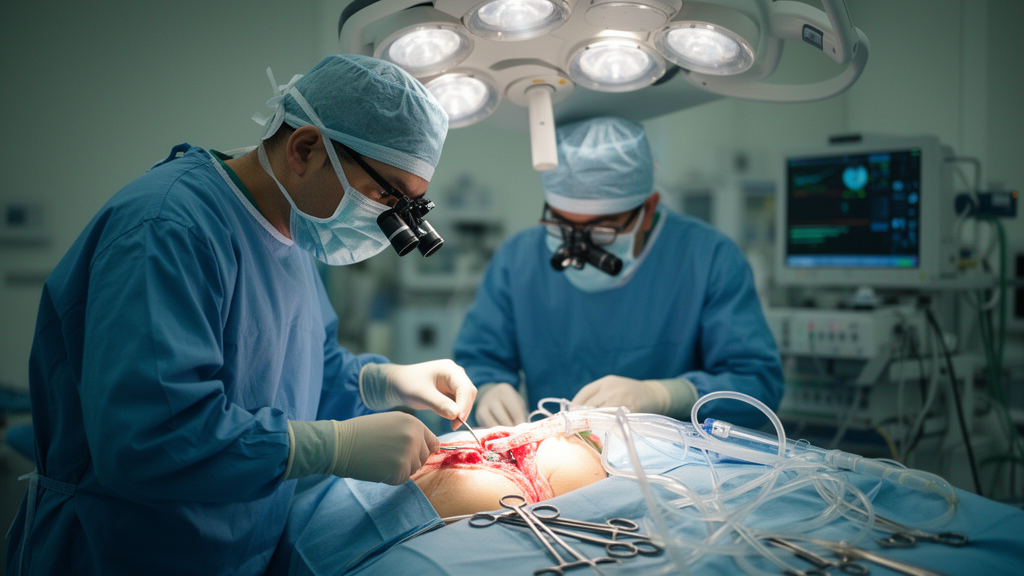
The Impella 5.5 microaxial flow pump was surgically introduced into systemic circulation across the aortic valve via a vascular graft placed through the left axillary artery. Following verified anatomical positioning, the Impella pump was initiated at the P5 performance level, delivering steady forward flow rates between 2.6 and 3.1 liters per minute while clinicians concurrently adjusted HeartMate 3 settings to deliver supplementary flow between 1.5 and 2.0 liters per minute. This strategic configuration achieved immediate hemodynamic improvement: the patient’s heart rate settled at 101 beats per minute, systemic blood pressure improved to 104/77 millimeters of mercury, central right atrial pressure decreased to 2 millimeters of mercury, mean pulmonary artery pressure declined to 24 millimeters of mercury, and mixed venous oxygen saturation normalized to 69 percent.
Renal function was preserved throughout the dual-device support phase, with estimated glomerular filtration rates stabilizing between 41 and 50 milliliters per minute per 1.73 square meters over six days of dual mechanical pumping. Due to the high ongoing thromboembolic hazard posed by the intraluminal graft clot, the patient was granted an upgrade to United Network for Organ Sharing status 1e, facilitating rapid donor organ allocation before adverse neurological or vascular sequelae could emerge.
Six days following the initiation of Impella rescue support, an appropriate donor heart became available, and the patient underwent orthotopic heart transplantation. The operative procedure was technically complex and prolonged, requiring more than twelve hours in the operating room due to dense mediastinal adhesions and severe fibrous reaction surrounding the HeartMate 3 pump and thrombosed outflow conduit. Examination of the explanted device confirmed a dense, layered thrombus severely occluding the graft interior. The patient experienced anticipated perioperative vasoplegia and bleeding requiring blood transfusions and an early mediastinal exploration for hematoma evacuation on postoperative day one. Nevertheless, inotropic support was successfully tapered by postoperative day six, leading to discharge on postoperative day fifteen with stable allograft performance, and the patient remained clinically well with preserved biventricular function six months following transplant.
Subject of Research: Dual mechanical circulatory support rescue bridging to heart transplantation
Article Title: Case Report: Rescue with Impella 5.5 after HeartMate 3 failure- a bridge to heart transplantation
Article References: Desai, A., Patel, V., Muniz, A., Bangari, L. R., Cortopassi, I., Sanghavi, D., Mergo, P., Vivek, R., Leventhal, D., Haney, J., Sareyyupoglu, B., Landolfo, K., Martin, A., Patel, P., Shapiro, A., & Goswami, R. (2026). Case Report: Rescue with Impella 5.5 after HeartMate 3 failure- a bridge to heart transplantation. Frontiers in Cardiovascular Medicine, 13, Article 1947199. https://doi.org/10.3389/fcvm.2026.1947199
Image Credits: AI Generated
DOI: 10.3389/fcvm.2026.1947199
Keywords: cardiology, mechanical circulatory support, HeartMate 3, Impella 5.5, heart transplantation, cardiogenic shock, ventricular assist device, thrombosis, Case, Report, Rescue, Impella
News Source: Ophelia Keating. (November 12, 2026). Surgeons Stabilize Failing Left Ventricular Assist Device Using Impella Rescue Pump. Scienmag.