Cardiac surgeons have reported the successful management of recurrent prosthetic valve endocarditis involving an aortoventriculoplasty patch through a complex redo Konno procedure combined with full aortic root replacement in a twenty-one-year-old male patient. The Konno surgery, initially described in 1975 to achieve annular enlargement during aortic valve replacement and avert patient-prosthesis mismatch in pediatric patients, relies on an aortoventriculoplasty patch alongside a right ventricular outflow patch. While long-term outcomes after initial Konno operations show overall survival rates of 91.9 percent at ten years and 87.7 percent at fifteen years, the requirement for reoperation remains constant over time, with freedom from aortic reoperation documented at 81 percent at five years and 61 percent at ten years. Most reoperations reported in surgical literature stem from structural complications such as paravalvular leakage, aneurysmal dilatation, or patch degeneration, leaving the management of infective endocarditis involving the patch complex rarely documented.
The patient had a documented history of multiple aortic valve interventions beginning in early childhood. At five years of age, he underwent mechanical aortic valve replacement using a 19-millimeter SJM Regent valve to treat congenital aortic regurgitation. Because of subsequent clinically significant prosthesis-patient mismatch, surgeons performed a Konno-aortic valve replacement when he was fifteen years old, implanting a 23-millimeter On-X mechanical valve and utilizing equine pericardium from Xenomedica as a reconstruction patch. Transthoracic echocardiography during the following year identified perivalvular leakage, leading to a redo Konno-aortic valve replacement with another 23-millimeter On-X mechanical valve. Despite this intervention, a residual perivalvular leak persisted, accompanied by progressive enlargement of the ascending aorta.
At nineteen years of age, the patient developed prosthetic valve endocarditis caused by an indolent infection with Propionibacterium acnes, which clinical teams treated medically using intravenous penicillin G at a dosage of 24,000 units per day for sixty days. Two years later, at age twenty-one, he suffered a relapse of Propionibacterium acnes prosthetic valve endocarditis complicated by a right subdural hemorrhage that prompted urgent referral for multidisciplinary perioperative management. The intracranial hematoma required emergency decompressive craniotomy, which resolved without residual neurological sequelae. Preoperative transthoracic echocardiography revealed mild left ventricular dilatation, characterized by a left ventricular end-diastolic diameter of 57 millimeters and an end-systolic diameter of 34 millimeters, alongside severe perivalvular leakage identified at the 2, 7, and 10 o’clock positions of the valve annulus.
Preoperative assessments documented preserved left ventricular contraction with an ejection fraction of 70 percent, sinus rhythm on electrocardiography, and clear lung fields without signs of congestive heart failure on chest radiography. Computed tomography demonstrated persistent dilatation of the ascending aorta reaching a maximum diameter of 47 millimeters. Following decompressive craniotomy and negative blood cultures, the surgical team scheduled definitive reoperation sixteen weeks after achieving sterile cultures. Although ascending aortic enlargement was present, aortic dilatation alone was not the primary indication for total root replacement; the initial operative plan considered redo Konno surgery paired with concomitant replacement of the ascending aorta.
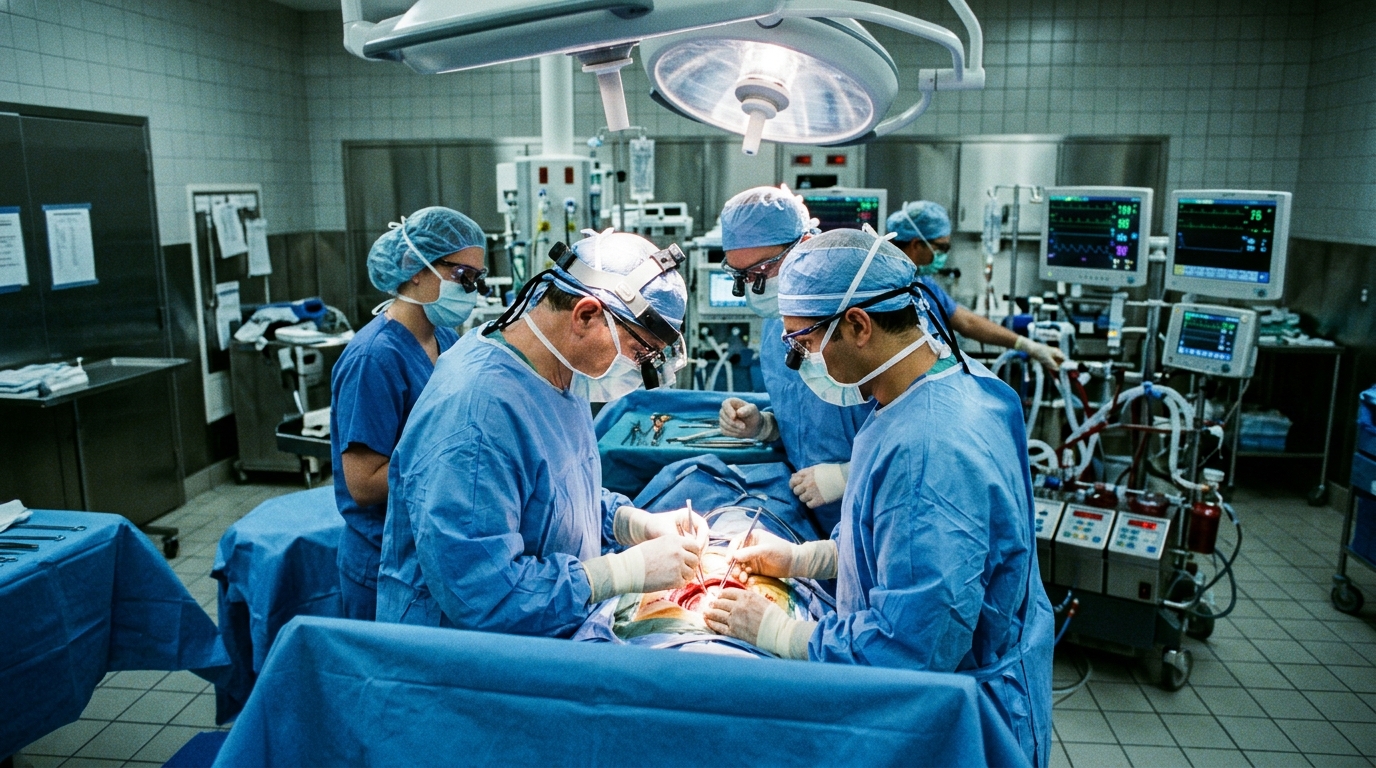
Surgical intervention commenced under general anesthesia with the patient positioned supine. To institute cardiopulmonary bypass, surgeons anastomosed a 7-millimeter J-Graft Shield to the right axillary and femoral arteries and cannulated the femoral vein, followed by re-sternotomy and extensive adhesiolysis across the anterior myocardium and great vessels. An additional venous drainage cannula was placed into the superior vena cava. Following aortic cross-clamping, antegrade cardioplegia induced intentional temporary cardiac arrest. An oblique incision made in the ascending aorta just distal to the prior patch revealed active vegetation adhering directly to the previous aortic patch material, while the mechanical valve leaflets themselves remained free of vegetations despite partial detachment from the valve annulus.
Because the intraoperative inspection proved that bacterial infection extended beyond the prosthetic valve itself into the aortoventriculoplasty patch complex, relying solely on standard valve re-replacement through an aortic incision was deemed insufficient to eliminate deep subvalvular and septal infectious foci. The surgical team detached the prosthetic valve, removed all residual sewing cuffs and suture materials, and completely excised both the aortic and right ventricular outflow tract patches to obtain direct visualization of the conus arteriosus. Direct inspection revealed sclerosis and degenerative changes within the interventricular septum patch, which was completely resected to eradicate all infected foreign material and anatomical remnants.
Reconstruction of the excised interventricular septum was accomplished by fashioning a patch from doubly folded fresh autologous pericardium to ensure structural integrity and mechanical reinforcement in a high-pressure zone. Root replacement proceeded using a composite graft combining a 26-millimeter Gelweave straight Dacron woven tube with a 22-millimeter ATS open pivot standard mechanical heart valve anchored to the neoaortic annulus. The surgeons reconstructed the conduit-side suture line of the right ventricular outflow tract with fresh autologous pericardium prior to cross-clamp release, recognizing that exposure in that region would become technically restricted once aortic flow resumed.
Systemic hypothermia was induced to achieve a core temperature of 25 degrees Celsius, enabling circulatory arrest and distal graft anastomosis to the proximal aortic arch under selective cerebral perfusion. Following connection of the distal arch graft to the composite root conduit, cross-clamp release allowed the spontaneous restoration of cardiac rhythm. The anterior seam of the right ventricular patch was then completed with autologous pericardium under direct visualization of the pulmonary valve and conus arteriosus, verifying the absence of residual right ventricular outflow tract stenosis. Hemostasis was secured, and chest closure was completed without requiring mechanical circulatory assistance after an operative duration of 17 hours and 7 minutes and a clamp time of 5 hours and 56 minutes.
Postoperative management confirmed clinical and hemodynamic stabilization, with intraoperative cultures of all resected prosthetic materials yielding negative microbial growth. Transthoracic echocardiography verified complete resolution of the perivalvular leak, normal prosthetic valve function, and favorable reverse remodeling with decreased left ventricular end-diastolic dimensions, while postoperative computed tomography confirmed the absence of pseudoaneurysms. Intravenous antimicrobial therapy consisting of ampicillin and sulbactam at 12 grams daily was administered for six weeks postoperatively, followed by oral clindamycin maintenance at 900 milligrams daily, allowing the patient to achieve an uneventful recovery and complete discharge home on postoperative day 42.
In evaluating the operative approach, the authors emphasized that complete excision of all indwelling prosthetic patches combined with composite root replacement provides superior clearance of infection compared to localized re-replacement when indolent organisms like Propionibacterium acnes colonize complex reconstruction patches. Although Propionibacterium acnes endocarditis is infrequent, it predominantly targets prosthetic apparatuses, carries high rates of invasive tissue destruction including valvular dehiscence in 33 percent of cases and perivalvular abscesses in 46 percent, and often presents subtle diagnostic signs. Utilizing doubly layered fresh autologous pericardium balanced pliable three-dimensional anatomical reconstruction with low calcification potential and infection resistance, demonstrating that redo Konno root replacement can serve as an effective definitive procedure for patients facing persistent prosthetic infections after childhood aortic surgery.
Beyond addressing active infection, the clinical team’s decision to pursue composite root replacement rather than localized valve re-implantation was driven by the compromised state of the native aortic annulus. Repeated surgical interventions and recurrent paravalvular leakage had left the surrounding annular tissue structurally fragile, even though gross annular destruction was absent. Under these anatomical conditions, anchoring another prosthetic valve directly onto previously manipulated annular tissue carried substantial mechanical risks. Furthermore, relying solely on an anterior aortic incision would have severely restricted direct inspection of the subvalvular apparatus and the septal reconstruction patch. Complete excision of the right ventricular patch provided an unobstructed operative view of both the root funnel and the conus arteriosus, though the authors emphasized that extending incisions from the right ventricular infundibulum into the outflow tract demands meticulous care to avoid accidental injury to the pulmonary valve.
The selection of patch material represented another critical technical consideration in an infected reoperative field. Glutaraldehyde-treated pericardium is widely utilized in cardiac reconstructions, but it carries well-documented risks of late calcific degeneration and diminished tissue pliability over time. In contrast, fresh autologous pericardium demonstrates high durability, superior pliability, and a remarkably low incidence of calcification even when implanted in high-pressure cardiac zones such as reconstructed roots, aortic valve cusps, and mitral valve cusps. In addition, its excellent hemostatic properties make it exceptionally well suited for complex re-do operations that demand prolonged operative times. While untreated autologous tissue carries theoretical concerns regarding late dilatation or aneurysmal expansion, folding the fresh pericardium into a doubly layered patch reinforced mechanical strength while preserving the three-dimensional flexibility necessary for secure anatomical reconstruction.
The case report also highlights the broader clinical role of root replacement during re-do Konno procedures following childhood aortic interventions. Although pediatric surgeons have observed promising results with the Ross-Konno procedure, which accommodates somatic annular growth without necessitating lifelong anticoagulation, selecting suitable candidates for subsequent reoperations remains clinically challenging. Konno surgery paired with root replacement serves as a viable, versatile reoperative strategy following various previous aortic procedures, particularly when infectious processes or abscesses extend into the interventricular septum. Given that Propionibacterium acnes endocarditis carries an embolic complication rate of 17 percent alongside frequent structural dehiscence, aggressive radical debridement is essential. Furthermore, replacing the entire root eliminates future risks of ascending aortic dissection and progressive aneurysm formation, establishing a stable foundation for long-term survival in patients with complex prosthetic valve endocarditis.
Subject of Research: Surgical management of prosthetic valve endocarditis involving an aortoventriculoplasty patch
Article Title: Re-do Konno procedure and aortic root replacement for prosthetic valve endocarditis involving the aorto-ventriculoplasty patch: a case report
Article References: Nomura, H., Katahira, S., Itagaki, K., Ito, K., Takahashi, G., Kumagai, K., & Saiki, Y. (2026). Re-do Konno procedure and aortic root replacement for prosthetic valve endocarditis involving the aorto-ventriculoplasty patch: a case report. General Thoracic and Cardiovascular Surgery Cases, 5(1), Article 28. https://doi.org/10.1186/s44215-026-00263-4
Image Credits: AI Generated
DOI: 10.1186/s44215-026-00263-4
Keywords: Konno procedure, aortic root replacement, prosthetic valve endocarditis, aortoventriculoplasty patch, Propionibacterium acnes, cardiac surgery, autologous pericardium, perivalvular leak, reoperation, aortic valve replacement, subdural hematoma, interventricular septum, right ventricular outflow tract, case report, mechanical heart valve, congenital heart disease
News Source: Ophelia Keating. (November 13, 2026). Surgeons Perform Redo Konno Procedure and Root Replacement for Infected Cardiac Patch. Scienmag.