Surgeons have completed the first documented robotic pancreaticoduodenectomy using the Hugo Robotic-Assisted Surgery platform, carrying out the full resection and reconstruction phases without conversion to open surgery or device-related adverse events. Pancreaticoduodenectomy, commonly known as the Whipple procedure, represents one of the most technically demanding operations within hepatopancreatobiliary surgery due to complex vascular relationships and delicate anastomotic requirements. While robotic platforms have increasingly entered advanced abdominal surgery to enhance visualization, dexterity, and ergonomics, the recently introduced Hugo system had not previously been documented in medical literature for this extensive procedure. Reporting in the journal Innovative Surgical Trends, the surgical team detailed the complete operational setup, robotic port mapping, multi-arm docking strategy, and patient recovery following the intervention. The successful completion of the operation established initial technical feasibility and perioperative safety for the modular robotic platform during complex pancreatic resection, yielding an uncomplicated postoperative course without high-priority system alarms, intraoperative blood transfusions, or hemodynamic instability.
The surgical candidate was a thirty-eight-year-old functionally independent patient whose prior medical background was notable for transthyretin familial amyloid polyneuropathy managed with tafamidis, alongside chronic gastroesophageal reflux disease. An esophagogastroduodenoscopy performed to investigate worsening reflux symptoms revealed a distinct submucosal tumor lesion measuring slightly over two centimeters within the second portion of the duodenum. Subsequent endoscopic ultrasound demonstrated that the mass originated from the fourth layer of the duodenal wall, positioned directly along the pancreatic border where it involved the major duodenal papilla and closely abutted the uncinate process of the pancreas. Contrast-enhanced computed tomography scanning of the chest, abdomen, and pelvis confirmed the absence of distant metastases or regional lymphadenopathy, while fine-needle aspiration cytology corroborated clinical suspicion of a gastrointestinal stromal tumor. The anatomical confinement of the lesion to the periampullary region established clear diagnostic parameters for surgical intervention while presenting significant technical challenges regarding operative planning and organ preservation.
Surgical management of gastrointestinal stromal tumors prioritizes complete macroscopic excision with histologically negative microscopic margins, known as an R0 resection, while omitting routine extensive lymphadenectomy because nodal involvement is exceedingly uncommon. In many duodenal presentations, surgeons pursue organ-preserving procedures such as local transduodenal excision, wedge resection, or pancreas-sparing duodenectomy to avoid the extensive morbidity associated with full pancreaticoduodenectomy. However, when duodenal tumors arise along the pancreatic aspect of the second portion and intimately involve the major papilla or uncinate process, conservative organ-sparing approaches carry severe risks of common bile duct or pancreatic duct transection, compromised margins, and technically fraught reconstructions. The multidisciplinary tumor board evaluated these anatomical limitations, concluding that local excision would require ampullectomy and intricate ductal reimplantation without guaranteeing negative margins. Consequently, the board recommended formal pancreaticoduodenectomy as the definitive approach to safely secure complete tumor clearance and ensure oncological adequacy while preventing irreversible ductal disruption.
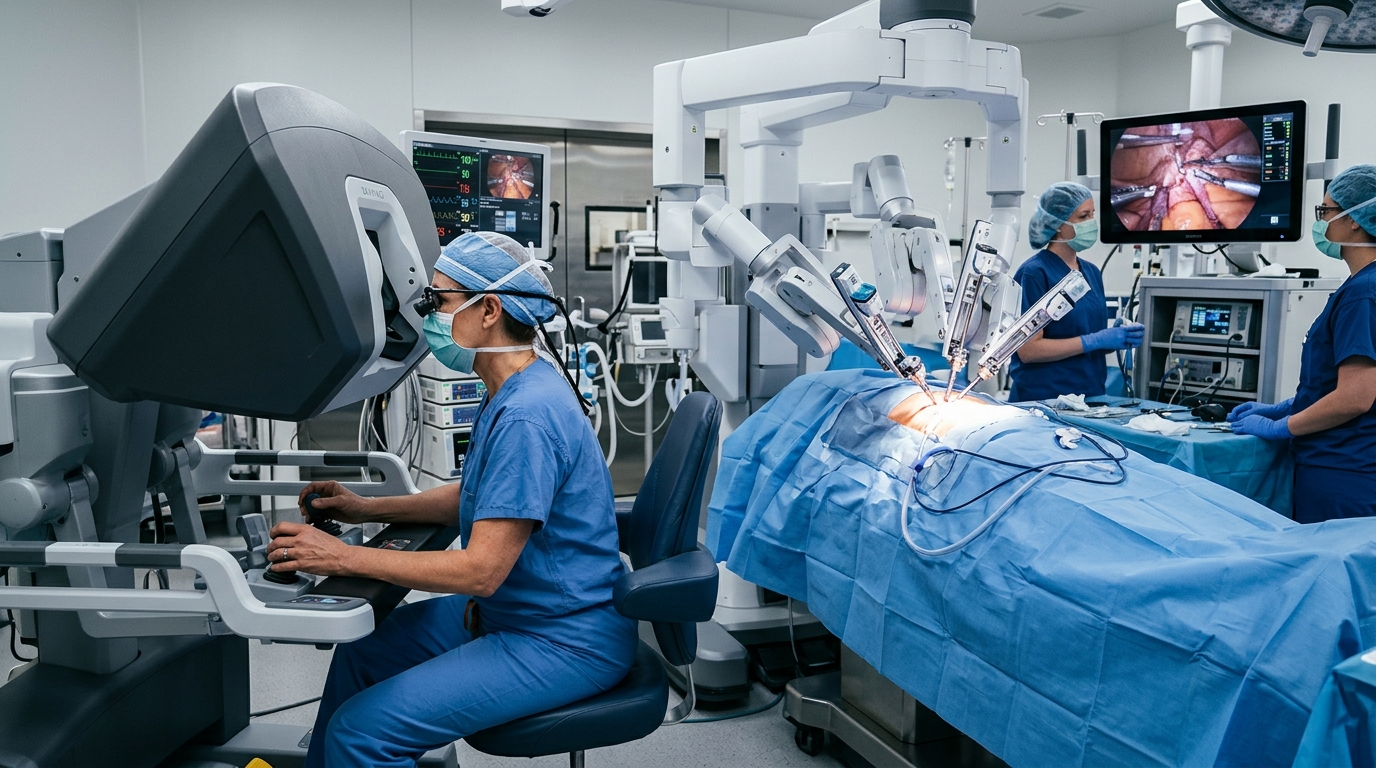
The operating surgical service possessed cumulative experience exceeding eight hundred procedures conducted with the Hugo robotic platform since introducing the system in March 2023, following its European Conformité Européenne general surgery clearance in October 2022. The institution’s upper gastrointestinal surgical division had completed nearly two hundred robotic cases, predominantly consisting of bariatric and complex gastric interventions, while the lead surgeon brought established expertise in open and laparoscopic hepatobiliary techniques. Prior to attempting a fully robotic Whipple operation, the team successfully validated procedural steps through a hybrid approach combining laparoscopic resection with robotic reconstruction. The Hugo system itself features a modular architecture comprising an open three-dimensional high-definition console, a central system tower, and four independently positioned mobile arm carts that allow customized operating room configurations. The platform also integrates the Touch Surgery Enterprise ecosystem, facilitating high-resolution digital video capture and intraoperative analytics to monitor operative performance throughout lengthy surgical workflows.
Patient positioning and robotic trocar placement followed a standardized upper abdominal configuration developed through the team’s high-volume bariatric and gastrointestinal operations, maintaining identical dock alignments throughout all procedural phases. Robotic instrumentation installed across the individual arm carts included an optical three-dimensional endoscope, monopolar curved shears, bipolar Cadiere forceps, and standard Cadiere forceps, while the bedside assistant port accommodated a powered stapling system, metallic clips, endoscopic applicators, and smoke evacuation filtration. The primary surgeon operated from the open console without utilizing advanced energy devices, relying entirely on precise mechanical dissection and electrosurgery. Operative workflow commenced with a comprehensive laparoscopic exploration of the peritoneal cavity, which verified the complete absence of ascites, macroscopic peritoneal carcinomatosis, or metastatic hepatic nodules. Systematic dissection of the hepatic hilum followed, during which the proper hepatic artery and its right and left bifurcations were identified and looped with vessel tapes before ligating the right gastric and gastroduodenal arteries.
Dissection proceeded along the biliary tree, where the common bile duct was mobilized, the cystic duct securely ligated, and a concurrent cholecystectomy executed to expose the underlying suprapancreatic structures. The portal vein was carefully visualized and dissected to establish a retropancreatic vascular tunnel beneath the neck of the pancreas, achieving complete proximal and distal vascular control over the mesenteric axis. Surgeons transected the common bile duct sharply using cold division techniques and placed an atraumatic temporary vascular clamp across the proximal stump to prevent bile leakage into the operative field until subsequent reconstruction. The stomach was transected proximally and the initial loop of proximal jejunum divided using a powered linear surgical stapler loaded with purple vascular cartridges. Hemostatic control of marginal pancreatic arcade vessels was accomplished using synthetic absorbable monofilament sutures, followed by parenchymal transection through the pancreatic neck utilizing monopolar electrosurgical scissors to clearly visualize and preserve the main pancreatic duct of Wirsung.
Following parenchymal division, the surgical team completed a formal Cattell-Braasch mobilization maneuver, rotating the ascending colon and right mesocolon medially to permit complete retroperitoneal exposure and facilitate en bloc specimen extraction without capsular breach. Overall operative metrics reflected steady surgical progression across the multi-step intervention, with total procedure duration measuring five hours and forty minutes. Robotic console time accounted for five hours and fourteen minutes, while initial docking of the four independent robotic arm carts required four minutes and thirty-five seconds. The resection phase occupied two hours and forty-five minutes, whereas the complex digestive reconstruction required two hours and twenty-nine minutes. Cumulative estimated blood loss totaled two hundred milliliters, and the operative team required no blood product transfusions, intraoperative vasopressor support, or emergent patient repositioning. Throughout the entire operative duration, the robotic system registered zero high-priority platform alarms, mechanical failures, or arm collisions that would compromise patient safety.
Digestive reconstruction was performed entirely within a Roux-en-Y configuration to reconstitute pancreatic, biliary, and gastric drainage into the alimentary tract without cross-contamination. Pancreatic continuity was established first via an end-to-side duct-to-mucosa pancreatojejunostomy positioned against the isolated jejunal limb, utilizing fine non-absorbable interrupted sutures placed circumferentially around a normal-caliber main pancreatic duct. This delicate anastomosis was constructed over an internal twenty-two-gauge temporary angiocatheter stent to guide accurate ductal alignment, reinforced by continuous seromuscular capsule sutures that minimized tissue tension. Approximately ten to fifteen centimeters distal to the pancreatic junction, an end-to-side hepaticojejunostomy was created through a precise enterotomy along the antimesenteric border, fashioned as a single-layer hand-sewn anastomosis with continuous absorbable monofilament sutures along the posterior and anterior mucosal walls. Finally, a semi-mechanical antecolic gastrojejunostomy was constructed sixty centimeters downstream from the biliary anastomosis, closing the enterotomy with barbed absorbable sutures and positioning closed-suction drainage catheters adjacent to both primary anastomoses.
The patient experienced a favorable immediate recovery, permitting extubation inside the operating suite before transfer to the intermediate care unit for continuous physiological monitoring. After two uneventful days of step-down surveillance without hemodynamic fluctuations, the patient transitioned to the general surgical ward, where oral liquid nutrition was initiated on postoperative day four. Clinical parameters progressed steadily without signs of systemic inflammation, and the patient was discharged home on postoperative day seven. Objective postoperative evaluations adhered to standard criteria established by the International Study Group of Pancreatic Surgery, confirming the complete absence of clinically relevant postoperative pancreatic fistula formation or delayed gastric emptying. Furthermore, routine outpatient monitoring throughout the mandatory thirty-day follow-up window documented no surgical site infections, delayed hemorrhage, secondary intra-abdominal fluid collections, or emergency hospital readmissions, validating that the initial perioperative pathway successfully replicated standard accelerated recovery milestones established for minimally invasive pancreaticoduodenectomy.
Pathological evaluation of the resected specimen confirmed successful oncological eradication, describing a well-circumscribed, solid, whitish-gray nodular mass measuring 1.8 by 1.4 by 1.4 centimeters that expanded into the pancreatic parenchyma without true histological invasion. Microscopic examination identified a gastrointestinal stromal tumor of mixed morphology, demonstrating predominantly spindle cell architecture interspersed with focal epithelioid regions, classified as histological Grade 1 with a mitotic rate of five or fewer mitoses per five square millimeters. The final pathological stage was documented as pT1 N0, with all ten examined regional lymph nodes confirmed negative for malignant involvement. Surgical margins achieved complete R0 clearance across all measured anatomical boundaries, including an eight-centimeter clearance from the proximal common hepatic duct, three centimeters from the pancreatic parenchymal transection line, three centimeters from the mesenteric venous groove, and two millimeters of microscopic clearance from the critical posterior superior mesenteric artery retroperitoneal margin.
Subject of Research: Robotic pancreaticoduodenectomy using the Hugo RAS system for duodenal gastrointestinal stromal tumor
Article Title: First reported robotic pancreaticoduodenectomy using the Hugo™ RAS system: feasibility and safety
Article References: Mesquita, I., Correia, T. F., Marcos, M., Santos, J., & Soares, P. (2026). First reported robotic pancreaticoduodenectomy using the Hugo™ RAS system: feasibility and safety. Innovative Surgical Trends, 2(1), Article 3. https://doi.org/10.1007/s44414-026-00013-7
Image Credits: AI Generated
DOI: 10.1007/s44414-026-00013-7
Keywords: Robotic Pancreaticoduodenectomy, Hugo RAS System, Whipple Procedure, Duodenal GIST, Gastrointestinal Stromal Tumor, Duct-to-Mucosa Anastomosis, Pancreatojejunostomy, Hepaticojejunostomy, Gastrojejunostomy, Minimally Invasive Surgery, Surgical Robotics, R0 Resection, Oncological Surgery, Postoperative Pancreatic Fistula, Cattell-Braasch Maneuver, Surgical Innovation
News Source: Ophelia Keating. (November 18, 2026). Surgeons Complete First Robotic Pancreaticoduodenectomy Using Hugo System Without Complications. Scienmag.