In a comprehensive clinical evaluation examining periodontal plastic surgery outcomes, researchers at Shanghai Jiao Tong University School of Medicine demonstrated that surgeon experience level significantly governs clinical efficacy and surgical efficiency in root coverage procedures for RT1 gingival recession. Analyzing 304 patients encompassing 1,020 treated teeth, the retrospective study revealed that senior periodontal surgeons with over five years of surgical experience achieved a significantly superior percentage of root coverage and greater clinical attachment gains compared to less experienced clinicians. Conversely, esthetic evaluations quantified through the root coverage esthetic score showed no significant differences among experience cohorts, indicating that soft-tissue esthetic integration remains comparable across career stages.
This progressive defect frequently causes esthetic concerns, dentin hypersensitivity, plaque retention, and an elevated vulnerability to cervical root caries. To address these problems, clinicians deploy root coverage procedures, a collective term for periodontal plastic surgeries aimed at restoring the receded gingival margin coronally toward the crown and maximizing exposed root surface coverage. Widespread adoption of these techniques has prompted an increasing number of practitioners to perform surgical treatments for recession defects. While previous studies have examined prognostic variables—categorized into patient-related factors, tooth-related anatomy, and treatment-related elements such as connective tissue grafting, root surface treatment, and flap tension control—the independent impact of surgeon experience level on surgical outcomes has seldom been systematically evaluated, often remaining obscured by subjective characterizations. In earlier literature, Ozcan and colleagues evaluated the initial forty coronally advanced flaps performed by a periodontology resident, reporting that surgeon experience significantly influenced clinical and esthetic outcomes, surgical duration, and the incidence of surgical complications.
To evaluate operator performance across established mucogingival techniques, the authors examined three distinct surgical approaches: the classic coronally advanced flap, the envelope coronally advanced flap, and the vestibular incision subperiosteal tunnel access technique. The classic coronally advanced flap, introduced by Bernimouli and colleagues in 1975, uses vertical releasing incisions to enhance surgical visualization, ease flap elevation, and facilitate tension-free coronal advancement. To enhance gingival flap stability during healing and improve long-term outcomes, Langer and Langer proposed combining flaps with autologous connective tissue grafts, which remains the recognized gold standard for managing recession defects. To avoid vertical scars, Zucchelli and collaborators introduced the envelope coronally advanced flap, relying on horizontal dissection to sever submucosal connective tissue fibers. Meanwhile, to minimize surgical trauma and preserve interdental papillae, researchers developed tunneling strategies, culminating in the vestibular incision subperiosteal tunnel access technique proposed by Zadeh in 2011, which employs vestibular incisions to facilitate instrument access while sparing marginal tissues.
The investigation followed the Strengthening the Reporting of Observational Studies in Epidemiology reporting guidelines, analyzing consecutive patients who underwent root coverage surgery between January 2022 and December 2024 at the Ninth People’s Hospital Department of Periodontology. Eligible participants were systemically healthy adults aged 18 to 65 years presenting at least one tooth with RT1 recession who had not received periodontal surgery within the prior 24 months. Participants completed comprehensive initial periodontal therapy before enrollment, exhibiting plaque scores under 20%, bleeding on probing scores under 20%, and no calculus on target or adjacent teeth. Exclusion criteria eliminated patients with uncontrolled oral mucosal diseases, maxillofacial bone lesions, non-carious cervical lesions, endodontic conditions, or dental restorations. Pregnant or lactating women, individuals unable to cooperate, and patients with severe smoking habits exceeding 10 cigarettes daily or alcohol abuse were also excluded.
Operating periodontal surgeons held valid medical practitioner certificates and completed comprehensive theoretical courses on mucogingival surgery along with model-based training. Surgeons were categorized into three groups matching the regional physician title structure. Group A included resident trainees with two or fewer years of surgical experience who had completed at least 10 root coverage procedures prior to study enrollment. Group B comprised residents with more than two but no more than five years of experience who had performed at least 20 qualifying procedures. Group C consisted of attending physicians with over five years of surgical experience who had executed at least 50 root coverage operations before the study. At baseline, keratinized gingiva width across Groups A, B, and C measured 2.15 ± 1.48 mm, 2.06 ± 1.28 mm, and 2.12 ± 1.26 mm, while gingival margin positions were -2.86 ± 1.42 mm, -2.90 ± 1.34 mm, and -2.85 ± 1.18 mm, respectively, with baseline clinical attachment levels measuring 4.01 ± 1.50 mm, 4.22 ± 1.49 mm, and 3.98 ± 1.26 mm.
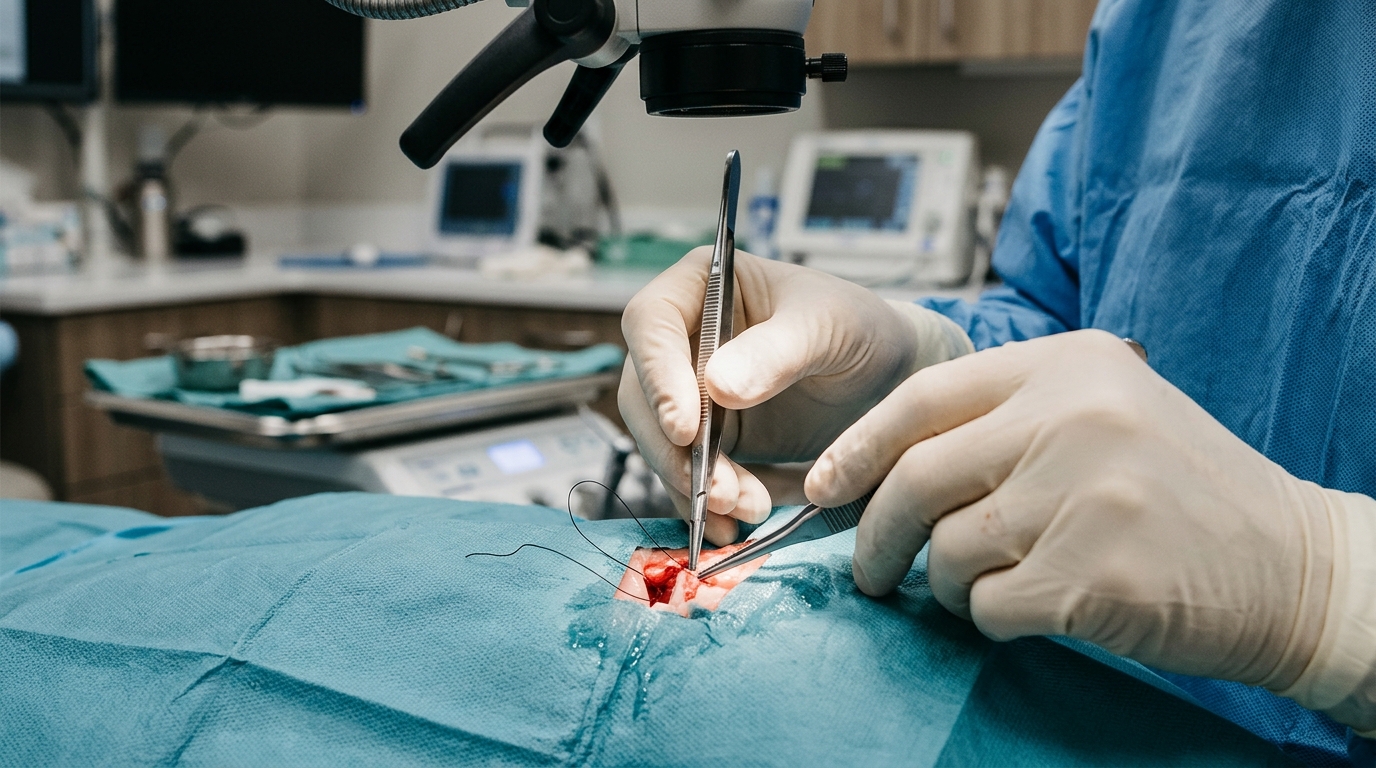
Surgical procedures were standardized across all arms, with every patient receiving an autologous connective tissue graft harvested from the ipsilateral maxillary palate, three millimeters apical to the gingival margin. Donor grafts were prepared to uniform dimensions of 5 mm in width, 1.0 to 1.5 mm in thickness, and sufficient length to cover exposed roots completely. The palatal donor site was protected with a collagen sponge and sutured, while the surgical flap was coronally positioned to ensure complete graft coverage and pursue maximum root coverage. Postoperative care required patients to rinse twice daily with 0.12% chlorhexidine gluconate solution for two weeks. Pain was managed with ibuprofen at 500 mg per dose as needed with a four-hour minimum interval, while systemic amoxicillin was prescribed at 500 mg three times daily for seven consecutive days, with sutures removed at two weeks.
Clinical measurements were conducted by two calibrated examiners who demonstrated high reproducibility in pre-study calibration trials on 10 recession defects across 10 patients evaluated at one-week intervals. Intraexaminer intraclass correlation coefficients reached 0.934 and 0.921, while interexaminer coefficients were 0.828 and 0.897, surpassing the accepted 0.80 calibration threshold. Periodontal parameters were recorded at baseline and six months post-surgery, assessing plaque index, bleeding index, probing depth, keratinized gingiva width, gingival margin position, and clinical attachment level. Primary outcome measures included surgical duration, percentage of root coverage, the root coverage esthetic score, and the mucosal scar index, which evaluates scar shape and size. Secondary outcomes tracked changes in keratinized tissue width, probing depth, and attachment gains across the six-month follow-up period.
To account for clustering and intrapatient correlation from multiple teeth within individual subjects, between-group comparisons were conducted using generalized estimating equations with an exchangeable correlation structure. The generalized estimating equations utilized patient identifiers as the clustering unit to adjust for correlation among multiple teeth within the same mouth. Post hoc pairwise comparisons utilized Bonferroni corrections to adjust for multiple testing and control Type I error rates. The multivariable regression model incorporated patient age, sex, tooth location, baseline keratinized tissue width, baseline gingival margin position, baseline clinical attachment level, and surgical technique as covariates. Statistical analysis indicated that patient age, sex, tooth location, baseline keratinized tissue, and baseline attachment level exerted no significant effect on primary or secondary outcomes. However, baseline gingival margin position significantly influenced root coverage percentage and esthetic scores at six months (p < 0.0001), while surgical technique significantly affected root coverage, esthetic scores, mucosal scar formation, and operative duration (p < 0.05).
The study analyzed 304 patients (97 males and 207 females; mean age 35.07 ± 7.69 years) with 1,020 treated teeth, including 107 treated with coronally advanced flap and graft, 515 with envelope flap and graft, and 398 with the vestibular tunnel technique and graft. At six months post-surgery, all experience groups showed significant gains in keratinized gingiva width, gingival margin coronal repositioning, and attachment gain compared to baseline (p < 0.0001). However, attending surgeons in Group C achieved significantly lower postsurgical clinical attachment levels (1.20 ± 0.42 mm) than resident surgeons in Group A (1.74 ± 1.02 mm) and Group B (1.47 ± 0.76 mm) (p < 0.0001). Overall root coverage percentage in Group A (89.71 ± 25.18%) was significantly lower than in Group B (96.34 ± 11.91%, p = 0.0117) and Group C (96.34 ± 10.95%, p < 0.0001). Operative duration decreased significantly as surgical experience increased (p < 0.0001), whereas root coverage esthetic scores did not differ significantly among the three groups.
Technique-specific analyses highlighted distinct differences in procedural sensitivity, providing actionable insights for surgical training and clinical practice. For the coronally advanced flap, novice surgeons in Group A demonstrated significantly higher mucosal scar index values (3.56 ± 1.61) than Group B (0.97 ± 1.96, p = 0.0024) and Group C (0.38 ± 1.14, p = 0.0012), reflecting technical difficulty in suturing vertical incisions precisely. For the envelope technique, root coverage in Group A was 85.33 ± 28.81%, significantly below Group B (97.43 ± 9.00%) and Group C (94.93 ± 13.03%), as the lack of vertical cuts impairs visibility and flap tension management for inexperienced operators. In the tunnel approach, mean operative duration for novice surgeons reached 69.31 ± 2.87 minutes compared to 58.17 ± 6.84 minutes for coronally advanced flaps, indicating heightened procedural caution that may prolong patient discomfort. Acknowledging limitations including retrospective design, lack of randomization, unrecorded daily cigarette consumption, and absent a priori power calculations, the authors recommend the coronally advanced flap with connective tissue graft for less experienced surgeons, while reserving envelope and tunnel techniques for experienced practitioners.
Subject of Research: Impact of surgeon experience on clinical and esthetic outcomes of root coverage procedures for RT1 gingival recession
Article Title: Impact of surgeon experience level on outcomes of three different root coverage procedures for RT1 gingival recession
Article References: Sun, W., Dong, J., Sun, M., Liao, Y., & Song, Z. (2026). Impact of surgeon experience level on outcomes of three different root coverage procedures for RT1 gingival recession. Maxillofacial Plastic and Reconstructive Surgery, 48(1), Article 16. https://doi.org/10.1186/s40902-026-00514-y
Image Credits: AI Generated
DOI: 10.1186/s40902-026-00514-y
Keywords: RT1 gingival recession, root coverage procedures, surgeon experience, coronally advanced flap, envelope coronally advanced flap, VISTA technique, connective tissue graft, percentage of root coverage, clinical attachment level, root coverage esthetic score, mucosal scar index, surgical duration, keratinized gingiva width, periodontal plastic surgery, probing depth, generalized estimating equations, palatal donor site
News Source: Ophelia Keating. (November 18, 2026). Surgeon Experience Level Improves Root Coverage and Shortens Operative Duration. Scienmag.