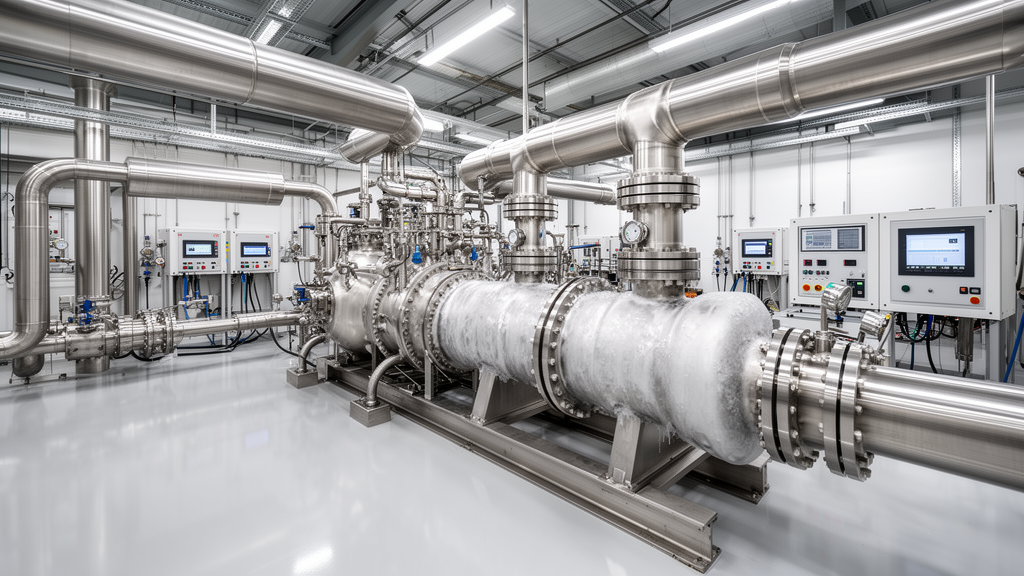
A newly commissioned closed-loop experimental facility at the Institute of Thermal Turbomachinery and Machinery Laboratory at the University of Stuttgart has validated the aerodynamic performance and thermal behavior of an ultra-high-speed radial turbocompressor designed for light gas mixtures. Developed in collaboration with the European Organization for Nuclear Research, the Technical University of Dresden, and industrial partners, the test rig provides empirical measurements to assess how conjugate heat transfer alters measured compressor stage efficiency during operation with air, pure neon, pure helium, and helium-neon mixtures known as Nelium. The experimental campaign revealed that internal heat transfer driven by the compressor motor cooling system artificially increases measured stage efficiency above theoretical adiabatic expectations by reducing discharge gas temperatures. Crucially, the measured stage pressure rise remained completely unaltered by these thermal interactions across all investigated operational regimes, confirming that aerodynamic pressure generation can be decoupled from diabatic thermal distortions in low molecular weight turbomachinery.
Superconducting magnets within the collider ring will operate under magnetic fields roughly twice as strong as those found in the existing Large Hadron Collider, resulting in substantially increased thermal heat loads. To cool this infrastructure efficiently, engineers developed a closed-loop pre-cooling cycle operating between forty and sixty Kelvin to pre-cool the primary helium refrigeration loop. Unlike the legacy system deployed at the Large Hadron Collider, this architecture eliminates the requirement for liquid nitrogen storage and achieves a thermodynamically superior distribution of refrigeration duties. Replacing traditional positive-displacement screw compressors with dynamic turbocompressors offers superior cycle efficiency, yet compressing pure helium presents severe hydrodynamic challenges due to its low molecular weight and elevated acoustic velocity. Ballasting helium with neon creates a heavier working medium while maintaining a low molecular weight rarely encountered in conventional turbomachinery engineering.
Operating dynamic compressors with light gases forces the aerodynamic stage into unconventional operational limits. High acoustic velocities in helium and neon restrict the characteristic rotational speed to relatively modest non-dimensional values, requiring ultra-high mechanical shaft speeds to achieve meaningful pressure ratios. To validate this regime experimentally, the research team installed a compact radial compressor stage driven by an electric motor supported by compliant gas bearings capable of reaching rotational speeds up to one hundred and twenty thousand revolutions per minute with a rated aerodynamic power output of fifteen kilowatts. Because high-power-density electric motors generate substantial waste heat, continuous liquid coolant circulation through the motor casing is mandatory to preserve operational safety. However, the proximity of the chilled housing jacket to the flowing process gas establishes an internal temperature gradient, inducing forced convection between the compressed gas and surrounding structural walls. In miniature turbomachines where total aerodynamic work is small, this parasitic heat exchange introduces substantial measurement uncertainty.
To evaluate compressor performance accurately across diverse working fluids, the researchers relied on a similitude framework founded on the Buckingham-Pi theorem. The machine’s aerodynamic behavior is governed by non-dimensional parameters, including the stage total inlet flow coefficient, tip Mach number, characteristic Reynolds number, impeller geometric length ratio, and specific heat ratio. Primary performance metrics include the stage total-to-static pressure ratio, polytropic efficiency, non-dimensional work input coefficient, and pressure coefficient, alongside the reduced mass flow rate. The compressor stage features an impeller diameter of sixty-eight and a half millimeters manufactured via five-axis milling and electrical discharge machining, enclosed within a shrouded impeller and vaned diffuser arrangement. The fluid domain guides incoming gas through radial inlet guide vanes before directing compressed discharge into an external collection volute. By maintaining dynamic and thermodynamic similitude across test gases spanning molecular weights from four grams per mole for helium to twenty-nine grams per mole for ambient air, the setup allows systematic isolation of Reynolds number and thermal effects.
The physical test rig consists of two interconnected circuits engineered with high vacuum tightness and strict resistance to helium permeation. The first section contains multiple buffer vessels pressurized with pure constituents or binary mixtures formulated by partial pressure control, verified in real time by an integrated binary gas analyzer. Connected to this supply is the hermetic turbocompressor loop, where gas enters the shrouded impeller, receives kinetic energy from the rotating blades, and converts kinetic velocity into static pressure within the vaned diffuser and volute. Downstream of the stage, a compact plate heat exchanger extracts the mechanical enthalpy added during compression to stabilize loop thermal conditions. The flow subsequently passes through a calibrated Venturi flow meter compliant with the international standard ISO 5167-4 to record operating mass flow rates. Coarse and fine throttling valves arranged in parallel dissipate remaining pressure before a flow conditioner eliminates spatial velocity non-uniformities ahead of the compressor suction inlet.
Data acquisition and rig automation rely on calibrated sensor chains coupled to a dedicated digital system and programmable logic controller. Upstream measurement planes incorporate total pressure and temperature probes, while downstream discharge planes feature calibrated static pressure taps and resistance temperature detectors to track stage thermodynamic conditions. An uncertainty analysis using the root-sum-square method established baseline sensor uncertainties, accounting for probe recovery factors, tap geometries, natural convection, and spatial averaging errors. For a baseline operating condition in air at a tip Mach number of zero point forty-eight and a reduced mass flow rate of zero point zero four zero four, propagated uncertainty was quantified across calculated performance variables. Automated loop regulation is maintained by triggering fast-acting solenoid valves between the test loop and buffer vessels to regulate inlet pressure, while a closed proportional-integral-derivative feedback loop modulates cooling water across the primary heat exchanger to control inlet gas temperature precisely.
Numerical modeling of the experimental compressor stage comprised both adiabatic aerodynamic calculations and coupled conjugate heat transfer simulations. The fluid domain was discretised using structured single-sector meshes totaling over one point eight five million computational cells across the inlet guide vanes, impeller passages, vaned diffuser, and hub and shroud cavity clearances, joined to an unstructured mesh of the discharge volute. Three-dimensional steady Reynolds-Averaged Navier-Stokes equations were solved in ANSYS CFX 2020.1 using the Shear Stress Transport turbulence closure model, selected after comparative evaluations with alternative closures demonstrated superior agreement with physical measurements. To model internal thermal exchange, a three-dimensional solid housing mesh encompassing nine hundred and twenty-five thousand tetrahedral elements represented aluminum and stainless-steel casings, thermal boundary conditions, and internal contact interfaces. Heat fluxes at the inlet flange and rear bearing plate were calibrated against experimental outer wall temperatures recorded by calibrated type-K thermocouples.
Aerodynamic validation under adiabatic assumptions demonstrated robust agreement between numerical predictions and physical measurements across the investigated range of tip Mach numbers, which spanned zero point twenty-four to zero point forty-eight for air, neon, and Nelium05, while helium testing was constrained to a maximum tip Mach number of zero point twenty-nine by motor rotational limits. Measurements of the pressure coefficient simultaneously confirmed the expected Reynolds number sensitivity: as the characteristic Reynolds number increased across the test gases, the measured pressure coefficient exhibited a corresponding upward shift. Numerical pressure ratio predictions matched experimental measurements across varied mass flow rates, confirming the fidelity of the aerodynamic flow model.
While pressure rise predictions matched experimental data closely, measured stage efficiencies diverged substantially from adiabatic numerical forecasts due to active heat transfer across internal casing boundaries. In diabatic conjugate heat transfer simulations conducted for neon at a tip Mach number of zero point thirty-six and an inlet flow coefficient of zero point zero seven, eighty-four percent of total heat removal occurred through the housing rear plate adjacent to the motor cooling passages. Conduction through the inlet casing surface contributed fourteen point four percent of heat extraction, while external natural convection accounted for only one point six percent. Forced convection between the compressed gas and internal metal surfaces established steep thermal gradients within the volute, chilling the gas before it reached downstream discharge sensors. Consequently, the measured temperature rise across the machine was suppressed, yielding an experimental diabatic polytropic efficiency noticeably higher than the true thermodynamic efficiency of the compression process.
Comparative analyses revealed that the divergence between measured diabatic efficiency and theoretical adiabatic efficiency decreases steadily as mass flow rate increases at constant shaft speed. Higher mass throughput delivers greater thermal mass to the stage, overwhelming the heat removal capability of the housing walls and diminishing the relative temperature drop. Similarly, increasing the impeller rotational speed and tip Mach number narrowed the gap between diabatic measurements and adiabatic predictions. Although elevated rotor speeds raise Reynolds numbers, convective heat transfer coefficients, and temperature differentials between the operating gas and cold structural boundaries, the aerodynamic enthalpy rise generated by the impeller increases at an even faster rate. As a result, the fractional cooling effect exerted on the fluid diminishes at high rotational velocities, causing diabatic stage efficiency measurements to asymptotically converge toward the adiabatic baseline as the tip Mach number approaches its upper limit.
A dedicated thirty-two-day experimental test sequence systematically characterized the isolated contributions of chiller coolant temperature and stage inlet temperature on heat transfer rates. Operating with neon at a constant tip Mach number of zero point thirty-six, the chiller temperature was varied from fifteen to thirty degrees Celsius across multiple daily test cycles. Raising the chiller coolant temperature reduced the thermal gradient across the housing, curtailing heat extraction from the gas path and shifting measured stage efficiencies downward toward adiabatic predictions. Correspondingly, measured diabatic work input increased toward the adiabatic level as cooling was throttled. When plotted against inlet flow coefficients, experimental pressure coefficient distributions acquired at differing coolant temperatures collapsed onto a single unified curve. This experimental overlap conclusively verified that internal thermal extraction does not alter dynamic pressure generation within the compressor, maintaining strict aerodynamic repeatability across varying thermal boundary conditions.
Evaluating non-dimensional work input differences between experimental diabatic measurements and adiabatic numerical baselines across all four working fluids clarified the decisive role of intrinsic gas thermophysical properties. When comparing pure helium to neon, similitude constraints dictate that approximately half the gas mass flows through the stage per unit time, while helium’s specific heat capacity is five times greater than that of neon. Consequently, extracting an equivalent temperature increment from a helium stream demands more than twice the cooling energy. Furthermore, helium’s characteristic Reynolds number is forty-five percent lower than neon under identical operating conditions, suppressing internal convective heat transfer coefficients. Elevating compressor inlet temperatures from fifteen to twenty-five degrees Celsius magnified temperature differentials against the chiller coolant, increasing absolute heat transfer rates and expanding the discrepancy between diabatic and adiabatic work input. These findings provide foundational scaling laws necessary to formulate unified correction models to reconstruct true adiabatic performance in future cryogenic collider compressors and hydrogen pipeline turbomachines.
Subject of Research: Experimental evaluation of heat transfer effects on light gas turbocompressor performance
Article Title: Experimental evaluation of heat transfer effect on turbocompressor performance operating with helium-neon gas mixtures
Article References: Podeur, M., & Vogt, D. M. (2022). Experimental evaluation of heat transfer effect on turbocompressor performance operating with helium-neon gas mixtures. EPJ Techniques and Instrumentation, 9(1), Article 6. https://doi.org/10.1140/epjti/s40485-022-00082-1
Image Credits: AI Generated
DOI: 10.1140/epjti/s40485-022-00082-1
Keywords: turbocompressor, heat transfer, helium-neon mixtures, nelium, cryogenic cycle, Future Circular Collider, conjugate heat transfer, shrouded impeller, vaned diffuser, polytropic efficiency, Reynolds number effect, aerodynamic performance, chiller cooling, diabatic efficiency, closed-loop test facility, computational fluid dynamics
News Source: Audrey Campbell. (November 12, 2026). Stuttgart Test Rig Validates Cryogenic Light Gas Turbocompressor Performance and Heat Transfer. Scienmag.