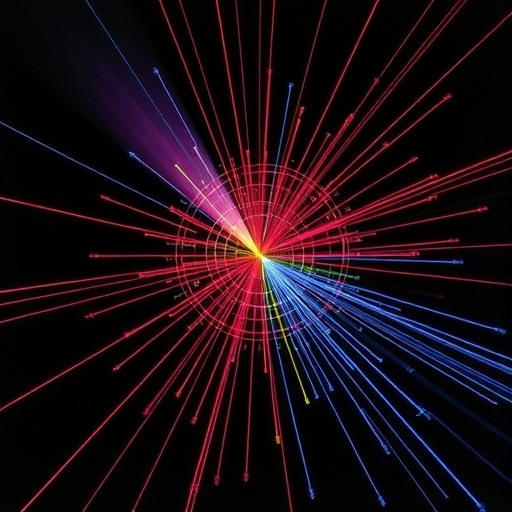
In the realm of nuclear physics, the study of prompt fission neutrons has long captivated scientists due to its fundamental implications for both theoretical understanding and practical applications. Recent research focusing on the energy correlations between prompt neutrons emitted from spontaneous fission of Californium-252 (^252Cf) has revealed intricate dependencies that promise to refine neutron detection techniques. Traditionally, neutron coincidence and multiplication measurement methods—widely used in fields such as nuclear safeguards, reactor physics, and radiation detection—have approached neutron energies as statistically independent. However, the assumption of independence neglects subtle, yet critical, energy correlations which this new study brings to light.
One of the core findings is that prompt fission neutrons are not emitted at random energies independent of one another; instead, their energies are intricately tied depending on the angular distribution between the detected neutron pairs. Specifically, neutron pairs detected at angles near 0° and 180° exhibit a positive correlation in energy. This means that when one neutron possesses a high kinetic energy, its correlated counterpart, emitted nearly collinearly or anti-collinearly, also tends to carry a higher energy. Conversely, neutron pairs with detection angles near 90° show a negative energy correlation, indicating an inverse relationship between the energies of the paired neutrons.
These correlations have been quantified through sophisticated computational simulations, employing prompt fission γ-ray tagging, pulse shape discrimination (PSD), and time-of-flight (TOF) measurements that enable precise time-correlation analysis of detected neutrons. These advanced tools allow researchers to reconstruct the neutron energy distribution with high resolution as a function of the angle separating the detected neutron pairs. The simulations demonstrate that the degree of these correlations intensifies with increasing energy of the first neutron, suggesting more complex angular and energy dynamics underlying neutron emission during fission than previously understood.
From a theoretical perspective, understanding these neutron energy correlations challenges simplistic models of the fission process, which often treat prompt neutron emission as an uncorrelated, isotropic event. The observed angular dependence of energy correlations provides key insights into the nuclear dynamics governing scission and the subsequent energy partitioning among emitted particles. These findings offer a stringent benchmark to test and refine fission modeling codes that simulate the prompt neutron emission spectra and neutron-neutron angular correlations, ultimately advancing nuclear reaction theories.
In practice, the implication of these energy correlations extends directly to the accuracy of neutron multiplicity counting technologies, especially in active interrogation and safeguards applications where the precise count and energy of emitted neutrons are critical for identifying fissile material. Since neutron detectors’ efficiency is inherently energy-dependent, neglecting the energy correlations could systematically bias neutron multiplicity measurements, leading to potential errors in material assay and nuclear security protocols. Incorporating these correlations into detector response models will enhance the reliability and sensitivity of neutron coincidence counting methodologies.
Moreover, fast neutron coincidence and multiplication techniques—which are particularly sensitive to neutron energy distributions—stand to benefit significantly from these insights. By adapting existing measurement protocols to account for the influence of neutron-neutron energy correlations across various detection angles, operators can reduce uncertainties associated with neutron emission characteristics. This leads to more robust characterizations of fissile sources, improved calibration of detection arrays, and refined nuclear material control and accounting practices.
The study hinges on evaluating the prompt fission neutron energy spectra from ^252Cf–a prototypical spontaneous fission source ubiquitous in nuclear science research. Using comprehensive computational simulations, the researchers mapped out the energy correlations over a full range of angular separations between neutron pairs. The results illustrate that at around 90°, the energy of the secondary neutron tends toward lower values when the first neutron’s energy is high, while at 0° or 180°, both neutron energies peak simultaneously. This nuanced behavior suggests underlying mechanisms in the fission process related to neutron emission timing, neutron-neutron interaction, and anisotropy of the fission fragments’ momentum.
This pioneering research, soon to be published in Nuclear Science and Techniques, underscores the importance of multi-parametric neutron measurements and pushes forward the frontier in nuclear instrumentation and methodology. It invites a reevaluation of neutron data interpretation and fosters the development of more refined neutron detection technologies that integrate angular and energy correlations for accurate nuclear material analysis. The practical adoption of these results promises to enhance nuclear safeguards verification and improve reactor monitoring systems by providing a granular understanding of neutron emissions.
Beyond the immediate nuclear safeguards and physics community, the findings may have ripple effects in other technologies involving neutron interactions, including neutron radiography, neutron scattering experiments, and fast neutron therapy planning in medical physics. Each of these fields relies on precise neutron characterization to optimize outcomes and verify results. The acknowledgment of correlated neutron energy behaviors introduces a new variable that could, once incorporated, optimize performance and analytical accuracy.
In sum, the measurement of energy correlations between two prompt fission neutrons from ^252Cf marks a significant leap in neutron physics. It dismantles the prior assumption of independent neutron energies, revealing a complex, angle-dependent energy relationship tied to the fission process’s physical dynamics. This breakthrough not only enriches theoretical modeling but also holds transformative potential for neutron detection technologies, leveraging energy-dependent efficiencies to yield more precise and dependable nuclear measurements. As nuclear science pursues ever greater precision and safety, integrating these correlations into practice is poised to become a standard component of neutron analysis protocols.
The researchers responsible for this investigation utilized computational simulation and rigorous experimental techniques to achieve these insights—a testament to the power of combining modeling and measurement in modern nuclear physics. The upcoming publication solidifies this knowledge and calls upon the scientific community to embrace these nuances in neutron emission behaviors, enabling a new era of accuracy in nuclear diagnostics and safeguards.
Subject of Research: Not applicable
Article Title: The measurement of the energy correlations between two 252Cf prompt fission neutrons
News Publication Date: 29-Jan-2026
Web References: http://dx.doi.org/10.1007/s41365-025-01881-3
Image Credits: Huai-Yong Bai
Keywords
Particle physics, Nuclear reactions
Tags: angular distribution of neutronsCalifornium-252 fission studydependencies in neutron emissionsenergy correlations in prompt neutronsneutron coincidence measurement methodsneutron detection techniquesneutron energy independence assumptionnuclear physics researchnuclear safeguards and reactor physicspractical applications of fission neutronsprompt fission neutron behaviorradiation detection advancements