• HOME
  • NEWS
  • EXPLORE
    • CAREER
      • Companies
      • Jobs
    • EVENTS
    • iGEM
      • News
      • Team
    • PHOTOS
    • VIDEO
    • WIKI
  • BLOG
  • COMMUNITY
    • FACEBOOK
    • INSTAGRAM
    • TWITTER
Monday, December 15, 2025
BIOENGINEER.ORG
No Result
View All Result
  • Login
  • HOME
  • NEWS
  • EXPLORE
    • CAREER
      • Companies
      • Jobs
        • Lecturer
        • PhD Studentship
        • Postdoc
        • Research Assistant
    • EVENTS
    • iGEM
      • News
      • Team
    • PHOTOS
    • VIDEO
    • WIKI
  • BLOG
  • COMMUNITY
    • FACEBOOK
    • INSTAGRAM
    • TWITTER
  • HOME
  • NEWS
  • EXPLORE
    • CAREER
      • Companies
      • Jobs
        • Lecturer
        • PhD Studentship
        • Postdoc
        • Research Assistant
    • EVENTS
    • iGEM
      • News
      • Team
    • PHOTOS
    • VIDEO
    • WIKI
  • BLOG
  • COMMUNITY
    • FACEBOOK
    • INSTAGRAM
    • TWITTER
No Result
View All Result
Bioengineer.org
No Result
View All Result
Home NEWS Science News

Study shows environmental link to herbicide-resistant horseweed

Bioengineer by Bioengineer
July 24, 2021
in Science News
Reading Time: 2 mins read
0
IMAGE
Share on FacebookShare on TwitterShare on LinkedinShare on RedditShare on Telegram

IMAGE

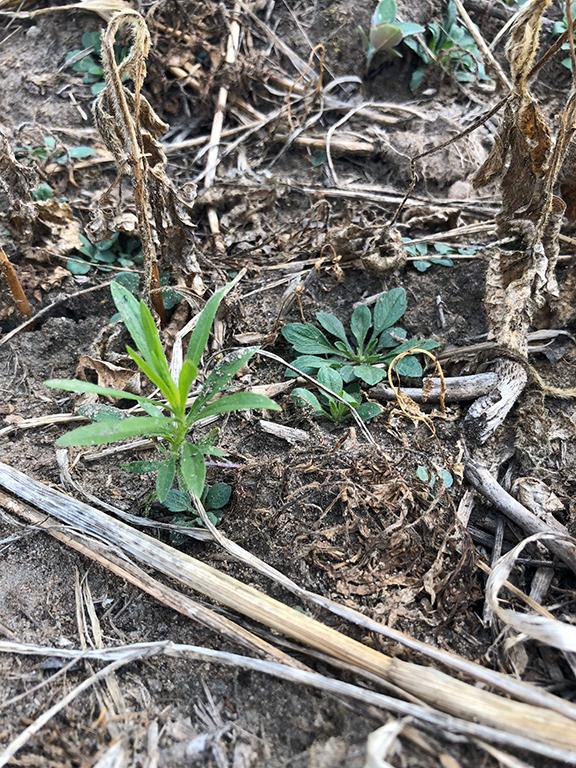
Credit: Photo by John A. Schramski

WESTMINSTER, Colorado – July 23, 2021 – Horseweed is a serious threat to both agricultural crops and natural landscapes around the globe. In the U.S., the weed is prolific and able to emerge at any time of the year.

Fall emerging horseweed overwinters as a rosette, while spring emerging horseweed skips the rosette stage and grows upright. In some instances, both rosette and upright plants emerge simultaneously in mid-summer. These unpredictable growth patterns create challenges for growers as they try to develop an appropriate weed management plan.

In a study featured in the journal Weed Science, a team from Michigan State University explored whether environmental cues could be used to predict horseweed growth type. They found that variations in temperature, photoperiod, competition, shading, and soil moisture resulted only in the rosette growth type. Upright plants emerged, though, when seeds were exposed to dry conditions, followed by a prolonged cooling.

Researchers also determined that upright horseweed plants from known glyphosate-resistant populations are three- to four-fold less sensitive to glyphosate than their rosette siblings, which makes them much harder to control.

“Our results suggest that when horseweed populations shift from winter to summer annual lifecycles, concurrent increases can be expected in glyphosate resistance,” says researcher John Schramski of Michigan State University.

###

To learn more, read the article “Environmental cues affecting horseweed (Conyza canadensis) growth type and their sensitivity to glyphosate” online, available Open Access.

About Weed Science

Weed Science is a journal of the Weed Science Society of America, a nonprofit scientific society focused on weeds and their impact on the environment. The publication presents peer-reviewed original research related to all aspects of weed science, including the biology, ecology, physiology, management and control of weeds. To learn more, visit http://www.wssa.net.

Media Contact
Natalie Warrender
[email protected]

Original Source

https://www.cambridge.org/core/journals/weed-science/article/environmental-cues-affecting-horseweed-conyza-canadensis-growth-types-and-their-sensitivity-to-glyphosate/34E4C5183D9A5F56CD5DC2243E90C968

Related Journal Article

http://dx.doi.org/10.1017/wsc.2021.27

Tags: AgricultureFertilizers/Pest Management
Share13Tweet8Share2ShareShareShare2

Related Posts

Choosing Elder Care: Insights from China’s Future Disability

December 15, 2025

Ethiopia’s Institutional Delivery: Dissecting Socioeconomic Disparities

December 15, 2025

Revolutionary SERS Structures Boost Sensitivity in Lithography

December 15, 2025

Boosting Digital Forensics with AI Techniques

December 15, 2025
Please login to join discussion

POPULAR NEWS

  • Scientists Uncover Chameleon’s Telephone-Cord-Like Optic Nerves, A Feature Missed by Aristotle and Newton

    Scientists Uncover Chameleon’s Telephone-Cord-Like Optic Nerves, A Feature Missed by Aristotle and Newton

    122 shares
    Share 49 Tweet 31
  • Nurses’ Views on Online Learning: Effects on Performance

    69 shares
    Share 28 Tweet 17
  • NSF funds machine-learning research at UNO and UNL to study energy requirements of walking in older adults

    70 shares
    Share 28 Tweet 18
  • MoCK2 Kinase Shapes Mitochondrial Dynamics in Rice Fungal Pathogen

    71 shares
    Share 28 Tweet 18
div>

About

We bring you the latest biotechnology news from best research centers and universities around the world. Check our website.

Follow us

Recent News

Choosing Elder Care: Insights from China’s Future Disability

Ethiopia’s Institutional Delivery: Dissecting Socioeconomic Disparities

Revolutionary SERS Structures Boost Sensitivity in Lithography

Subscribe to Blog via Email

Enter your email address to subscribe to this blog and receive notifications of new posts by email.

Join 69 other subscribers
  • Contact Us

Bioengineer.org © Copyright 2023 All Rights Reserved.

Welcome Back!

Login to your account below

Forgotten Password?

Retrieve your password

Please enter your username or email address to reset your password.

Log In
No Result
View All Result
  • Homepages
    • Home Page 1
    • Home Page 2
  • News
  • National
  • Business
  • Health
  • Lifestyle
  • Science

Bioengineer.org © Copyright 2023 All Rights Reserved.