

• HOME
  • NEWS
  • EXPLORE
    • CAREER
      • Companies
      • Jobs
    • EVENTS
    • iGEM
      • News
      • Team
    • PHOTOS
    • VIDEO
    • WIKI
  • BLOG
  • COMMUNITY
    • FACEBOOK
    • INSTAGRAM
    • TWITTER
Saturday, September 12, 2026
BIOENGINEER.ORG
No Result
View All Result
  • Login
  • HOME
  • NEWS
  • EXPLORE
    • CAREER
      • Companies
      • Jobs
        • Lecturer
        • PhD Studentship
        • Postdoc
        • Research Assistant
    • EVENTS
    • iGEM
      • News
      • Team
    • PHOTOS
    • VIDEO
    • WIKI
  • BLOG
  • COMMUNITY
    • FACEBOOK
    • INSTAGRAM
    • TWITTER
  • HOME
  • NEWS
  • EXPLORE
    • CAREER
      • Companies
      • Jobs
        • Lecturer
        • PhD Studentship
        • Postdoc
        • Research Assistant
    • EVENTS
    • iGEM
      • News
      • Team
    • PHOTOS
    • VIDEO
    • WIKI
  • BLOG
  • COMMUNITY
    • FACEBOOK
    • INSTAGRAM
    • TWITTER
No Result
View All Result
Bioengineer.org
No Result
View All Result
Home NEWS Science News Agriculture

Study Reveals How Plants Detect When to Grow or Pause

Bioengineer by Bioengineer
July 28, 2026
in Agriculture
Reading Time: 2 mins read
0
Study Reveals How Plants Detect When to Grow or Pause
Share on FacebookShare on TwitterShare on LinkedinShare on RedditShare on Telegram

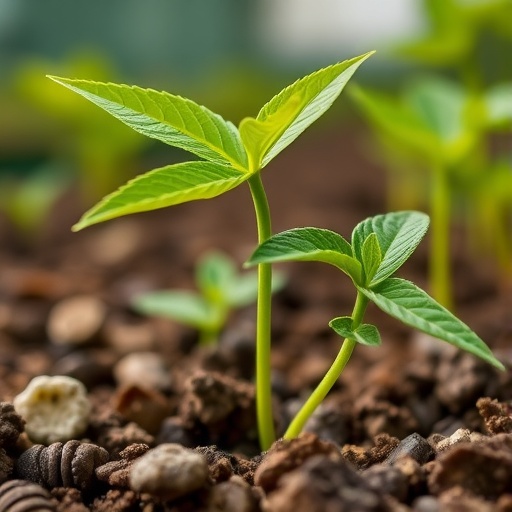
Plants build organs by coordinating “initiation” and “growth,” but how one signal can drive two opposite outcomes has been unclear. A new study reveals a timed hormone handoff that allows plants to first suppress an architecture-promoting pathway and then activate it to expand new tissue.

Researchers led by Dr. Alon Israeli and Prof. Naomi Ori from the Hebrew University of Jerusalem focused on tomato as a model system. Writing in Development, they show that the plant hormone auxin orchestrates organ formation through two sequential phases of cross talk with gibberellin (GA).

In the earliest window after auxin signaling starts, auxin shifts gene regulation to lower GA activity. It activates pathways that break down gibberellin while simultaneously suppressing genes required for GA biosynthesis. This transient reduction creates permissive conditions for leaflets and other new structures to emerge at precise locations.

As development proceeds, auxin reverses its influence. Instead of maintaining GA suppression, auxin transitions to a mode that enhances gibberellin production and/or signaling. The same hormone therefore triggers a later growth program rather than initiation.

To test causality, the team used genetic engineering, hormone treatments, and gene-expression analyses. When GA activity was experimentally sustained at higher levels, plants produced fewer leaflets, consistent with a failure to properly initiate new structures.

Conversely, local reduction of gibberellin caused extra leaflet formation in areas where leaflets would not normally develop. This demonstrates that proper GA downshifting is not merely correlated with initiation—it is functionally required.

For the expansion phase, plants engineered to fail to mount sufficient GA responses were unable to execute the robust blade growth normally induced downstream of auxin. Together, these results argue that the auxin–GA relationship is dynamic, not static.

The work also highlights an elegant logic: auxin accomplishes two distinct developmental tasks by altering which GA-regulating target genes it controls over time. This provides a mechanistic explanation for how plants “alternate between brakes and accelerator” during organ assembly.

Beyond leaf development, the sequential hormonal strategy may generalize to other organs such as flowers and roots. If so, manipulating this timing could become a new lever for engineering crop architecture with improved growth and resilience.

Article Title: A two-step auxin-GA cross talk regulates organ formation
News Publication Date: 25-Jun-2026
Web References: http://dx.doi.org/10.1242/dev.205772
Image Credits: Dr. Alon Israeli.

Keywords: Plant development; Plant sciences; Plant hormones; Auxin; Gibberellin; Organ formation; Crop science; Experimental study; Leaf morphology.

Tags: auxin and gibberellin interactiongenetic engineering in plant hormone studieshormone crosstalk during plant growthhormone-mediated control of plant architectureorgan initiation and growth controlplant developmental biologyplant growth regulation mechanismsplant hormone signalingregulation of plant tissue expansionsequential hormone regulation in plant developmenttiming of hormone signals in plant developmenttomato plant organogenesis


Share12Tweet7Share2ShareShareShare1

Related Posts

Color-based prediction of mango total soluble solids and vitamin C using reflectance color measurement

Color-based prediction of mango total soluble solids and vitamin C using reflectance color measurement

September 11, 2026
Gene Behind Chalky Rice Mutant Unlocks High-Resistant-Starch Breeding

Gene Behind Chalky Rice Mutant Unlocks High-Resistant-Starch Breeding

September 11, 2026

Scientists Crack the Genetic Transformation Barrier in Tartary Buckwheat

September 11, 2026

Deep-Learning Framework Crop-GPA 2.0 Cracks the Shared Genetic Code of Crop Traits Across Species

September 11, 2026

POPULAR NEWS

  • Lonely Sleep Waves: How Tau Tangles Quietly Sabotage the Aging Brain’s Memory.

    29 shares
    Share 12 Tweet 7
  • New Tools Pluck Gene Cassettes From Bacteria at Unprecedented Scale

    29 shares
    Share 12 Tweet 7
  • Scientists Learn to Stack Fano Interferences for Sharper Plasmonic Energy Transfer

    29 shares
    Share 12 Tweet 7
  • Ten-Second Flash Reaction Turns Toxic Fluorine Waste Into Valuable Drug-Making Chemical

    29 shares
    Share 12 Tweet 7

About

BIOENGINEER.ORG

We bring you the latest biotechnology news from best research centers and universities around the world. Check our website.

Follow us

Recent News

Lonely Sleep Waves: How Tau Tangles Quietly Sabotage the Aging Brain’s Memory.

New Tools Pluck Gene Cassettes From Bacteria at Unprecedented Scale

Scientists Learn to Stack Fano Interferences for Sharper Plasmonic Energy Transfer

Subscribe to Blog via Email

Enter your email address to subscribe to this blog and receive notifications of new posts by email.

Join 85 other subscribers
  • Contact Us

Bioengineer.org © Copyright 2023 All Rights Reserved.

Welcome Back!

Login to your account below

Forgotten Password?

Retrieve your password

Please enter your username or email address to reset your password.

Log In
No Result
View All Result
  • Homepages
    • Home Page 1
    • Home Page 2
  • News
  • National
  • Business
  • Health
  • Lifestyle
  • Science

Bioengineer.org © Copyright 2023 All Rights Reserved.