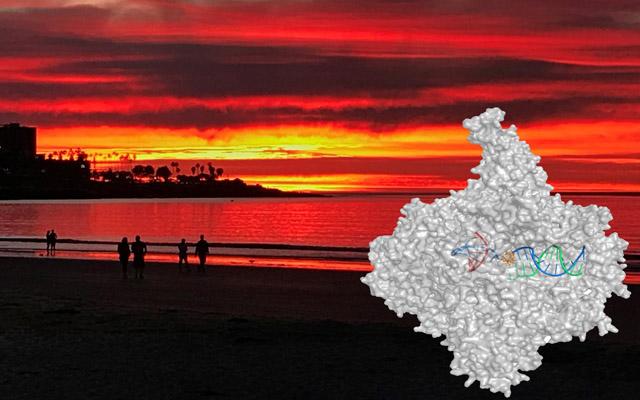
Credit: Image collage courtesy of Dong Wang, UC San Diego
Damage to DNA is a constant threat to cellular life, and so it is constantly monitored and detected by a family of enzymes called RNA polymerases, resulting in subsequent repair to maintain genome integrity. In a paper published this week in the journal PNAS, researchers at University of California San Diego School of Medicine, with colleagues in Spain and Finland, describe for the first time how one type of RNA polymerase gets stalled by DNA lesions caused by exposure to ultraviolet (UV) light.
Called thymine dimers, DNA lesions are damage sites to the base pairs that comprise the structure of DNA. The DNA lesions are caused by exposure to UV light, such as sunlight, which causes neighboring thymine base pairs to bond, disrupting the DNA strand. Untreated, these lesions may eventually result in cancerous growths, such as melanoma.
RNA polymerase I (Pol I) is an enzyme responsible for up to 60 percent of total transcriptional activity in growing cells. It is a key determinant for cell growth control, and is also responsible for identifying lesions and activating repairs at the rDNA region, a DNA sequence that codes for ribosomal RNA.
"It's the most active RNA polymerase in growing cells and so its ability to identify lesions has significant influence on whether a cell can survive UV-caused genetic damage," said co-corresponding author Dong Wang, PhD, associate professor in the Skaggs School of Pharmacy and Pharmaceutical Sciences and the Department of Cellular and Molecular Medicine at UC San Diego. "However, little is known about how this enzyme actually processes UV-induced lesions."
In the new study, Wang's lab, in collaboration with Carlos Fenandez-Tornero, PhD, molecular biologist, and colleagues at the Spanish National Research Council in Madrid, combined in vitro enzymatic activity studies with electron cryomicroscopy to characterize the mechanisms that stall Pol I as it approaches a lesion to begin recruiting proteins responsible for DNA repair. They found that Pol I is able to sense the DNA lesion through specific interactions with both the damaged base and the DNA backbone, stalling right before the lesion reaches the active site of RNA Pol I.
Additionally, the study identified a key amino acid among more than 5,000 that constitute Pol I that is essential to detecting DNA lesions formed by UV damage. Interestingly, this Pol I-specific residue does not exist in other forms RNA polymerases. Mutation studies suggest that this residue is important in controlling the polymerase stall profile at DNA lesions.
Because RNA Pol I is a key determinant for cell growth control, it is also an attractive cancer therapeutic target, said Wang, who suggested the findings could open a new avenue for the development of novel anticancer drugs that target RNA Pol I transcription machinery.
###
Co-authors include: Marta Sanz-Murillo and Maria Moreno-Morcillo, Spanish National Research Council; Jun Xu, UC San Diego; Georgiy A. Belogurov, University of Turku, Finland; Olga Calvo, Spanish National Research Council and University of Salamanca, Spain; and David Gil-Carton, Cooperative Center for Research in Biosciences, Spain.
Media Contact
Scott LaFee
[email protected]
858-249-0456
@UCSanDiego
http://www.ucsd.edu