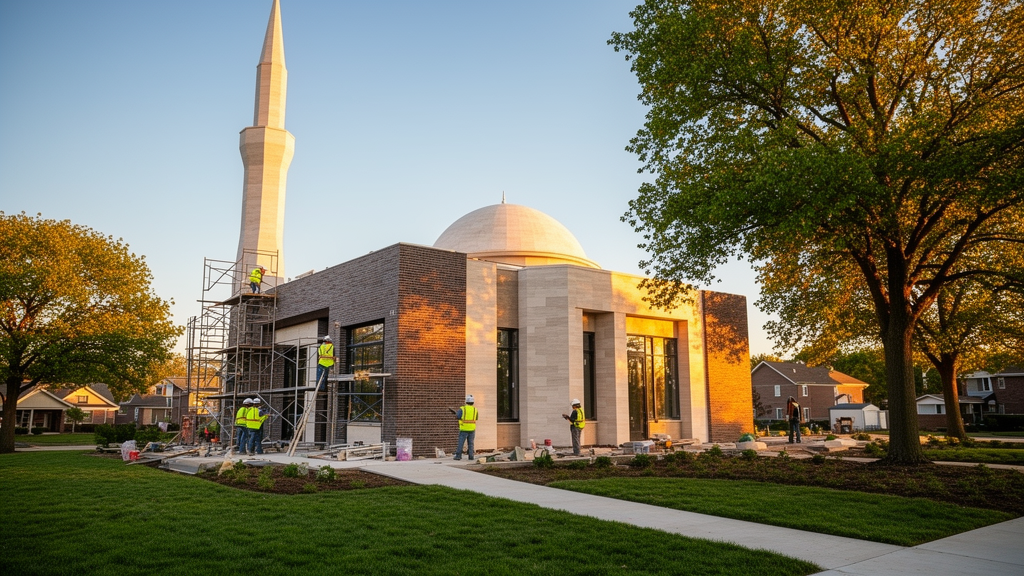
A new interdisciplinary study published in City, Territory and Architecture presents a contextual framework for understanding the design and construction of mosques in the United States. The research, authored by Hassnaa Mohammed, examines the specific factors that shape the development of these religious and community hubs from initial conception through to final construction. By focusing on the Greater Phoenix area, also known as the Valley of the Sun, the article addresses the challenges arising from the rapid growth of mosques in various U.S. cities and the limited resources available to architects and planners. The study aims to provide a shift in perspective, moving away from purely aesthetic critiques of finished structures toward an analysis of the developmental processes that respond to practical community needs.
The research is grounded in the demographic reality that the number of U.S. Muslims is projected to double by 2050, according to a 2017 Pew Research Center report. Between 2010 and 2020, there was a 31% increase in mosque establishment in the U.S., a trend expected to continue. This growth introduces complexity as younger generations of U.S. Muslims develop their own practices while recent immigrants bring diverse traditions. The study seeks to understand how existing mosques were founded and are developing at the intersection of local and global dynamics, using empirical methods to answer questions about what triggers mosque conception and how local funding influences site selection and design.
The methodology relied on three primary sources of data: semi-structured interviews, archival research, and site visits. The author conducted in-depth interviews with seventeen long-standing members of mosques in the Greater Phoenix area, including nine males and eight females. These participants, mostly over the age of 50, represented a diverse range of national backgrounds, including Bengali, Pakistani, Indian, Chinese, Syrian, Palestinian, Egyptian, Lebanese, Kuwaiti, Bosnian, and Belgian. The interviews were triangulated with extensive archival research conducted at the Tempe History Museum and other web-accessible sources to confirm historic facts. Ethnographic field observations, which included attending events, iftar meals, and prayer services, provided additional nuance regarding how occupants currently use the spaces.
The study identifies several key drivers behind the conception of mosques in the region, including ideological differences, demographic shifts, and the need for convenience. Before the 1970s, there were no mosques in the Greater Phoenix area. The first mosque, Jawharatul-Islam, was established in 1981 in South Tempe as a physical manifestation of the ideological transition of the Nation of Islam toward quasi-Sunni practices. This was followed by the Islamic Community Center of Tempe (ICC-Tempe), which was conceived with ideological roots in the founder’s nostalgia for Palestinian heritage, specifically resembling the Dome of the Rock. However, convenience also played a significant role, as the location of the first mosque was perceived as remote by students at Arizona State University, leading to the demand for a more centralized facility.
Funding strategies significantly influenced site selection and project management. Most of the mosques studied relied on local community resources rather than foreign funds, a decision often driven by a desire to avoid prescribed international expectations of design and operation. In adherence with the Islamic principle of avoiding interest, known as riba, these projects were funded without interest-bearing loans. For smaller communities, purchasing and repurposing existing properties, such as former church buildings, was a pragmatic solution to avoid the financial burden of new construction. This approach also helped mitigate Not in my Back Yard (NIMBY) opposition, as the existing zoning for worship spaces reduced the likelihood of neighbor complaints regarding traffic or noise.
In contrast, larger communities with a long-term vision for comprehensive facilities opted for purpose-built structures. The Islamic Center of the East Valley (ICEV) in Chandler serves as a notable example of the challenges associated with this approach. The community initially purchased land off the grid in an underdeveloped area, which led to significant delays and unexpected costs related to connecting utilities and digging a basement. The reliance on pro bono services for design and construction proved difficult to manage, resulting in interruptions to the contracting process. It was not until a paid general contractor was hired that the project was completed, with the mosque finally opening in 2009 after a five-year construction period.
The study highlights the critical role of professional advocacy in navigating community opposition. In the case of the Islamic Center of Northeast Valley (ICNEV) in Scottsdale, the proposal to build a mosque on residentially zoned lots drew significant opposition from nearby homeowners’ associations. Neighbors expressed concerns about traffic and noise, but public hearings revealed a deeper sentiment of resistance to what was perceived as an alien cultural presence. The architect played a crucial role in defending the project by demystifying mosque practices and presenting architectural drawings in public meetings. Concrete modifications, such as lowering the height of the mosque by six feet and changing the exterior color, were proposed to accommodate neighbor concerns while preserving the community’s needs.
Architectural forms in the Valley reflect a progression from symbolic international styles to functional, community-centered designs. Early mosques like Jawharatul-Islam and ICC-Tempe displayed clear inspirations from North African and Levantine aesthetics. However, later purpose-built mosques, such as ICEV and ICNEV, were guided by sustainable, functional, and programmatic drivers. These facilities were designed to serve multiple community needs, including educational programs and social events, rather than focusing solely on worship. The Islamic Community Center of Phoenix (ICCP) represents a unique deviation, featuring an Ottoman-inspired design with a prominent dome, intended to reassert Muslim presence in the urban landscape in a post-9/11 context.
The involvement of diverse community members in the design process was found to be essential for social sustainability. Mosques that formed ad-hoc committees with diverse representation were more successful in completing projects on time and within budget. These committees helped address specific needs, such as the placement of stairs for the women’s section to avoid exposure to the scorching Arizona heat. Additionally, the integration of youth spaces, such as a library with glass walls for visibility, allowed for shared resources that accommodated gendered etiquette while promoting community engagement. This inclusive approach helped ensure that younger generations felt a sense of ownership and connection to the space.
Some mosques drew inspiration from the spatial programs of local churches, which had previously served as trial spaces for Muslim worship. Founding members who had attended church daycares or used church facilities for Friday prayers reinterpreted practical interior design elements, such as commercial kitchens and courtyards, in their own mosques. These courtyards evolved over time to serve as transitional spaces for socializing and, in some cases, as basketball courts for children. This adaptability indicates that mosque designs are responding to the changing needs of a multi-generational community, moving beyond static religious functions to become dynamic community hubs.
The study concludes that successful mosque projects are rooted in capitalizing on community expertise for both functional operation and ideological representation. Mosques that hired paid professional services through a bidding process from the beginning of the project or for permitting purposes generally achieved better outcomes in terms of schedule and budget preservation. The findings suggest that architects and designers must understand the implicit nuances that impact mosque projects to propose sustainable and community-centered solutions. By bridging the gap between community experts and design professionals, future mosques can be better positioned to respond to the diverse and evolving needs of U.S. Muslim populations.
This research contributes to a small number of empirical studies that document the complex contextual challenges of mosque construction in specific U.S. regions. By providing a detailed narrative of the design and building process, the study offers a practical framework for understanding how local dynamics shape religious architecture. The findings emphasize the importance of moving away from politicized views of mosque exteriors to focus on the programmatic needs of a growing population. As the Muslim community in the U.S. continues to expand, understanding these contextual determinants will be crucial for the development of inclusive and functional community spaces.
Subject of Research: Contextual determinants of mosque design and construction in the U.S.
Article Title: The contextual determinants of mosque design and construction process in the U.S.: the case of the Valley of the Sun
Article References: Mohammed, H. (2026). The contextual determinants of mosque design and construction process in the U.S.: the case of the Valley of the Sun. City, Territory and Architecture, 13(1), Article 6. https://doi.org/10.1186/s40410-025-00296-2
Image Credits: AI Generated
DOI: 10.1186/s40410-025-00296-2
Keywords: mosque architecture, urban planning, community development, Greater Phoenix, religious studies, construction process, demographic shifts, interfaith relations, contextual, determinants, mosque, design
News Source: Denise Maddox. (November 12, 2026). Study Maps Contextual Drivers of U.S. Mosque Construction. Scienmag.