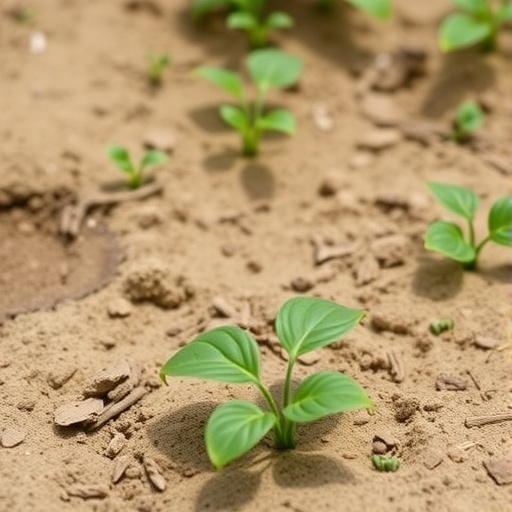
Sandy soils, characterized by their coarse texture and high permeability, present formidable challenges to agricultural productivity due to their tendency to rapidly lose water and essential nutrients. These inherent limitations impede crop growth, especially under drought conditions. A recent long-term field investigation, spanning over 441 days, has illuminated a practical and innovative solution to this problem through the synergistic application of biochar, compost, and sludge amendments. This groundbreaking study reveals significant enhancements in soil water retention and hydraulic behavior when these organic materials are combined, offering promising avenues to boost resilience in sandy soils subjected to arid and semi-arid climates.
The researchers employed lysimeter experiments under realistic environmental conditions to rigorously assess how individual and combined organic amendments influence the water balance of sandy soils. By continuously monitoring soil moisture dynamics, drainage rates, and evaporation losses, the team provided detailed insights into how these amendments modify subsurface hydrology. The triple combination of biochar, compost, and sludge yielded the most pronounced reduction in soil drainage, decreasing cumulative water loss by over 40% relative to plots receiving single amendments. This critical finding suggests that more water remains accessible within the root zone for extended periods, directly impacting plant-available moisture and potentially enhancing drought tolerance.
Fundamental to the observed improvements is the unique physicochemical nature of biochar—a carbon-rich byproduct of biomass pyrolysis conducted under oxygen-limited conditions. Biochar’s porous morphology and high surface area facilitate enhanced soil aeration and increased water retention capacity. When integrated with compost and sludge—sources rich in organic matter and fine particulates—the amendments collectively restructure the soil matrix. This restructuring generates a more balanced pore size distribution, stabilizing soil aggregates and reducing preferential flow paths that typically expedite water loss in sandy substrates. The result is an optimized soil pore network that retains moisture efficiently while allowing adequate gas exchange essential for root respiration.
The study’s extended duration captured fluctuations in climatic factors such as precipitation and temperature, which fluctuate seasonally and influence soil water dynamics. Unlike controlled laboratory experiments, this real-world setting provided robust validation that the organic amendment strategy maintains higher average soil moisture contents through varying environmental stresses. Treatments combining biochar, compost, and sludge exhibited the greatest stability in water storage, underscoring their potential to mitigate the adverse effects of intermittent dry spells that commonly afflict sandy soils. This temporal analysis highlights the amendments’ capacity to buffer soils against natural variability, a feature critical for sustainable agriculture.
Beyond water retention, the amendments also altered soil surface evaporation and drainage patterns. Soils treated with biochar showed reduced drainage volumes but increased evaporation rates compared to unamended controls, suggesting that biochar influences the partitioning of water within soil layers. Statistical evaluations confirmed the significance of these changes, reinforcing the concept that biochar-based amendments substantially modify hydraulic properties. This modulation of evaporation and drainage is vital for maintaining soil moisture within the root zone and minimizing water wastage, key objectives in enhancing water use efficiency in agriculture.
Importantly, the study emphasizes the superiority of integrating multiple organic amendments rather than relying on a single input. The complementary properties of biochar, compost, and sludge create synergistic effects that surpass the benefits achieved independently. Compost contributes nutrients and microbial populations essential for soil fertility, while sludge offers fine particles that enhance soil texture and nutrient content. Biochar’s stability and carbon sequestration capabilities add long-term value by improving physical and chemical soil attributes. Together, these amendments establish a resilient soil ecosystem conducive to plant growth and sustainable land management.
From an agronomic perspective, adopting this integrated amendment approach can transform marginal sandy soils, often overlooked due to their low fertility and poor water retention, into productive landscapes. By increasing soil water availability and enhancing soil structure, farmers can reduce irrigation requirements, optimize nutrient management, and improve crop yields. This strategy holds particular promise for regions experiencing intensified drought conditions due to climate change, where securing water resources is paramount. Enhanced soil moisture buffering capacity can improve plant resilience and reduce crop failure risks associated with water scarcity.
Moreover, the implications of these findings extend beyond agriculture into broader environmental and climate adaptation realms. Improved soil water retention reduces irrigation dependency, thereby conserving groundwater and surface water resources. Additionally, biochar’s inherent carbon-rich nature contributes to carbon sequestration, aiding climate mitigation efforts. Stable soil ecosystems supported by organic amendments promote biodiversity and reduce erosion, thus sustaining ecosystem services. Collectively, these benefits underscore the multidimensional value of integrating biochar, compost, and sludge in sustainable land use.
Technically, the research employed advanced monitoring tools including soil moisture sensors and lysimeter setups that provided continuous data on water fluxes. This rigorous experimental design enabled the quantification of the amendments’ effects on soil hydraulic conductivity, field capacity, and water retention curves. These metrics are critical in understanding and modeling soil-water-plant interactions and provide a technical foundation for designing effective soil management practices tailored to sandy soils. Such precision in data acquisition and analysis elevates the reliability and applicability of the study’s conclusions.
In summary, this comprehensive research articulates a scientifically grounded, practically viable method for enhancing the water retention capacity of sandy soils through the combined use of biochar, compost, and sludge. The demonstrated improvements in soil moisture stability, reduced drainage, and modified evaporation patterns lay a strong foundation for developing sustainable agriculture practices adapted to water-limited environments. This integrative amendment approach not only supports crop growth but also offers environmental co-benefits including carbon sequestration, nutrient recycling, and ecosystem resilience, marking a substantial advance in soil management science.
The study’s findings encourage policymakers and agricultural stakeholders to consider integrated organic amendments as a key component of water-smart farming. Tailoring amendment compositions and application rates to specific local soil and climatic conditions can optimize outcomes, making this strategy versatile and scalable. As global water scarcity challenges mount, innovative soil management approaches such as this become essential in securing food production and preserving natural resources. This research sets a precedent for future work exploring multi-amendment effects and their potential to underpin resilient agroecosystems worldwide.
As climate change accelerates, the resilience of vulnerable soils such as sandy substrates will play a crucial role in global food security. This study offers compelling evidence that integrating biochar, compost, and sludge into soil management practices constitutes a promising pathway toward sustainable, drought-resilient agriculture. Continued research and field validation will further refine these techniques, facilitating widespread adoption and yielding substantial environmental and economic benefits for communities dependent on marginal lands.
Subject of Research: Not applicable
Article Title: Impact of biochar, compost, and sludge amendments on the soil water balance of a sandy soil
News Publication Date: 19-Jan-2026
References: Tenodi, S., Maletić, S., Kragulj Isakovski, M. et al. Impact of biochar, compost, and sludge amendments on the soil water balance of a sandy soil. Biochar 8, 14 (2026). DOI: 10.1007/s42773-025-00509-4
Image Credits: Slaven Tenodi, Snežana Maletić, Marijana Kragulj Isakovski, Jens Kruse & Lutz Weihermüller
Keywords: Civil engineering, Soil chemistry, Soil science, Environmental sciences
Tags: agricultural productivity in arid climatesbiochar compost sludge soil treatmentdrought resilience in agricultureenhancing soil hydraulic propertiesimproving water retention in sandy soilslong-term soil amendment studylysimeter experiments for soil moistureorganic matter effects on soil water balanceorganic soil amendments for sandy soilreducing water drainage in sandy soilssoil moisture conservation techniquessustainable soil management practices