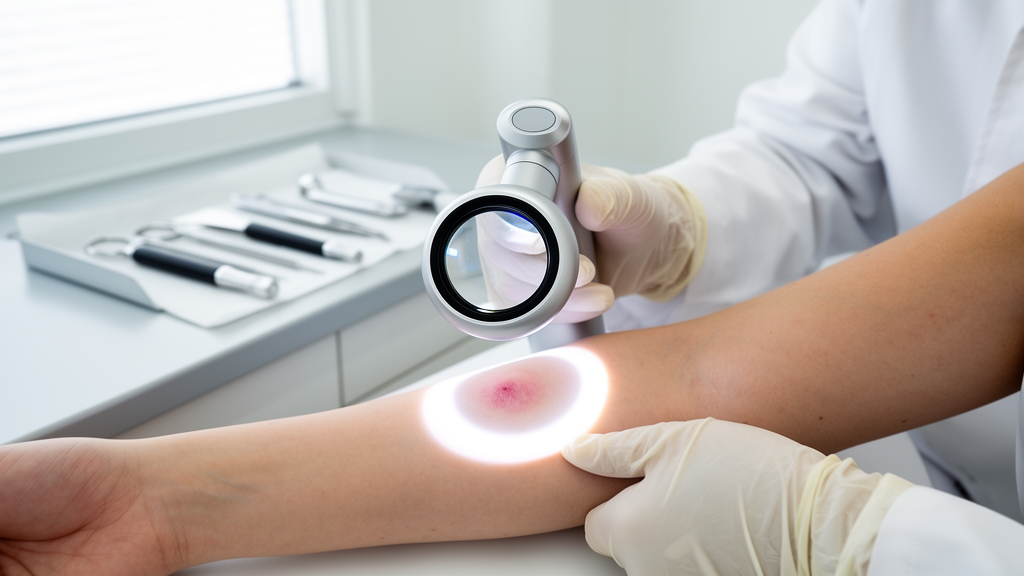
Evaluating standardized image panels scored by twenty dermatoscopists across twelve countries, the investigation demonstrated that device engineering directly dictates the visibility of critical diagnostic signals. The findings, published in Frontiers in Medicine as the POLARIS study, revealed that visibility was not uniform across contemporary hybrid instruments. Handyscope achieved the highest overall visibility ratings, whereas the DELTA 30 consistently received the lowest scores across evaluated lesions.
Polarization serves as an indispensable tool in modern dermatologic practice, reducing superficial reflections from the stratum corneum and permitting non-invasive visual access to deeper structures within the skin. When combined with contact non-polarized examination, polarized dermatoscopy exposes structures that were historically considered artifacts but are now verified as critical diagnostic clues. These polarization-dependent features have been directly integrated into principal diagnostic algorithms for early skin cancer detection, including Chaos and Clues, Prediction without Pigment, the Triage Amalgamated Dermatoscopic Algorithm, and the revised two-step algorithm. Features visible specifically under cross-polarized light include white lines or shiny white streaks, four-dotted clods arranged in rosettes, white structureless areas or blotches, and polychromatic areas showing the full color spectrum of visible light, known as the rainbow pattern. Conversely, polarization-dependent milia-like cysts are white dots and clods typically recognized more clearly under non-polarized illumination.
The biological and optical mechanisms underlying these features correlate with distinct pathophysiological alterations within cutaneous tissue. Polarization-specific white lines reflect light birefringence across remodeled collagen bundles that expand within the papillary dermis or extend deeper into the reticular dermis during fibroplasia. While an orthogonal or perpendicular arrangement of white lines is highly specific to melanoma and serves as a histopathologic marker of tumor invasiveness, disorganized white lines accompanied by structureless white areas frequently indicate basal cell carcinomas, particularly in non-pigmented variants lacking distinct vascular patterns. Similar white clods and streaks can also appear across benign lesions such as dermatofibromas, lichen planus-like keratosis, and dysplastic nevi. Polarization-specific four-dotted rosettes reflect light interactions with concentric perifollicular fibrosis or keratinous material within adnexal openings, appearing in actinic keratosis, squamous cell carcinoma, basal cell carcinoma, and inflammatory conditions. Polychromatic rainbow patterns arise from the birefringent properties of lesion stroma in Kaposi sarcoma, malignant melanoma, vascular malformations, and dermatofibromas.
To rigorously quantify how optical hardware affects feature visibility, the researchers captured consecutive cutaneous lesions displaying polarization-specific or polarization-dependent structures between August 2021 and September 2024 at a private dermatology clinic in Poznań, Poland. A single investigator photographed each lesion using standardized native camera settings on a single smartphone to prevent variable gain control, shifting white balance, or automatic high dynamic range modifications. Seven commercial dermatoscopes were compared: the DL3, DL4, and DL5 manufactured by DermLite LLC; the Handyscope manufactured by FotoFinder Systems GmbH; and the DELTA 20 T, DELTA 30, and DELTA 30 PRO manufactured by HEINE Optotechnik GmbH & Co. KG. Standardized magnetic or mechanical adapters maintained optical alignment and a fixed perpendicular distance, utilizing 70% isopropyl alcohol for flat lesions and silicone sonographic gel for nodular lesions. Aside from clinically benign conditions including scars, dermatofibromas, and angiomas, all included lesions were histopathologically confirmed, yielding a test dataset of 61 cases comprising 18 malignant, 5 borderline, and 38 benign conditions.
Twenty certified dermatoscopists completed the evaluation through a specialized testing platform after screening eliminated participants with prior awareness of device polarization differences to prevent confirmation bias. The rater cohort displayed substantial clinical background, with 55 percent reporting advanced expertise, 30 percent intermediate expertise, and half possessing over a decade of clinical practice. Within standardized panels showing synchronized magnification and identical orientations, raters independently scored feature visibility for each device on a five-point Likert scale ranging from absent to textbook quality. Observers were informed which target structures were present in each case but remained partially blinded to dermatoscope identity, although peripheral cropping could not entirely obscure distinctive manufacturer measurement reticles. Across 7,719 case-device evaluations generating 10,779 individual feature ratings, inter-rater agreement demonstrated an intraclass correlation coefficient of 0.45, reflecting moderate overall concordance across the independent international observers.
Statistical evaluation using cumulative link mixed models confirmed that dermatoscope hardware significantly altered feature visualization scores, yielding a likelihood-ratio test statistic of 209.1 with six degrees of freedom. Pairwise comparisons revealed that the DELTA 30 scored significantly lower than all six alternative instruments, with odds ratios indicating higher visibility for competing devices ranging from 7.03 to 43.21. In descriptive distributions, the DELTA 30 received low-visibility scores of two or below in 69.5 percent of assessments and high ratings of four or five in only 12.6 percent, achieving a mean score of 2.10. Conversely, the Handyscope was rated significantly higher than every other tested dermatoscope, demonstrating odds ratios between 2.31 and 43.21 and attaining high-visibility scores in 60.8 percent of assessments with a mean score of 3.68. In direct paired comparisons scoring the same lesion structure, raters scored Handyscope higher than DELTA 30 in 80.3 percent of instances and lower in only 3.7 percent.
The remaining instruments established a graded hierarchy between these extremes, led by the DELTA 20 T with a mean rating of 3.33 and high ratings in 48.0 percent of cases, followed closely by the DL4 with a mean of 3.30 and 45.7 percent high ratings. The newer DELTA 30 PRO demonstrated a marked recovery in optical performance over its direct predecessor, achieving a mean score of 3.18, high ratings in 41.6 percent of evaluations, and an odds ratio of 10.1 relative to the DELTA 30. The DL5 and DL3 recorded mean scores of 3.01 and 2.95, earning high ratings in 36.0 percent and 33.0 percent of evaluations, respectively. Stratified subgroup analyses comparing eleven advanced specialists against nine intermediate or beginner raters demonstrated that rater experience did not alter the hierarchical ranking of the instruments. Both expert and less experienced cohorts ranked the seven dermatoscopes in identical order, with permutation tests and ordinal mixed models showing no significant interaction between clinical experience and device scores.
Feature-specific analyses indicated that Handyscope retained the highest point estimates across all five evaluated structures, recording mean scores of 3.71 for white lines, 3.92 for white areas, 4.01 for polychromatic areas, 3.38 for four-dotted clods, and 3.36 for milia-like cysts. The DELTA 30 recorded the lowest visibility across every individual feature category, including mean scores of 2.06 for white lines and 1.89 for polychromatic areas. The DELTA 30 PRO ranked second behind Handyscope for four-dotted clods with a mean of 3.56 and for milia-like cysts with a mean of 4.03, though odds ratios did not demonstrate statistical superiority over Handyscope. The researchers noted that differences across structural categories suggest variations in how devices handle superficial epidermal light scattering versus deeper dermal collagen birefringence, although feature-specific estimates for several categories rested on small lesion subsets.
The physical basis for these performance discrepancies resides in underlying optical engineering, primarily spatial illumination geometry, light emitting diode placement, emission spectra, and polarization filter alignment. Because polarization-dependent structures rely fundamentally on tissue birefringence altering the polarization state of light, feature clarity is exceptionally sensitive to diode angles and illumination trajectories. Cross-polarized dermatoscopy requires illumination filters and viewing analyzers to maintain precise perpendicular alignment to eliminate surface glare from the stratum corneum. Minor manufacturing tolerances or misaligned filters permit glare leakage that overwhelms subtle subsurface birefringent signals. Furthermore, because the Handyscope maintained performance advantages across both monochromatic white patterns and polychromatic rainbow spectrums, the investigators hypothesized that spatial diode geometry and illumination angles exert a stronger influence on diagnostic clarity than spectral color temperature variations alone.
The authors emphasized several methodological constraints when interpreting these optical findings. Single commercial units were evaluated for each dermatoscope model, meaning the study could not assess unintended intra-device manufacturing variances or internal filter alignment inconsistencies across identical production lines. Image capture relied on a smartphone interface, which introduces proprietary digital signal processing, automated edge enhancement, and noise reduction algorithms that clinicians cannot disable. Additionally, the DELTA 30 PRO was represented in fewer cases due to its later commercial release, and distinctive millimeter contact scales prevented total rater blinding. Finally, because the dataset was acquired at a single European center from fair-skinned individuals exhibiting Fitzpatrick phototypes I through III, variations in epidermal melanin density mean the results cannot be directly extrapolated to skin of color without dedicated multi-center validation.
Subject of Research: Optical performance of handheld dermatoscopes in visualizing polarization-dependent skin structures
Article Title: Optical performance of handheld dermatoscopes in visualizing polarization-dependent structures – results of the polaris study
Article References: Pietkiewicz, P., Koper, M., Falkowski, P., Lesiak, A., Calik, J., Korecka, K., Giedziun, P., Akay, B. N., Kohut, I., Chia, J. C., Todorovska, V., Leszczyńska-Pietkiewicz, A., Navarrete-Dechent, C., Mayisoğlu, H., Litaiem, N., Kiss, N., Boostani, M., Karampinis, E., Kelati, A., … Salwowska, N. (2026). Optical performance of handheld dermatoscopes in visualizing polarization-dependent structures – results of the polaris study. Frontiers in Medicine, 13, Article 1972723. https://doi.org/10.3389/fmed.2026.1972723
Image Credits: AI Generated
DOI: 10.3389/fmed.2026.1972723
Keywords: dermatoscopy, polarization, skin cancer detection, Handyscope, DELTA 30, DELTA 30 PRO, DermLite DL4, birefringence, melanoma, basal cell carcinoma, optical engineering, cross-polarized light, rosettes, shiny white streaks, rainbow pattern, dermatology
News Source: Nathaniel Bowman. (November 17, 2026). Study Finds Handheld Dermatoscopes Differ Significantly in Visualizing Polarization Features. Scienmag.