Conducted by researchers at the Chinese PLA General Hospital and published in the journal Arthroplasty, the clinical investigation evaluated the operative performance and patient-reported outcomes associated with two distinct robotic architectures. The clinical trial specifically examined whether an autonomous direct-saw cutting system or an arm-positioned cutting guide plate imposes a steeper technical barrier on practicing orthopedic specialists. By tracking surgical timings, bone registration milestones, anatomical cutting precision, and two-year functional recovery scores, the research team established that while specific step durations differ between the engineering mechanisms, neither system poses an excessive learning burden for experienced arthroplasty surgeons, with both robotic paradigms ultimately delivering indistinguishable clinical improvements.
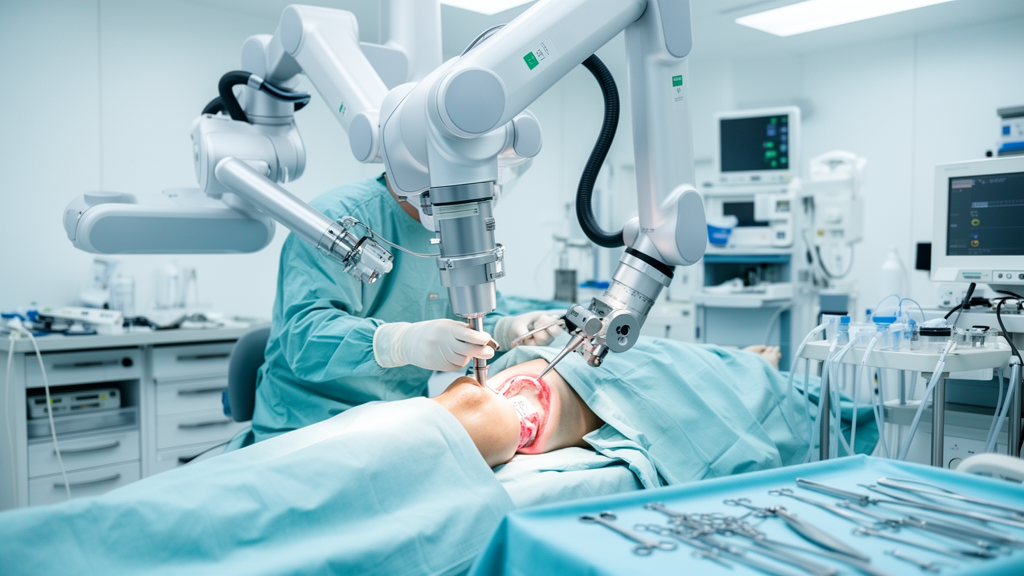
Robotic assistance in total knee arthroplasty has expanded rapidly to overcome the alignment variances and soft-tissue imbalances occasionally encountered during conventional manual joint replacement surgery. Contemporary robotic systems generally fall into two distinct engineering paradigms: direct osteotomy platforms, where an oscillating saw is rigidly mounted directly onto a robotic arm to execute autonomous bone resections, and template-guided platforms, where the robotic arm instead positions an osteotomy cutting block through which the operating surgeon manually guides a conventional oscillating saw blade. Despite widespread clinical adoption of both platforms, direct comparative evidence assessing their respective operative learning curves and mid-term clinical efficacy under controlled clinical conditions had remained scarce.
To rigorously evaluate the operational differences between these two robotic paradigms, the investigators initiated a prospective observational trial between January and May 2023, enrolling one hundred consecutive patients diagnosed with severe knee osteoarthritis requiring primary surgical replacement. Fifty consecutive patients underwent robotic total knee arthroplasty utilizing the TINAVI robotic system, an established Chinese pin-guided robotic platform representing the template-guided paradigm, paired with DePuy Attune posterior-stabilized knee implants. An identical cohort of fifty consecutive patients underwent surgical reconstruction utilizing the Stryker MAKO robotic system, representing the internationally recognized direct osteotomy paradigm, paired with Stryker Triathlon posterior-stabilized prostheses. The institutional review board approved the clinical protocol under ethics clearance number S2022-744-02, and all one hundred enrolled participants completed comprehensive postoperative monitoring through a full twenty-four months of clinical follow-up, ensuring robust data capture without patient attrition.
Surgical procedures were standardized across both cohorts and executed by two senior orthopedic surgeons, each possessing more than a decade of clinical joint replacement experience and performing over two hundred conventional total knee arthroplasties annually. Although both operating surgeons had extensive experience with conventional manual implantations of both the Triathlon and Attune prosthesis designs and were proficient with robotic bone registration protocols from prior robotic total hip arthroplasty procedures, neither surgeon had prior operative experience performing total knee reconstructions with either the TINAVI or MAKO platforms. Standard operative guidelines mandated preoperative computed tomography scans spanning the hip, knee, and ankle joints for digital surgical planning, intraoperative gap balancing, dynamic planning adjustments, strict tourniquet times limited to sixty minutes or less, and target postoperative mechanical alignment boundaries maintained within three degrees of neutral alignment.
Resection precision was evaluated immediately intraoperatively using precision vernier calipers measuring harvested bone slices to an accuracy of 0.1 millimeters, which were compared against the planned resection thickness generated by the digital navigation software. To map the operational learning curve for each surgeon across successive procedures, the researchers implemented cumulative sum control chart analysis, commonly known as CUSUM. By plotting cumulative sum deviations of osteotomy execution times relative to overall cohort means against chronological surgical case sequence numbers, the investigators mathematically modeled the inflection points that designate the exact procedural milestone where surgical efficiency stabilizes and technical proficiency is formally achieved.
The mathematical analysis revealed clear learning inflection points for both robotic technologies, demonstrating that initial technical adaptation occurs within a manageable volume of surgical cases. For the first surgeon, the cumulative sum analysis identified an osteotomy learning inflection point at case five when using the template-guided TINAVI system, compared with case nine when employing the direct-saw MAKO platform. For the second surgeon, cumulative sum modeling established identical osteotomy learning inflection points occurring precisely at case thirteen for both robotic platforms. Total operating durations for the first surgeon averaged 98.16 ± 9.68 minutes with the template-guided robot versus 118.52 ± 15.95 minutes with the direct osteotomy robot, reflecting a statistically significant procedural time advantage for the guide-plate system. Furthermore, the first surgeon’s operative duration with the direct robot decreased from 129.2 ± 11.94 minutes across the initial ten cases to 107.8 ± 15.24 minutes across the final ten cases, alongside an osteotomy duration decline from 15.30 ± 3.97 minutes down to 11.50 ± 3.21 minutes.
For the second surgeon, total operative durations exhibited smaller overall variations between the two technologies, averaging 104.52 ± 12.65 minutes with the template-guided robot and 105.76 ± 33.03 minutes with the direct osteotomy system. Across the second surgeon’s series, average operative times for the guide-plate robot decreased from 104.00 ± 8.71 minutes in the initial ten cases to 100.00 ± 14.26 minutes in the concluding ten cases, while the direct-saw platform witnessed a procedural reduction from 114.10 ± 29.19 minutes down to 112.10 ± 18.72 minutes. Osteotomy execution times for the second surgeon dropped significantly from 13.50 ± 3.41 minutes to 9.60 ± 2.72 minutes with the direct osteotomy system, while guide-plate resections decreased from 10.70 ± 2.50 minutes to 9.10 ± 3.48 minutes.
Direct caliper measurements evaluating bone cutting precision within the template-guided robotic group documented an overall resection discrepancy of 0.39 ± 1.68 millimeters relative to preoperative digital models. When comparing the initial ten cases against the final ten cases, resection error narrowed from 0.61 ± 2.00 millimeters down to 0.10 ± 1.58 millimeters, reflecting an encouraging trend toward heightened precision, although this difference did not attain statistical significance. Resection deviations along the lateral margin of the distal femur and both the medial and lateral facets of the posterior femoral condyle consistently remained below 0.1 millimeters. In contrast, bone resection error along the lateral plateau of the proximal tibia demonstrated a larger observed deviation of 1.70 ± 1.58 millimeters. Safety profiles were outstanding across the entire cohort; no intraoperative vascular or major neurological injuries occurred, zero patients required blood transfusions, no cases of prosthetic component loosening or periprosthetic joint infection emerged over twenty-four months, and all one hundred patients mobilized successfully on postoperative day one.
Longitudinal assessments of patient recovery confirmed that both robotic architectures yielded substantial, equivalent clinical improvements over two years of follow-up. Knee functional performance and general health status were tracked preoperatively, at six weeks, and at twenty-four months using the Short Form-12 Health Survey, the Hospital for Special Surgery knee scoring assessment, and the Forgotten Joint Score. At the twenty-four-month milestone, Hospital for Special Surgery scores reached 78.96 ± 5.35 in the guide-plate cohort versus 80.56 ± 5.46 in the direct osteotomy cohort, while Short Form-12 scores averaged 80.54 ± 4.67 and 81.88 ± 4.19, respectively. Forgotten Joint Scores, which quantify a patient’s ability to perform daily activities without conscious awareness of their prosthetic implant, improved from 63.6 ± 4.77 at six weeks to 79.96 ± 5.22 at two years in the guide-plate group, closely matching the direct osteotomy cohort scores of 64.38 ± 4.60 at six weeks and 80.98 ± 5.04 at two years. Across all evaluated metrics and postoperative intervals, no statistically significant differences separated the two robotic groups.
The study authors highlighted several methodological limitations that provide essential context for interpreting these clinical findings. Total surgical duration was partially influenced by variations among assistant surgical teams who placed optical tracker arrays and performed wound closures, prompting the investigators to focus their primary learning curve calculations on the lead surgeon’s dedicated osteotomy time rather than overall operating room time. Additionally, because the institutional supply of alternative robotic platforms was limited, the trial utilized the domestic TINAVI platform rather than the international ROSA or DePuy VELYS systems, pairing it with DePuy Attune prostheses because TINAVI lacks proprietary knee components.
Subject of Research: Comparison of surgical learning curves and functional outcomes between direct osteotomy and template-guided robotic total knee arthroplasty systems
Article Title: Comparison of the learning curves of the osteotomy guide robot and guide plate-based robot-assisted total knee arthroplasty
Article References: Zhi, X., Liu, T., Ren, P., Zheng, Q., Ni, M., & Zhang, G. (2026). Comparison of the learning curves of the osteotomy guide robot and guide plate-based robot-assisted total knee arthroplasty. Arthroplasty, 8(1), Article 34. https://doi.org/10.1186/s42836-026-00388-5
Image Credits: AI Generated
DOI: 10.1186/s42836-026-00388-5
Keywords: total knee arthroplasty, robotic surgical procedures, learning curve analysis, osteotomy guide robot, guide plate-based robotics, TINAVI robotic system, MAKO robotic system, cumulative sum analysis, orthopedic surgery, Hospital for Special Surgery score, Short Form-12 Health Survey, Forgotten Joint Score, bone resection accuracy, knee osteoarthritis, surgical operative time, joint replacement rehabilitation
News Source: Ophelia Keating. (November 14, 2026). Study Finds Comparable Learning Curves for Direct and Template Robotic Knee Surgeries. Scienmag.