• HOME
  • NEWS
  • EXPLORE
    • CAREER
      • Companies
      • Jobs
    • EVENTS
    • iGEM
      • News
      • Team
    • PHOTOS
    • VIDEO
    • WIKI
  • BLOG
  • COMMUNITY
    • FACEBOOK
    • INSTAGRAM
    • TWITTER
Wednesday, December 10, 2025
BIOENGINEER.ORG
No Result
View All Result
  • Login
  • HOME
  • NEWS
  • EXPLORE
    • CAREER
      • Companies
      • Jobs
        • Lecturer
        • PhD Studentship
        • Postdoc
        • Research Assistant
    • EVENTS
    • iGEM
      • News
      • Team
    • PHOTOS
    • VIDEO
    • WIKI
  • BLOG
  • COMMUNITY
    • FACEBOOK
    • INSTAGRAM
    • TWITTER
  • HOME
  • NEWS
  • EXPLORE
    • CAREER
      • Companies
      • Jobs
        • Lecturer
        • PhD Studentship
        • Postdoc
        • Research Assistant
    • EVENTS
    • iGEM
      • News
      • Team
    • PHOTOS
    • VIDEO
    • WIKI
  • BLOG
  • COMMUNITY
    • FACEBOOK
    • INSTAGRAM
    • TWITTER
No Result
View All Result
Bioengineer.org
No Result
View All Result
Home NEWS Science News

Study discovers proteins which suppress the growth of breast cancer tumors

Bioengineer by Bioengineer
June 12, 2017
in Science News
Reading Time: 3 mins read
0
Share on FacebookShare on TwitterShare on LinkedinShare on RedditShare on Telegram
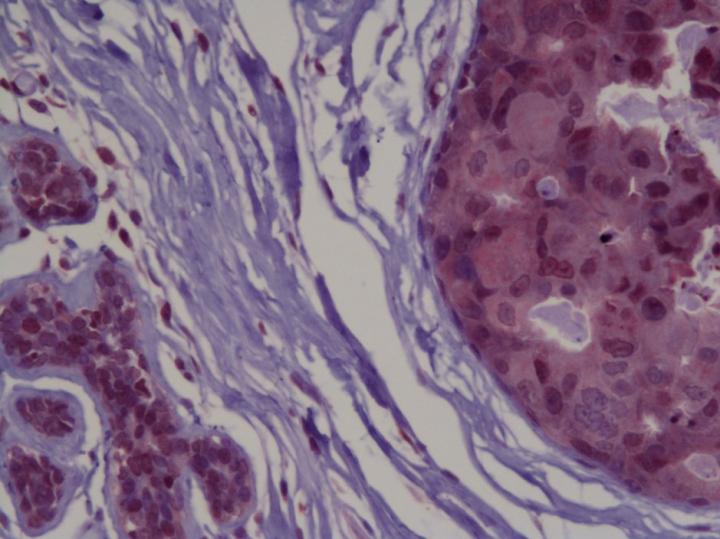
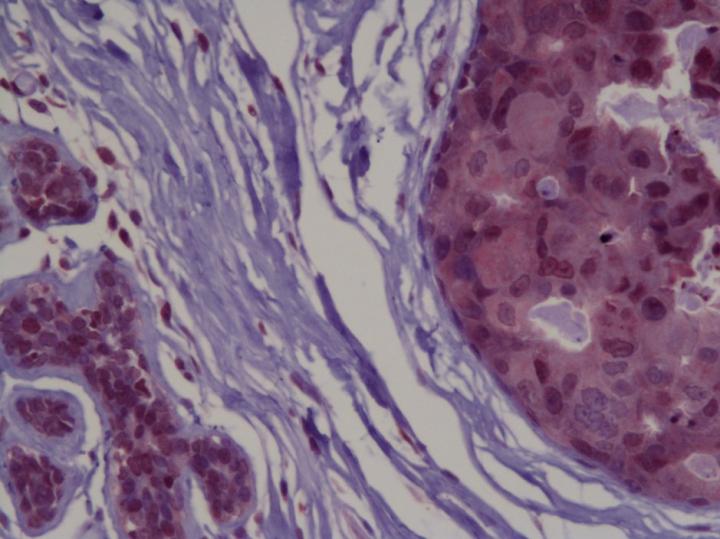
IMAGE

Credit: University of Birmingham

Researchers at the University of Birmingham have found that a type of protein could hold the secret to suppressing the growth of breast cancer tumours.

The research, published today in Oncogenesis, examined the role Proline-Rich Homeodomain protein (PRH) can play in the progression of breast cancer tumours and could, in turn, help to better determine the prognosis for patients with the disease.

Dr Padma Sheela Jayaraman, of the University of Birmingham's Institute of Cancer and Genomic Sciences, said: "PRH is a protein that controls and regulates when genes are switched on or off.

"However, prior to our research, the role of this protein in breast cancer has been poorly understood.

"Public databases show that, in a large number of breast cancer patients with a poor prognosis, the activity of the PRH gene had decreased.

"However, it was not known whether the amount of PRH protein was also lower in these patients as protein levels had not been recorded."

The researchers used a special staining process on breast cancer tissue removed during biopsy to observe the levels and location of PRH proteins in breast cancer cells. They found that in a small study there were changes in PRH proteins in tumour cells compared to normal cells that were consistent with the decreased activity of the PRH gene in the public database.

Dr Jayaraman added: "In the laboratory, we found that when PRH protein levels are reduced in a breast tumour the cells are more able to divide, speeding up the progression of the tumour.

"Moreover, we identified some of the genes which are regulated by PRH and specifically contribute to the increased cell division."

The researchers also carried out tests in a tumour model of mammary cancers, increasing PRH levels to observe the effect.

"We made the significant finding that high levels of PRH actually blocked the formation of the tumours, therefore our data suggests that PRH can block tumour formation in some breast cancers," added Dr Jayaraman.

"We propose that monitoring PRH protein levels or activity in patients with breast cancer could be particularly important for assessing their prognosis.

"In addition, since PRH is known to be important in multiple cell types, this work has important implications for other types of cancer.

"We are now working to investigate the importance of PRH in prostate cancer and in cancer of the bile duct, a type of liver cancer."

###

For further information or interviews contact Emma McKinney, Press Office, University of Birmingham, at 0121 414 6681 or email [email protected] or call the Press Office out of hours on +44 (0)7789 921165.

Notes to Editors

  • The University of Birmingham is ranked amongst the world's top 100 institutions. Its work brings people from across the world to Birmingham, including researchers, teachers and more than 5,000 international students from over 150 countries.
  • Kershaw et al. (2017). 'Proline-Rich Homeodomain protein (PRH/HHEX) is a suppressor of breast tumour growth'. Oncogenesis. DOI: 10.1038/oncsis.2017.42

Media Contact

Emma McKinney
[email protected]
44-012-131-36681
@unibirmingham

http://www.bham.ac.uk

Related Journal Article

http://dx.doi.org/10.1038/oncsis.2017.42

############

Story Source: Materials provided by Scienmag

Share12Tweet8Share2ShareShareShare2

Related Posts

HBV and HDV Genotypes Link to Liver Disease Risk

HBV and HDV Genotypes Link to Liver Disease Risk

December 10, 2025
Natural Oils and Nano-Emulsions: Herbicide Alternatives for Weeds

Natural Oils and Nano-Emulsions: Herbicide Alternatives for Weeds

December 10, 2025

Stable Biopolymer Hydrogels for Controlled Metal Nanostructure Release

December 9, 2025

Transparent Solar Cells with UV-Blocking Fluorene Dyes

December 9, 2025
Please login to join discussion

POPULAR NEWS

  • New Research Unveils the Pathway for CEOs to Achieve Social Media Stardom

    New Research Unveils the Pathway for CEOs to Achieve Social Media Stardom

    204 shares
    Share 82 Tweet 51
  • Scientists Uncover Chameleon’s Telephone-Cord-Like Optic Nerves, A Feature Missed by Aristotle and Newton

    121 shares
    Share 48 Tweet 30
  • Neurological Impacts of COVID and MIS-C in Children

    108 shares
    Share 43 Tweet 27
  • Nurses’ Views on Online Learning: Effects on Performance

    69 shares
    Share 28 Tweet 17

About

We bring you the latest biotechnology news from best research centers and universities around the world. Check our website.

Follow us

Recent News

HBV and HDV Genotypes Link to Liver Disease Risk

Natural Oils and Nano-Emulsions: Herbicide Alternatives for Weeds

Stable Biopolymer Hydrogels for Controlled Metal Nanostructure Release

Subscribe to Blog via Email

Success! An email was just sent to confirm your subscription. Please find the email now and click 'Confirm' to start subscribing.

Join 69 other subscribers
  • Contact Us

Bioengineer.org © Copyright 2023 All Rights Reserved.

Welcome Back!

Login to your account below

Forgotten Password?

Retrieve your password

Please enter your username or email address to reset your password.

Log In
No Result
View All Result
  • Homepages
    • Home Page 1
    • Home Page 2
  • News
  • National
  • Business
  • Health
  • Lifestyle
  • Science

Bioengineer.org © Copyright 2023 All Rights Reserved.