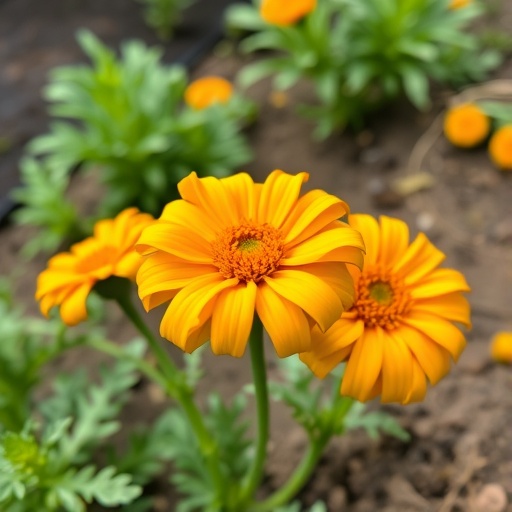
In recent times, the quest for sustainable agricultural practices has taken center stage in scientific discourse. One of the most promising developments in this realm has been the investigation of struvite as a viable alternative to traditional fertilizers. Researchers have turned their attention to the integration of struvite in soilless cultivation systems, particularly focusing on the popular ornamental plant Marigold, scientifically known as Tagetes erecta. The findings from this research could fundamentally alter conventional fertilizer use, showcasing the potential benefits of recycling nutrients from organic waste materials.
Struvite, a crystalline compound composed of magnesium, ammonium, and phosphate, has emerged as a focus for agronomists aiming to enhance soil fertility while minimizing environmental damage. The formation of struvite from waste materials, such as wastewater and agricultural byproducts, not only presents an innovative approach to nutrient recovery but also addresses pressing issues related to waste management in urban settings. The dual benefit of nutrient recycling and environmental remediation makes struvite an attractive option for modern horticultural practices.
The research conducted by Neofytou, Chrysargyris, and Tzortzakis delves into the application of struvite in soilless systems, a cultivation method characterized by its efficiency and minimal land use. Marigolds, specifically known for their vibrant colors and pest-repelling properties, serve as an ideal plant species to assess the efficacy of struvite as a nutrient source. The study examines various concentrations of struvite application to gauge its impact on plant growth, flower yield, and overall health, marking a significant step towards innovation in ornamental horticulture.
Initial findings indicate that marigolds thrive when provided with struvite as an alternative nutrient source. The incorporation of struvite in fertigation systems—where nutrients are delivered directly to the plant’s root zone through water—has shown promising results. Plants receiving optimal levels of struvite exhibit enhanced growth rates and robust flowering compared to those nourished with conventional fertilizers. This not only supports the potential of struvite use but also highlights a reduced reliance on synthetic fertilizers, which can lead to soil health degradation over time.
Moreover, the research emphasizes the environmental ramifications of moving towards struvite-based fertilizers. Traditional fertilizers often contain harmful substances that can leach into water systems, causing pollution and eutrophication. Struvite, on the other hand, is not only non-toxic but also promotes a circular economy approach by converting waste into valuable resources. This aligns with global sustainability goals, placing emphasis on minimizing the ecological footprint of agricultural practices.
Interestingly, the study also explores the economic implications of struvite use. By repurposing waste materials into a functional fertilizer, farmers can potentially lower their input costs. As struvite is derived from excess nutrients present in wastewater treatment processes, using it as a fertilizer not only facilitates cost savings but also reduces the overall need for importing fertilizers that often come with significant transport emissions and costs.
However, the research does face challenges, particularly in scaling the use of struvite from laboratory settings to commercial applications. Questions around the consistency of nutrient release rates from struvite, as well as its interaction with other growing media components, must be addressed before it can be widely adopted. Ongoing studies aim to refine the processes that govern struvite application, ensuring that it can consistently meet the nutritional demands of various crops, including ornamentals such as Marigold.
Another vital aspect of the discussion around struvite involvement in agriculture is its role within the larger framework of food security. By enhancing the nutritional quality of crops while promoting sustainable practices, the findings from the research hold promise for future agricultural resilience. Further exploration into struvite-produced fertilizers could pave the way for innovations that not only yield healthier plants but also contribute to global efforts in combating hunger and malnutrition.
Ongoing research efforts will also investigate how struvite impacts soil microbiomes, the communities of microorganisms that play a crucial role in maintaining soil health. Understanding the interactions between struvite and soil microbes can provide insights into establishing well-balanced ecosystems that enhance plant growth and resilience.
The study highlights a paradigmatic shift needed in how we perceive waste materials. Rather than viewing waste as a burden, the potential of transforming it into resourceful solutions like struvite beckons a new way of thinking in agricultural practices. Encouraging the adoption of this mindset could lead to sustainable farming techniques that benefit the environment and farmers alike.
As we move forward in this era of climate change and resource scarcity, research such as this plays a pivotal role in shaping sustainable agricultural practices. The innovative application of struvite as an alternative fertilizer component can significantly influence not only horticulture but all aspects of farming. With further investigation and validation, struvite could emerge as a cornerstone in the transition towards a regenerative agricultural model.
The fabric of agricultural science is being woven with more sustainable threads, and struvite is just one piece of this intricate puzzle. As the importance of waste management and nutrient recycling becomes increasingly paramount, the journey towards a greener and more efficient agricultural system continues to unfold, and studies like those from Neofytou et al. will undoubtedly steer the direction for future research and development.
In conclusion, the findings from this innovative approach to fertilizer use underscore the importance of continuous exploration in agricultural science. The implications of these studies resonate far beyond the laboratory and into the fields where they can have a tangible impact on farming practices, environmental health, and food security for future generations.
Subject of Research: The use of struvite as an alternative fertilizer component in soilless cultivation systems.
Article Title: Struvite as an Alternative Fertilizer Component in Soilless Cultivation of Marigold (Tagetes erecta) L.
Article References:
Neofytou, G., Chrysargyris, A. & Tzortzakis, N. Struvite as an Alternative Fertilizer Component in Soilless Cultivation of Marigold (Tagetes erecta L.).
Waste Biomass Valor (2026). https://doi.org/10.1007/s12649-025-03469-9
Image Credits: AI Generated
DOI: https://doi.org/10.1007/s12649-025-03469-9
Keywords: Struvite, alternative fertilizer, soilless cultivation, Marigold, sustainable agriculture, nutrient recovery, environmental impact.