A nationwide educational needs assessment of practicing variant scientists in Israel has guided the development of a structured, scalable training program designed to standardize clinical variant interpretation across genomics services. Published in BMC Medical Education, the study evaluated the training backgrounds, daily workflows, and professional difficulties of 38 practicing variant scientists, representing approximately 48 percent of the estimated 80 variant scientists employed across Israeli clinical genomics facilities. In response to wide variation in training pathways and heavy reliance on informal learning, a multidisciplinary working group established a comprehensive curriculum combining core theoretical instruction, supervised experiential practice, and standardized competency assessment. The newly formulated framework addresses an urgent requirement within clinical genomics, where the rapid adoption of high-throughput sequencing technologies has made accurate variant interpretation essential for clinical diagnostics, patient management, and genetic counseling. By aligning educational content with empirical workforce needs, the initiative provides a practical model to improve diagnostic consistency across modern genomic medicine laboratories.
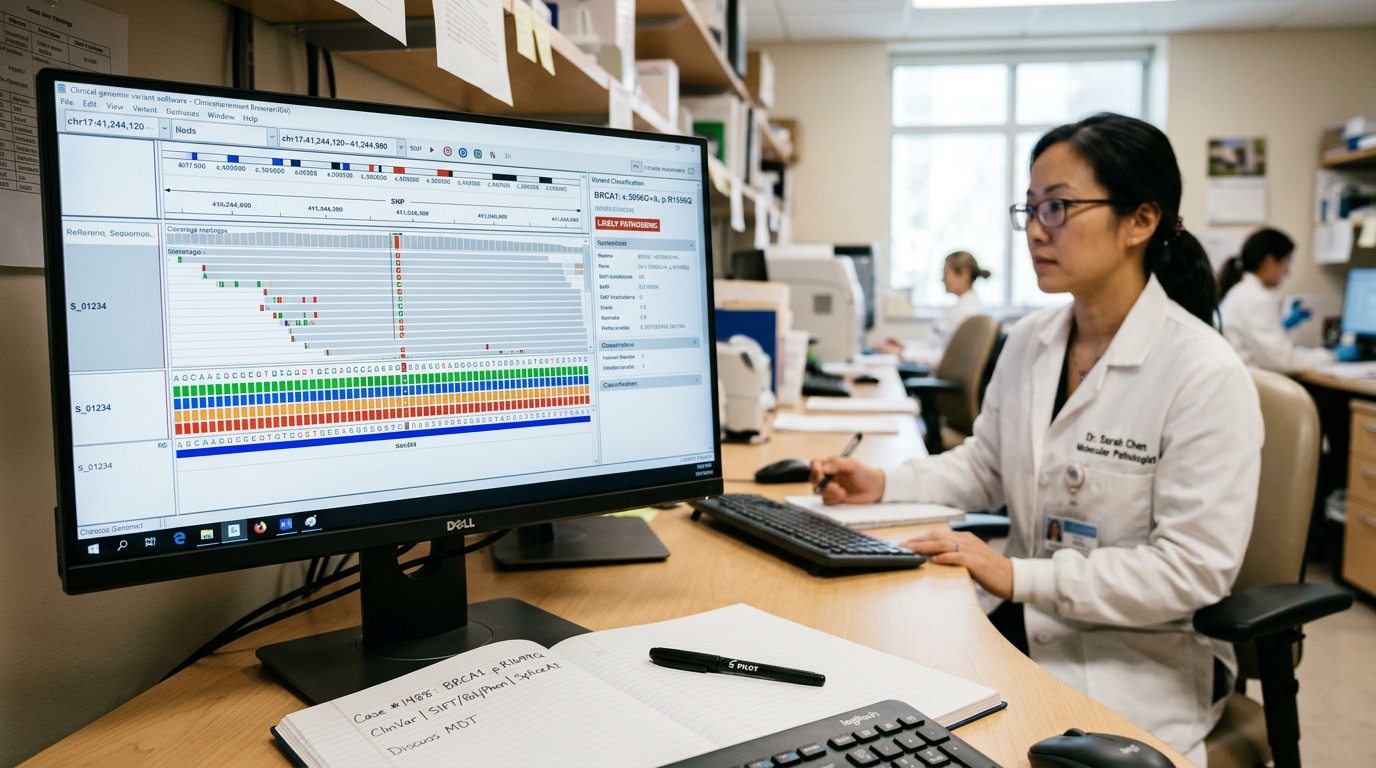
Over the past decade, variant interpretation has evolved into a dynamic, highly specialized scientific discipline shaped by continuous progress in sequencing technologies, curated databases, and clinical guidelines. Following the introduction of the 2015 ACMG/AMP classification standards, alongside general recommendations from the ClinGen Sequence Variant Interpretation Working Group and specialized gene-disease specifications, the technical evaluation of genomic variants has grown significantly more complex. This analytical complexity is driven by advances in whole-genome and long-read sequencing platforms, expanding population and functional datasets, advanced prediction algorithms, and multiplex functional assays that analysts must integrate for each variant. Within modern clinical laboratories, variant scientists hold a central responsibility, integrating diverse genomic evidence sources to classify variants and generate clinically actionable interpretations that direct diagnostic outcomes, therapeutic decisions, and genetic counseling. Because precise interpretation enables timely clinical intervention, diagnostic misclassification presents major risks, including missed diagnoses, incorrect therapeutic management, and unnecessary psychological anxiety for patients and their families.
Despite the foundational role of variant interpretation in clinical genomics, formal educational pathways for variant scientists remain considerably less standardized than those established for peer healthcare professions. Established medical genomics specialties benefit from well-defined training structures and rigorous accreditation systems that maintain consistent professional competencies across institutions. In many countries, genetic counselors must complete an accredited master of science degree and pass a national certification examination to practice. Similarly, medical geneticists complete clinical residencies, practical training, and continuous education, while clinical laboratory directors and molecular technologists must obtain doctoral or master degrees followed by board certification in genetic testing, variant interpretation, and clinical reporting. In contrast, variant scientist training remains fragmented internationally. While recent initiatives have emerged, including the Graduate Certificate in Genomic Counselling and Variant Interpretation at the University of British Columbia, published literature describing structured, workplace-based training programs designed specifically for variant scientists in clinical diagnostic laboratories remains remarkably limited.
To evaluate existing educational gaps, onboarding practices, and daily analytical workflows, the researchers conducted an anonymous nationwide survey targeting practicing variant scientists across Israel. Distributed electronically through professional WhatsApp groups, the survey reached practitioners within hospital-based genetics institutes, health maintenance organization genomics departments, and private clinical laboratories. According to Israeli Society of Medical Genetics data, approximately 80 variant scientists work nationally, meaning the 38 eligible survey participants represented approximately 48 percent of the country’s active variant scientist workforce. Although 39 total questionnaires were submitted, one response was excluded because fewer than half of the questions were answered, leaving 38 valid submissions for descriptive analysis in Microsoft Excel.
Survey responses revealed striking heterogeneity across previous training routes, with participants reporting heavy dependence on informal, decentralized learning methods rather than formal academic or vocational curricula. Only 18.4 percent of respondents (7 out of 38) reported completing a dedicated variant scientist training course, whether taken domestically or abroad. In contrast, structured workplace training was reported as a primary learning approach by 34.xx percent of participants (13 out of 38). The most commonly reported learning modality was observational shadowing of senior expert analysts, cited by 42.1 percent of respondents (16 out of 38), followed closely by independent self-directed study, which was reported by 39.5 percent (15 out of 38). Additionally, 18.4 percent of respondents (7 out of 38) identified self-directed hands-on practical experience as their primary learning method. These empirical survey findings confirmed that most practicing variant scientists historically entered clinical diagnostic workflows through informal, unstandardized mechanisms lacking structured oversight, uniform instructional curricula, or objective assessments of interpretive competence.
When evaluating the primary professional hurdles encountered in routine practice, participants identified several major technical, diagnostic, and operational challenges. The most frequently cited challenge, reported by 55.3 percent of respondents (21 out of 38), was keeping pace with rapidly evolving interpretation guidelines, particularly ClinGen specifications and anticipated framework updates. Copy number variant analysis represented the second most prevalent challenge, highlighted by 47.4 percent of respondents (18 out of 38). Furthermore, 28.9 percent of participants (11 out of 38) reported difficulties stemming from workforce shortages and restricted access to bioinformatics tools or databases. Complex variant classification rules were reported as challenging by 23.7 percent of participants (9 out of 38), while clinical diagnostic report writing was selected least frequently, by 10.5 percent (4 out of 38).
The survey also characterized the technical tools, curation databases, and methodological scoring systems utilized across diagnostic facilities. Although variant scientists frequently use commercial or proprietary tertiary analysis software, including Franklin or VarSome, reliance on automated classifications varied widely. A majority of respondents, representing 65.8 percent (25 out of 38), reported utilizing tertiary computational tools alongside additional manual interpretation methods. In contrast, three respondents relied entirely on automated software outputs, whereas eight participants reported that they did not rely on automated tertiary software for final classifications. Familiarity with ClinGen recommendations was extremely high, utilized by 91.9 percent of respondents (34 out of 37). Formal scoring systems were applied by 84.2 percent of participants (32 out of 38), although one participant lacked familiarity with scoring systems. Regarding curated resources, 62.2 percent of respondents (23 out of 37) utilized the Human Gene Mutation Database, while 21.6 percent (8 out of 37) expressed a desire to use it but lacked institutional access.
In terms of continuous learning, 42.1 percent of respondents (16 out of 38) attended international scientific conferences, and 57.9 percent (22 out of 38) engaged regularly in professional forums or lectures, though several noted constraints involving institutional support or time. When identifying priorities for improving the discipline, 78.4 percent of respondents (29 out of 37) emphasized enhancing employment conditions, while 51.4 percent (19 out of 37) prioritized establishing formal training pathways. Developing a national variant knowledge base was advocated by 48.6 percent (18 out of 37), strengthening inter-laboratory collaboration was favored by 32.4 percent (12 out of 37), and refining tertiary tools was selected by 24.3 percent (9 out of 37). Informed by these survey findings, a multidisciplinary working group—comprising a senior variant scientist, clinical geneticist, genetic counselor, genomic laboratory director, and bioinformatician—defined core competencies and iteratively developed a phased curriculum, refining its sequence and activities during the onboarding of five newly recruited variant scientists.
The resulting training program is structured into distinct, sequential educational phases designed to advance trainees systematically from theoretical concepts to autonomous clinical practice. The initial foundational phase spans four weeks, providing structured instruction in genomic variation, nomenclature conventions, inheritance models, gene-disease curation, next-generation sequencing workflows, file formats, and quality control metrics. Trainees receive guided practice with genetic databases, in silico prediction algorithms, interpretation software, institutional standard operating procedures, and ethical considerations, alongside laboratory observations to observe sequencing processes and recognize technical artifacts that could alter interpretation. Following this foundational month, trainees enter an applied experiential phase lasting three to six months, comprising approximately 500 hours of practical training. Working within active diagnostic workflows under the direct supervision of a senior variant scientist, each trainee curates approximately 50 clinical cases. Progression toward independent practice is individualized based on demonstrated competency rather than rigid schedules, concluding with a blind assessment of 20 clinical cases to verify interpretation accuracy.
To support continuous professional development, the educational framework incorporates weekly multidisciplinary review meetings where teams collaboratively evaluate complex, borderline, or uncertain variants. These regular case conferences reinforce evidence-based reasoning, promote transparent decision-making, and ensure the consistent application of ACMG/AMP and ClinGen criteria, helping to reduce inter-laboratory interpretation discrepancies that published studies show can result in overall concordance rates of only 54 percent and clinically significant discordance in 11 percent of cases. Additionally, a longitudinal educational network provides monthly inter-institutional sessions covering advanced technologies—such as long-read sequencing, methylation profiling, and optical genome mapping—alongside updated curation frameworks including ACGS and MaveDB. Although the study authors acknowledged notable operational limitations, including implementation within a single healthcare system, the initial absence of standardized pre- and post-training objective evaluation metrics, and potential self-reported survey response bias, they concluded that structured onboarding combined with continuous inter-institutional learning provides a scalable model to strengthen the international variant scientist workforce.
Subject of Research: Workforce training and competency standardization for variant scientists in clinical genomics
Article Title: Educational framework to strengthen the variant scientist workforce in clinical genomics
Article References: Marek-Yagel, D., Greenberg, R., Naftali, M., Isakov, O., & Ben-Shachar, S. (2026). Educational framework to strengthen the variant scientist workforce in clinical genomics. BMC Medical Education, 26(1), Article 1795. https://doi.org/10.1186/s12909-026-10014-2
Image Credits: AI Generated
DOI: 10.1186/s12909-026-10014-2
Keywords: clinical genomics, variant interpretation, variant scientists, medical education, curriculum development, genetic testing, competency assessment, genomic medicine, Educational, framework, strengthen, variant
News Source: Courtney Benton. (November 6, 2026). Structured Training Framework Developed to Strengthen Variant Scientist Workforce in Clinical Genomics. Scienmag.