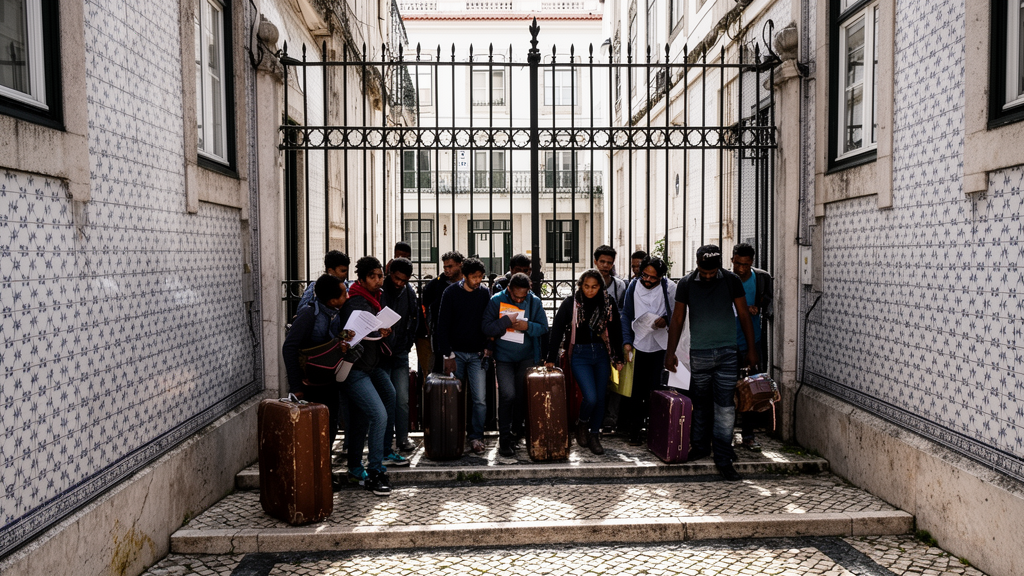
A comprehensive qualitative investigation conducted in Portugal demonstrates that the fundamental well-being and social inclusion of newly arrived refugees are primarily hindered by institutional, legal, and structural barriers rather than individual psychological deficits. Published in Frontiers in Public Health by researchers from the Applied Psychology Research Center Capabilities and Inclusion at ISPA Instituto Universitário in Lisbon, the study evaluates post-migration living experiences using the capability approach as an alternative framework to traditional clinical paradigms. The authors examined how nineteen refugees and asylum seekers residing across the Lisbon metropolitan area navigate complex daily settlement systems. Across detailed narrative assessments, the investigation determined that systemic inadequacies within housing security, public healthcare access, and personal bodily integrity represent the most severe structural impediments newcomers face. Rather than demonstrating that individual traumatic backgrounds or sociodemographic characteristics directly cause reduced well-being, the empirical findings highlight that restrictive governance structures, administrative ambiguity, and socioeconomic deprivation function as systemic drivers that curtail refugees’ substantive freedoms and capacity to achieve self-sufficiency.
For decades, conventional psychological and public health scholarship concerning displaced populations has concentrated heavily on psychiatric symptomatology, emphasizing the prevalence of post-traumatic stress disorder, clinical anxiety, and major depression under a predominantly biomedical framework. The authors emphasize that while assessing pre-migratory and transit trauma remains vital, this clinical focus has historically medicalized, dehistoricized, and depoliticized refugees’ lived realities by portraying people on the move almost exclusively through lenses of vulnerability, victimhood, and personal deficit. To counterbalance this individual-centered focus, the research team grounded their inquiry in the capability framework formulated by Amartya Sen and Martha Nussbaum, intersecting it with principles of community psychology and broader scholarship on post-migration living difficulties. The capability approach conceptualizes human welfare in terms of capabilities, defined as the actual, substantive opportunities that individuals have to pursue ways of being and doing that they have reason to value, and functionings, which reflect those valued activities and states realized through choice. By focusing on conversion factors that enable or block the translation of external resources into meaningful life choices, the authors analyzed how municipal and national administrative structures actively shape or suppress refugees’ opportunities.
The investigation was carried out within the specific institutional landscape of Portuguese migration governance, where national reception frameworks operate under national asylum legislation while distributing integration responsibilities across a decentralized network of state bodies, municipalities, and non-governmental entities. At the time the underlying doctoral fieldwork commenced, public administrative responsibilities were shared between the Foreigners and Borders Service, which managed border enforcement, legal regularization procedures, and international protection processing, and the High Commission for Migration, tasked with designing reception models and coordinating hosting entities. Operational delivery of accommodation, material subsidies, and initial integration services was substantially delegated to civil society organizations, such as the Portuguese Council for Refugees, the Jesuit Refugee Service, Social Security, and local municipal platforms. Prior research cited by the authors documented that although state commitments toward international protection expanded following European migration agendas, the Portuguese integration system has frequently been characterized by institutional inexperience, resource constraints, administrative fragmentation, and an overreliance on improvised responses coordinated by charitable and community groups, creating substantial discrepancies between formal policy intentions and operational realities.
To explore these complex dynamics empirically, the research protocol employed an in-depth qualitative design utilizing hybrid deductive-inductive thematic coding. Ethical clearance was formally granted by the ISPA Ethics Committee. Participant recruitment took place between April 2021 and November 2024 across the metropolitan area of Lisbon through purposive and snowball sampling strategies conducted in collaboration with a community-based collective and a refugee-led organization. The final study cohort comprised nineteen adults aged 18 to 42 years, with a mean age of 31.4 years and an average duration of residence in Portugal of 18.3 months, spanning from 6 months up to 60 months. The sample included ten cisgender women and nine cisgender men originating from diverse geographic regions, including Asia, Southern Africa, the Middle East, West Africa, Central Africa, Northeast Africa, and North Africa. In terms of legal status, ten held formal refugee status, seven were active asylum seekers awaiting formal decisions, one was a beneficiary of subsidiary protection, and one had entered through an administrative expression of interest procedure. Thirteen participants were unemployed, six were employed, and living arrangements encompassed shared room rentals, hostels, temporary institutional centers, and independent rental housing.
Before conducting data collection, the researchers collaborated with three community mediators possessing personal displacement histories to translate and contextually adapt Martha Nussbaum’s ten central human capabilities into five tailored dimensions relevant to the settlement environment: life circumstances and emotions, access to healthcare services, housing security, bodily integrity, and control over one’s environment. Semi-structured in-depth interviews, lasting from 11 minutes to over 110 minutes with an average duration of one hour and forty minutes, were executed predominantly face-to-face in Portuguese or English, with Arabic interpretation provided by voluntary community mediators when necessary. All transcribed narrative material was systematically reviewed and coded within Dedoose software, integrating analytic memos to ensure methodological reflexivity. The resulting analytical coding architecture revealed substantial intersectionality across the identified capability domains. In evaluating life circumstances and emotions, the authors documented that participants frequently experienced profound chronic insecurity, institutional ambiguity, and arbitrary delays during asylum processing. Informants described feelings of entrapment, disorientation, and systemic humiliation, noting that social interactions with administrative agencies frequently reproduced paternalistic stereotypes of the needy refugee, which undermined their personal autonomy and emotional stability.
Access to public healthcare services surfaced as one of the most critical structural deficits, disproportionately impacting female participants and families with complex medical needs. Under Portuguese statutory law, both recognized refugees and beneficiaries of subsidiary protection are formally entitled to public social assistance and national healthcare access comparable to domestic citizens. Nevertheless, participants encountered severe administrative bottlenecks, extensive language barriers, and a pervasive absence of official translation services within primary health facilities. Crucially, the systemic scarcity of assigned family doctors forced many individuals to rely exclusively on hospital emergency rooms for routine ailments, general inquiries, and preventative care. Others were entirely unaware of how the National Health Service operated due to an absence of institutional guidance. The authors documented that administrative hurdles varied by legal categorization; for instance, individuals possessing expression of interest status faced additional bureaucratic documentary requirements before accessing care. In several acute cases, prolonged delays in diagnostic referrals and specialized interventions forced participants to forego domestic clinical appointments entirely or rely on informal remote telecommunications with medical professionals in their countries of origin.
Housing security emerged as the capability domain marked by the most persistent systemic failures, functioning as a primary determinant of vulnerability across the entire cohort. Lisbon’s acute broader metropolitan housing crisis, escalating private rent costs, and stringent landlord guarantees created an environment where independent housing remained largely unattainable. Participants reported receiving nominal institutional monthly subsidies, typically ranging from 150 to 175 euros per person, or housing support grants around 210 euros, which were entirely insufficient to secure private accommodations where individual room rentals frequently demanded 350 euros or more. Recognized refugees placed in state-funded apartments faced mandatory program discharge after eighteen months without viable transitional alternatives, causing several longer-term residents to slide back into emergency hostels or overcrowded shared rooms. Single mothers faced severe discrimination from property owners unwilling to accept minor children, while municipal recommendations to relocate to remote inland municipalities, such as Guarda, were rejected due to the risk of severing specialized pediatric hospital links in the capital. The authors observed that institutions often operated under a do-it-yourself paradigm, expecting newcomers to secure market rentals independently despite lacking financial guarantors, tax filings, or formal employment contracts.
The study demonstrated that inadequate shelter and living conditions directly impaired participants’ bodily integrity, an outcome that exhibited marked gender disparities. While male respondents generally expressed satisfaction with broad public street safety in Portugal, half of the women interviewed reported direct threats to their bodily security, physical peace, and personal dignity. Women housed in structurally degraded, highly segregated neighborhoods described sleeplessness and persistent anxiety caused by nighttime disturbances and insufficient police protection. Furthermore, severe workplace exploitation was reported among isolated female asylum seekers whose informal employers leveraged their lack of local family networks and language skills to impose harsh conditions. The authors also documented extreme institutional distrust at national entry points, highlighting a case where an incoming pregnant asylum seeker with children was subjected to maternity testing, temporary detention, and subsequent child removal by social services under administrative assessments of normative parenting standards. Such practices, the researchers argue, illustrate how border governance and reception protocols can enact deep structural violence against marginalized, racialized migrant mothers under institutional cultures of disbelief.
Negotiating control over one’s material and social environment proved equally constrained across gender groups, largely due to precarious labor conditions and administrative dependencies. While informants displayed consistent agency, motivation, and desire to achieve financial independence, the structural design of welfare subsidies frequently disincentivized formal employment. Securing low-wage, informal, or entry-level positions often prompted the immediate cancellation of state allowances, leaving households in deeper financial precarity than before. Paradoxically, obtaining formal refugee status did not guarantee greater stability; only two of the ten recognized refugee participants were employed at the time of the study, as the loss of structured initial aid thrust them into an unsupportive labor and housing market. Confronted with widespread informational deficits regarding legal entitlements, several participants described their relationship with migration authorities as unfolding along a spectrum of strategic ignorance or omission. To navigate these profound systemic constraints, refugees mobilized informal solidarity networks, leveraged accidental personal contacts to secure employment, and strategically utilized institutional narratives of powerlessness to access vital survival resources and maintain forward-looking family aspirations.
In evaluating the limitations of their investigation, the authors note that the qualitative, context-specific methodology was tailored to uncover in-depth personal trajectories within Lisbon and is not intended to provide statistical generalizations across entire national or international refugee demographics. Additionally, because the research explicitly prioritized the identification of structural constraints and human rights deficits within migration governance, the researchers emphasize that future inquiries should explore the specific community resources, institutional facilitators, and protective factors that actively support capability expansion and human flourishing. Ultimately, the study concludes that public health and migration scholarship must undergo a structural and contextual turn, shifting focus from individual psychiatric symptom counts to the material determinants of daily existence. The authors call for urgent policy accountability, comprehensive language education, reform of restrictive welfare thresholds, and the replacement of institutionalized temporary hostel models with sustainable, community-integrated housing initiatives that protect newcomers’ fundamental human rights, autonomy, and dignified participation in civic life.
Subject of Research: Qualitative evaluation of structural constraints and capability dimensions among refugees settling in Lisbon, Portugal
Article Title: Exploring refugees’ capabilities: the role of sociodemographic characteristics and structural constraints
Article References: Briozzo, E., Sacchetto, B., Ornelas, J., & Vargas-Moniz, M. J. (2026). Exploring refugees’ capabilities: the role of sociodemographic characteristics and structural constraints. Frontiers in Public Health, 14, Article 1924546. https://doi.org/10.3389/fpubh.2026.1924546
Image Credits: AI Generated
DOI: 10.3389/fpubh.2026.1924546
Keywords: refugee settlement, capability approach, structural constraints, Lisbon, public health, housing security, healthcare access, bodily integrity, migration governance, community psychology, asylum seekers, post-migration living difficulties, qualitative interviews, subsidiary protection, social inclusion, maternal health, bureaucratic barriers
News Source: Ophelia Keating. (November 18, 2026). Structural Barriers Severely Constrain Refugee Capabilities During Settlement in Lisbon Study. Scienmag.