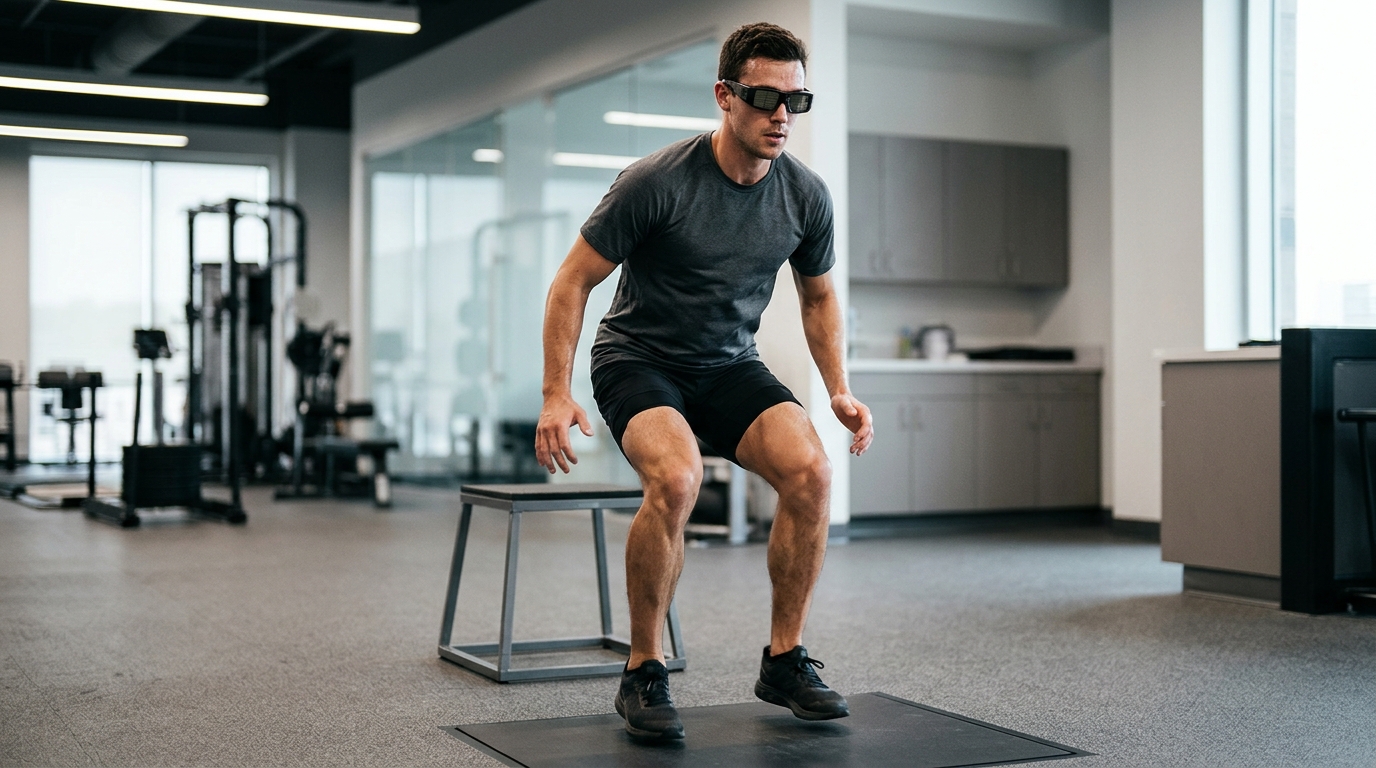
A within-subject investigation evaluating thirty physically active men determined that acute exposure to stroboscopic visual manipulation failed to produce systematic alterations in drop jump mechanics. While participants completed drop jumps under both binocular and alternating monocular stroboscopic conditions, primary mechanical metrics showed no statistically significant divergences from jumps completed under normal binocular vision without goggles. Researchers observed only two isolated neuromuscular shifts across electromyographic recordings, which occurred in the absence of broader mechanical changes.
The study was designed to clarify the acute neuromuscular and mechanical responses that occur when visual input is intermittently disrupted during drop jumps from platform heights of 20, 30, and 45 centimeters. Testing incorporated two distinct visual intervention settings using specialized eyewear: binocular stroboscopic vision, designated as A mode, and alternating monocular stroboscopic vision, designated as D mode. These experimental conditions were directly compared against baseline trials performed under normal binocular vision without goggles to capture potential immediate adjustments in movement execution.
To control for potential ordering confounders across trials, the researchers balanced the order of visual conditions using three cyclic sequences. Meanwhile, the drop jump heights followed a fixed ascending order from the lowest platform to the highest. Neuromuscular activity was recorded via surface electromyography to evaluate absolute root mean square amplitudes across distinct temporal response windows. Concurrently, biomechanical instrumentation captured peak vertical ground reaction force alongside the reactive strength index to quantify mechanical jump performance.
The primary analytical framework employed linear mixed-effects models that specified participant random intercepts, alongside visual condition, fixed height and order, and condition-by-height interactions as fixed effects. Secondary pairwise comparisons between experimental conditions were evaluated through paired t tests or Wilcoxon signed-rank tests depending on distributional properties. To account for the inflation of type I error across extensive secondary testing, the investigators applied Benjamini–Hochberg false discovery rate correction alongside Cohen’s dz effect size calculations.
Statistical analysis of mechanical performance revealed that neither peak vertical ground reaction force nor the reactive strength index exhibited a significant main effect of visual condition, yielding p-values of 0.905 and 0.390, respectively. Similarly, condition-by-height interaction effects were not significant for either ground reaction force at p = 0.860 or reactive strength index at p = 0.809. However, both mechanical variables displayed significant variations across the fixed ascending height and order sequence, with ground reaction force demonstrating p = 0.006 and reactive strength index reaching p < 0.001.
Across 144 secondary electromyographic comparisons evaluating muscle activation across latency windows, only two comparisons survived false discovery rate correction, both reflecting differences relative to unhindered binocular vision. Under alternating monocular stroboscopic vision at a 30-centimeter drop height, tibialis anterior activity during the long-latency window was significantly higher at 181.16 ± 92.35 microvolts compared to 140.30 ± 71.65 microvolts under normal vision, yielding q = 0.033 and dz = 0.67. Conversely, under binocular stroboscopic vision at 45 centimeters, vastus medialis activity during the medium-latency window was significantly lower at 124.01 ± 174.23 microvolts compared to 314.32 ± 695.65 microvolts, with q = 0.033 and dz = -0.31.
The authors concluded that because these two isolated electromyographic differences were unaccompanied by corresponding mechanical adaptations, they do not establish a coordinated neuromuscular strategy, leaving their functional relevance uncertain. Additionally, no mechanical between-condition comparisons survived false discovery rate adjustment. The researchers emphasized that these findings reflect only a single acute exposure in physically active men, meaning they neither establish equivalence between visual conditions nor clarify potential long-term adaptations resulting from repeated stroboscopic visual training.
Subject of Research: Acute neuromuscular and mechanical responses to stroboscopic vision during drop jumps
Article Title: Acute effects of binocular and alternating monocular stroboscopic vision on neuromuscular and mechanical responses during drop jumps in physically active men
Article References: Işık, M., Yavuz, M., Orhan, Ö., Işıkdemir, E., Çalıkuşu, İ., Dişçeken, O., & Uzlasir, S. (2026). Acute effects of binocular and alternating monocular stroboscopic vision on neuromuscular and mechanical responses during drop jumps in physically active men. BMC Sports Science, Medicine and Rehabilitation. https://doi.org/10.1186/s13102-026-02269-5
Image Credits: AI Generated
DOI: 10.1186/s13102-026-02269-5
Keywords: stroboscopic vision, drop jumps, binocular stroboscopic vision, alternating monocular stroboscopic vision, electromyography, vertical ground reaction force, reactive strength index, tibialis anterior, vastus medialis, neuromuscular responses, mechanical responses, long-latency window, medium-latency window, physically active men, within-subject analysis, linear mixed-effects models, jump height
News Source: Ophelia Keating. (November 28, 2026). Stroboscopic Vision Shows Minimal Effect on Drop Jump Mechanics in Active Men. Scienmag.