A comprehensive academic review published in Health Nanotechnology indicates that pushing stretchable electronics to withstand extreme elongation frequently delivers diminishing returns while creating severe material and functional penalties across practical biomedical and industrial applications. Researchers Qingtian Zhang and Shi-Yang Tang analyzed the pronounced disparity between record-setting laboratory benchmarks, where experimental prototypes routinely demonstrate elongation exceeding 100 percent or even 1000 percent, and the comparatively modest mechanical demands encountered in operational environments. In practical healthcare monitoring, human skin typically deforms by at most 50 to 60 percent during natural body motion, with most on-skin and implantable patches experiencing strains under 20 to 30 percent during regular physiological activities. Similarly, industrial machinery monitoring and soft robotic actuators operate predominantly under strains well below 50 percent, with structural surfaces frequently exhibiting operational deformations below 5 percent. The authors argue that prioritizing maximal tensile elongation over mechanical conformability, environmental durability, and operational signal stability compromises real-world utility.
The review underscores that biological tissues rarely undergo extreme tensile deformations, rendering academic pursuits of ultra-high elasticity largely mismatched with clinical needs. Human skin exhibits maximum strains around 50 to 60 percent only across highly mobile joint articulations, while vital internal organs function under strictly bounded dynamic ranges. For instance, contracting cardiac muscle fibers exhibit approximately 30 percent deformation during each rhythmic heartbeat cycle, and the external surface of the human brain undergoes virtually no tensile deformation, sustaining less than 1 percent strain under baseline physiological conditions. Chest-worn bioelectronic patches monitoring pulmonary expansion and posture regularly encounter operational expansions of merely 10 to 20 percent. Consequently, engineering medical bioelectrodes or health-tracking patches to survive 200 percent or greater tensile elongation introduces substantial fabrication overhead without improving physiological data collection or patient comfort.
Industrial machinery, transportation infrastructure, and robotics similarly expose stretchable electronic sensors to relatively mild mechanical strains. Surface-mounted sensors deployed across manufacturing equipment monitor vibration, pressure, and structural integrity under operational loads that rarely produce mechanical strains exceeding 5 percent. In aerospace and automotive engineering, conformal sensor arrays affixed to aircraft wing surfaces to measure aerodynamic load distributions, along with embedded tire pressure monitors and seat occupancy sensors, experience deformations that consistently remain below 10 percent strain. Soft robotic grippers and locomotion systems function effectively within moderate strain ranges spanning 20 to 50 percent, requiring extreme stretchability only in specialized edge cases. Rather than surviving massive tensile elongation, industrial deployments prioritize survival against harsh environmental stressors including wide thermal swings, moisture intrusion, oil contact, abrasive wear, and continuous cyclic vibration, conditions under which ultra-soft elastomeric materials frequently degrade or lose calibration.
To achieve laboratory elongations exceeding hundreds or thousands of percent, material scientists frequently lower covalent crosslink densities within elastomeric networks or introduce high concentrations of dynamic, reversible chemical bonds. Decreasing permanent covalent junctions allows extended polymer chains to uncoil and slide past one another, thereby increasing elongation at break, but directly compromises the underlying structural framework. Sparsely crosslinked networks display diminished mechanical stiffness and reduced tensile strength; for example, loosely crosslinked epoxy resin formulations stretch nearly twice as far as densely crosslinked counterparts but suffer more than a 40 percent drop in tensile strength. This structural weakening leaves ultra-stretchable substrates vulnerable to tearing, accelerated mechanical fatigue, and permanent inelastic deformation when subjected to repeated stress cycles in practical settings.
Incorporating reversible interactions such as hydrogen bonds, ionic links, metal-ligand coordination, and pi-pi stacking provides sacrificial energy dissipation and self-healing, yet introduces pronounced viscoelastic trade-offs including severe hysteresis and residual plastic deformation. Because reversible dynamic crosslinks do not re-form instantaneously following unloading, materials subjected to cyclic strain fail to return to their original resting dimensions. Experimental evaluations demonstrate that an elastomer showing zero residual strain after a modest 25 percent stretch retained approximately 7 percent permanent deformation after being stretched to 100 percent, while polymers capable of 14,000 percent strain exhibited an unrecovered 5 percent permanent elongation after every strain cycle. Reversible bond rearrangement under constant loads produces long-term creep and accelerated stress relaxation, which intensifies significantly at large deformations of 40 to 80 percent compared to modest 10 percent strains, while ambient moisture and temperature fluctuations cleave non-covalent links such as boronic ester bonds, inducing baseline signal drift.
Multi-network architectures designed to balance elasticity and fracture toughness by combining densely crosslinked brittle networks with loosely crosslinked ductile matrices introduce severe synthetic and manufacturing complexities. While interpenetrating double networks dissipate fracture energy through the controlled rupture of sacrificial bonds under load, their synthesis requires intricate multi-step polymerizations and tight reaction kinetics that limit reproducible large-scale production. Batch-to-batch variations in crosslinking density create unpredictable mechanical properties that hinder industrial translation. Although modern vacuum deposition methods demonstrate promising pathways toward wafer-scale fabrication of stretchable thin-film transistors, multi-network processing challenges continue to impede cost-effective manufacturing for widespread commercial and medical use.
Electrical reliability degrades sharply when conductive pathways within stretchable composites undergo extreme mechanical extension. Flexible conductors relying on percolating networks of silver nanowires, carbon nanotubes, or liquid metal droplets experience pathway disruption as inter-particle distances widen under high strain, causing sharp increases in electrical resistance or complete open circuits. In liquid metal conductors, severe elongation can rupture encapsulating elastomeric layers, causing fluid leaks and catastrophic device failure. Material hysteresis further causes baseline resistance drift; for example, conductive strain sensors subjected to 900 cycles at 60 percent elongation showed their normalized resistance range rise from an initial 0 to 1 percent up to 0.5 to 2 percent. Furthermore, interfacial mechanical mismatch between soft substrates and rigid conductive traces causes delamination and blistering at strains as low as 25 percent in standard polydimethylsiloxane encapsulants, accelerating device failure under cyclic wear.
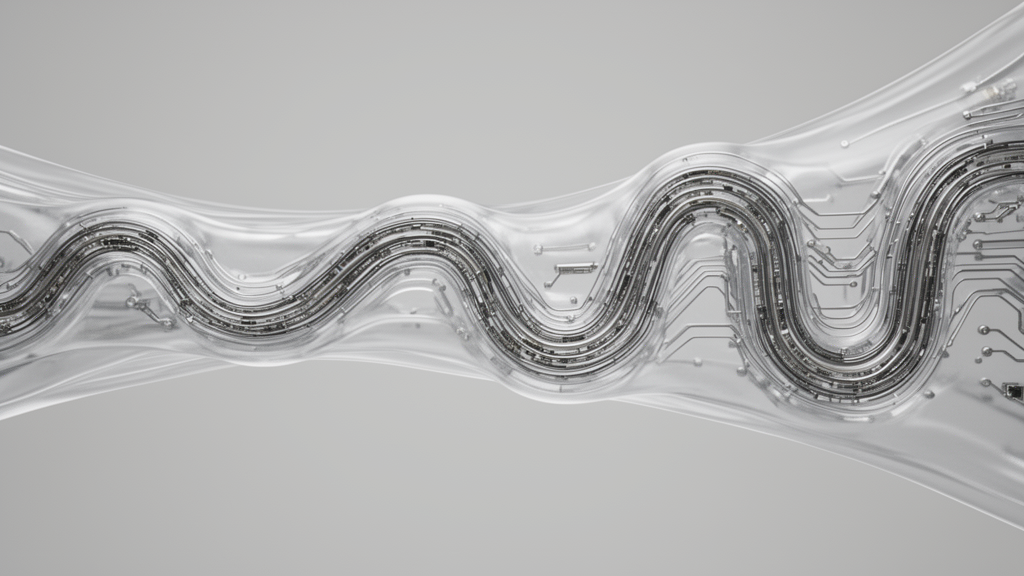
To prevent mechanical and electrical failure without pursuing extreme elongation, the review highlights structural mechanics and hybrid device architectures that decouple active electronic components from applied strain. In practical wearable devices, high-performance data processing, wireless transmission, and power storage functions depend on rigid microelectronic chips rather than intrinsically stretchable active materials. Hybrid island-bridge layouts bond rigid silicon chips to flexible substrates using meandering, serpentine metallic interconnects. In one validated electrocardiogram patch, rigid sensing islands connected by serpentine tracks accommodated over 20 percent global stretch without degrading signal transmission. Advanced geometric strategies—including chemically matched soft-rigid gradient boundaries, strain-suppression overlayers, kirigami patterned slits, and pre-stretched substrates—shield sensitive elements from mechanical stress, allowing global motion while keeping local strains on delicate components near zero.
The authors formulate a redefined design criterion termed sufficient compliance, which establishes that materials should safely accommodate local strain concentrations roughly three times greater than the maximum expected global strain. Because rigid-soft interfaces, patterned edges, and islands amplify local deformations to levels more than twice the applied global strain, prioritizing this localized safety margin ensures robust operational durability. The framework urges the stretchable electronics field to shift development priorities away from chasing extreme tensile records and toward optimizing intimate skin conformability, ultra-thin profiles, tissue-matched elastic moduli, biocompatible breathable matrices, and scalable packaging that maintains Hermetic seals against physiological fluids, temperature fluctuations, and environmental degradation.
Ultimately, clinical translation and commercial adoption will depend on system-level reliability, regulatory biocompatibility, and user acceptance rather than laboratory elongation benchmarks. Bulky, poorly adhering devices engineered purely for extreme elongation face rejection by patients and clinicians if they provoke dermal irritation or degrade during sustained perspiration. Ultrathin conformal sensors measuring only a few micrometers in thickness conform tightly to microscopic skin wrinkles, substantially lowering electrode-skin contact impedance and suppressing motion artifacts during natural movement while requiring only 50 to 60 percent elasticity. Emphasizing balanced application-driven designs that combine moderate compliance with high signal fidelity, power efficiency, and long-term cyclic resilience offers the most direct path to transitioning stretchable bioelectronics from academic laboratories into functional clinical and industrial technologies.
Subject of Research: Engineering and design trade-offs in stretchable electronics for healthcare and industrial applications
Article Title: Rethinking the need for ultra-high stretchability in stretchable electronics
Article References: Zhang, Q., & Tang, S.-Y. (2025). Rethinking the need for ultra-high stretchability in stretchable electronics. Health Nanotechnology, 1(1), Article 10. https://doi.org/10.1186/s44301-025-00011-7
Image Credits: AI Generated
DOI: 10.1186/s44301-025-00011-7
Keywords: Stretchable electronics, Wearable technology, Bioelectronics, Mechanical strain, Conformability, Dynamic crosslinks, Island-bridge design, Percolating networks, Liquid metal, Soft robotics, Sensor hysteresis, Encapsulation failure, Interfacial adhesion, Electronic skin, Structural health monitoring, Polymer crosslinking
News Source: Denise Maddox. (November 19, 2026). Stretchable Electronics Review Challenges Extreme Elongation Goals for Real-World Systems. Scienmag.