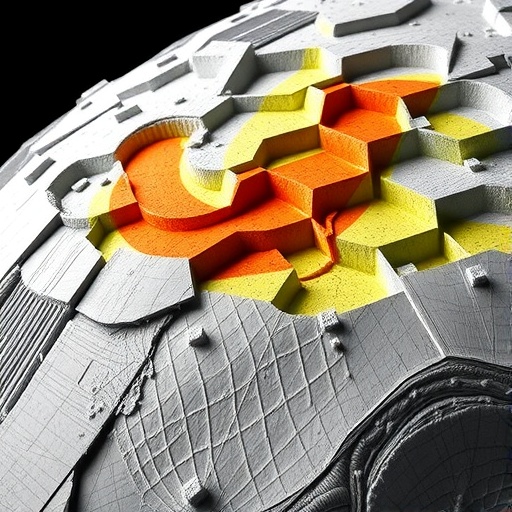
In a groundbreaking advancement poised to redefine the frontiers of materials science and optical engineering, researchers have unveiled a novel technique that leverages stress-driven photo-reconfiguration to dynamically manipulate surface microstructures. This pioneering research offers an unprecedented level of control over micro- and nanoscale surface patterns by employing vectorial field-guided lithography, a method that intricately orchestrates the spatial distribution of mechanical stress using complex light fields. The implications of this technology resonate broadly, affording new possibilities in adaptive optics, information storage, and responsive materials.
Traditional lithographic methods, while highly sophisticated, often rely on static processing conditions that limit the reconfigurability of fabricated structures. The research team, spearheaded by Januariyasa, Reda, Liubimtsev, and others, has transcended this limitation by harnessing stress as an active agent for post-fabrication reconfiguration. Employing carefully tailored optical vector fields—the spatially structured polarization and phase properties of light beams—they induce stress distributions within the substrate, triggering controlled morphological changes in the surface topography.
At the core of this transformative approach is the interplay between light-induced stress and the physicochemical properties of the material’s surface layer. When illuminated with vectorial light fields, specific regions of the substrate undergo tensile or compressive stress patterns, which locally modulate the mechanical energy landscape. This, in turn, prompts microstructures such as ridges, grooves, or pillars to reorient, reshape, or even migrate, enabling a level of dynamism previously unattainable with conventional hard-lithographic patterns.
A particularly compelling aspect of this technique is its non-contact and highly localized nature. By utilizing vectorial fields—essentially light beams whose polarization and intensity vary spatially—the researchers can finely tune the induced stress patterns without direct mechanical intervention. This precision opens avenues for crafting microstructured surfaces with programmable features, adding a dynamic layer of control over optical or tactile functionalities. The capacity to rewrite surface patterns on demand fosters applications in tunable photonics, where surfaces can adapt their optical response in real time.
Moreover, the intensity and directionality of the applied stresses can be modulated by altering the properties of the illuminating vectorial fields, such as their polarization state, phase distribution, and beam shape. This vectorial field-guided lithography serves as a versatile toolkit that transcends conventional scalar light patterning techniques, enabling multi-dimensional reconfiguration of surface architectures. The researchers’ experimental results demonstrate reversible surface pattern transformations with high fidelity, showcasing the robustness and repeatability of the method.
From a mechanistic viewpoint, the process involves a complex coupling between photomechanical effects and the intrinsic elasticity of the substrate material. The targeted light fields induce localized heating or photochemical reactions that alter polymer crosslinking densities, or alternatively, activate photoresponsive moieties embedded in the surface layer. These localized changes modulate the internal stress distribution, which manifests as controlled deformation of microstructures. Importantly, the methodology supports iterative reprogramming, where successive illumination steps refine or completely alter the surface morphology.
The implications of stress-driven photo-reconfiguration resonate significantly within the field of responsive materials. Surfaces can be dynamically tuned to modulate properties such as wettability, adhesion, friction, or optical scattering simply by adjusting the illumination pattern. This adaptability is particularly promising for the development of “smart” interfaces that respond to environmental stimuli or user inputs. In advanced optics, the ability to reconfigure microstructures dynamically can lead to programmable diffractive elements, adaptive lenses, and surfaces with switchable color or reflectivity.
Another salient feature of this research lies in its integration with existing nanofabrication infrastructures. The stress-driven vectorial lithography technique complements current photolithography and nanoimprint methods, enabling post-processing modifications without the need for chemical etching or physical re-machining. This compatibility enhances its translational potential for industrial manufacturing, where flexibility and scalability are paramount. Furthermore, the approach lends itself to high-throughput processing given the rapid, contactless nature of light-induced stress fields.
The team’s experimental demonstrations employ a range of substrates—both polymeric and hybrid composites—highlighting the versatility of the method across diverse material systems. By tailoring the substrate chemistry and thickness, the extent and nature of photo-induced stress patterns can be finely adjusted, offering customizable reconfiguration protocols for specific applications. The research also delves into the theoretical modeling of stress distribution under complex vectorial illumination, providing predictive frameworks that guide the design of experimental parameters.
Importantly, the novel use of vectorial light fields transcends scalar intensity modulation by exploiting the directional and polarization aspects of light-matter interaction. This refined control over light’s electromagnetic vector components facilitates spatially varying photomechanical responses with an unprecedented degree of precision. The researchers’ methodology includes holographic beam shaping and polarization modulation techniques, which establish complex stress landscapes through superpositions of multiple vector beams, further expanding the reconfiguration repertoire.
In potential real-world applications, this technology could revolutionize the fabrication of adaptive camouflage materials that change surface texture dynamically, or biointerfaces that alter their microtopography to influence cellular behaviors on demand. The biomedical field may benefit from reconfigurable microstructured surfaces that optimize cell adhesion or release therapeutic agents in response to non-invasive optical cues. Similarly, microfluidic devices could be endowed with tunable wettability patterns, enhancing control over fluid flow without physical valves.
Another intriguing avenue is in high-density data storage. The ability to reversibly photo-reconfigure nano- and micro-patterns via light-induced stress fields opens the door to multi-layered, rewritable data storage media. These media could achieve significantly enhanced data densities by encoding information in the morphology of surface structures, with data written and erased using tailored vectorial light fields. The stability and endurance of these structures suggest promising longevity for practical deployments.
The research also explores the fundamental limits of stress-driven lithographic resolution and reconfiguration speed. By varying the wavelength, pulse duration, and intensity of the vectorial light fields, the team characterizes the spatiotemporal dynamics of the induced morphological changes. They observe submicron resolution control and microsecond-scale response times, underscoring the method’s potential for rapid, high-precision surface engineering. These performance metrics position the technology favorably for integration into ultrafast optical devices and dynamic surface prototypes.
Ethical and environmental considerations of this photomechanical approach are favorable as well. The non-contact, light-driven method significantly reduces waste and the use of harmful chemicals compared to traditional lithographic processes that often require solvents and etching agents. This environmentally benign approach aligns with the growing demand for sustainable manufacturing in materials science and nanotechnology, highlighting the broader societal benefits of the development.
In conclusion, the advent of stress-driven photo-reconfiguration mediated by vectorial field-guided lithography marks a seminal step forward in dynamic surface engineering. By harnessing the intricate coupling between complex light fields and material stress responses, this technique unlocks programmable, reversible control over microstructured interfaces with exceptional spatial and temporal precision. The broad applicability across photonics, smart materials, and biomedical devices heralds a new era where surface functionalities can be tailored on demand through light alone. This inspiring advance sets the stage for future innovations that will reshape how we create, interact with, and optimize micro- and nanostructured surfaces in myriad technology domains.
Article References:
Januariyasa, I.K., Reda, F., Liubimtsev, N. et al. Stress-driven photo-reconfiguration of surface microstructures via vectorial field-guided lithography. Light Sci Appl 15, 194 (2026). https://doi.org/10.1038/s41377-025-02174-5
Image Credits: AI Generated
DOI: 10 April 2026
Tags: adaptive optical materialsadvanced optical engineering methodsdynamic surface microstructureslight-induced stress modulationmechanical stress in lithographynanoscale surface patterningphoto-reconfiguration techniquespost-fabrication microstructure controlresponsive material surfacesspatially structured light fieldsstress-driven vectorial lithographyvectorial field-guided lithography