Infectious diseases have always posed intricate challenges to public health systems worldwide, complicating efforts to manage and control their impact on populations. Influenza-like illnesses, in particular, display multifaceted patterns of contagion influenced not just by biological agents but by a constellation of socioeconomic and environmental factors. To navigate this complexity, researchers have sought to develop refined tools that capture the nuanced vulnerabilities of different regions, enabling tailored and effective responses.
Traditionally, assessments of regional risk for infectious diseases have leaned heavily on health data such as hospital admissions and incidence rates. However, this approach often overlooks the social and economic dimensions that profoundly shape disease dynamics. Recognizing this gap, scientists at Washington University in St. Louis embarked on an ambitious project to enhance risk evaluation by integrating a broader spectrum of variables. Their pioneering work, recently published in the prestigious journal PLOS Computational Biology, introduces a novel state-level vulnerability index that maps influenza-like illness risk across the United States with unprecedented granularity.
The foundation of this research builds upon the Social Vulnerability Index (SVI) framework established by the Centers for Disease Control and Prevention (CDC), which has been instrumental in disaster risk assessment by incorporating variables related to socioeconomic status, household composition, minority status, and housing type. While invaluable, the SVI is a generalized metric not originally tailored for infectious diseases. The Washington University team recognized the necessity to adapt this framework specifically to infectious disease epidemiology, emphasizing the intricate interplay between social factors and health outcomes.
Key to the advancement achieved by this team is their application of machine learning algorithms capable of dissecting complex, nonlinear relationships among diverse data points. These models analyzed 39 distinct socioeconomic and health indicators—ranging from demographic profiles and migration trends to health insurance coverage and access to healthcare infrastructure—unveiling how subtle combinations of factors amplify influenza vulnerability within specific regions. This methodological innovation allows the model to move beyond simplistic correlations, capturing emergent patterns that conventional statistical techniques might miss.
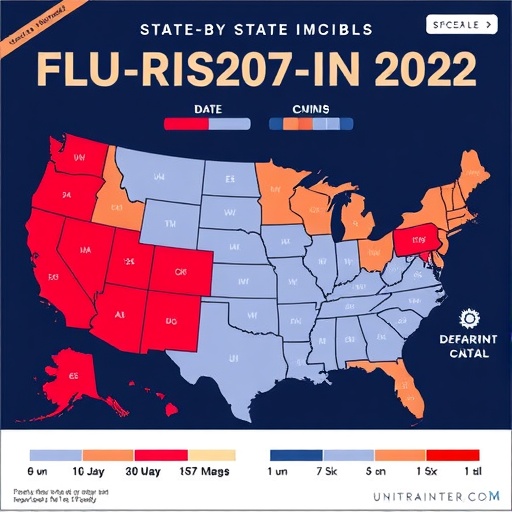
The resulting vulnerability index reveals a striking heterogeneity across states, each exhibiting a unique “fingerprint” of risk. For example, urban centers such as the District of Columbia emerge as acute vulnerability hotspots. The high population density intrinsic to major metros accelerates viral transmission, while significant proportions of uninsured foreign-born residents and longer commute times—factors not traditionally considered in disease modeling—compound these risks significantly. This multifactorial analysis underscores the limitations of one-size-fits-all public health strategies.
Conversely, states characterized by expansive rural areas, such as New Mexico and Arizona, display vulnerability driven by a different constellation of risk factors. Here, demographic elements such as an aging population, higher percentages of females, and substantial Hispanic communities heighten susceptibility to flu complications. This differentiation highlights how rural health disparities—often involving diminished healthcare access and economic hardship—intersect with epidemiological risks in ways uniquely challenging to address.
The state of Michigan presents a compelling case study encapsulating both urban and rural vulnerabilities. Michigan’s metropolitan regions confront high transmission potential due to population density and mobility, factors intensified by socioeconomic stresses accentuated in its rural periphery. The dual challenge complicates resource allocation and demands adaptive public health policies that are sensitive to localized needs. Such insights exemplify the power of the index to inform nuanced, place-based intervention planning.
This new machine learning-driven approach, as described by Rajan Chakrabarty, Harold D. Jolley Professor of Engineering at WashU’s McKelvey School of Engineering, “considers the relative importance of the many socioeconomic and health factors within a defined area.” By quantifying how variables like urbanization, healthcare access, demographics, and economic disparities coalesce to determine vulnerability, the index empowers policymakers to identify “hotspots” where targeted interventions could yield maximum benefit in preventing flu spread.
Beyond just influenza-like illnesses, the broader implications of this work lie in its potential to fortify epidemic preparedness across diverse infectious diseases. By understanding spatial variations in vulnerability with this level of sophistication, public health authorities can design layered strategies that address social determinants alongside conventional biomedical responses. This holistic perspective is vital as emerging diseases and evolving pathogens continue to challenge global health security.
One important aspect underscored by the research is the recognition that vulnerability is inherently multifactorial and synergistic. No single factor alone precipitates outbreak severity; rather, it is the interactive effects among economic disadvantage, limited healthcare coverage, demographic characteristics, and mobility patterns that create fertile grounds for disease proliferation. This understanding encourages cross-sector collaboration spanning healthcare, economic development, urban planning, and social services.
In practical terms, regions emerging as high-risk areas may benefit from initiatives such as expanding healthcare coverage, improving healthcare infrastructure, facilitating access for marginalized populations, and enhancing community outreach focused on vaccination and preventive care. Urban areas with dense and diverse populations might prioritize measures reducing transmission in public transportation and workplaces, while rural zones might emphasize bridging healthcare gaps and socioeconomic upliftment.
The research, led by Shrabani Sailaja Tripathy, a postdoctoral associate in Chakrabarty’s laboratory and the paper’s lead author, emphasizes that all states will require an amalgamation of these policies, though the emphasis should vary according to the unique vulnerability profile identified. Such tailored approaches are likely to optimize resource utilization and increase resilience against influenza and potentially other infectious diseases.
The implications extend to national epidemic preparedness as well, strengthening the capacity to anticipate and mitigate outbreaks before they escalate. By operationalizing data-driven vulnerability maps, public health agencies can elevate their strategic planning, exercise targeted risk communication, and deploy interventions more effectively. This aligns with global calls for more integrative and proactive disease surveillance systems.
Reflecting on the broader landscape of public health, this innovative integration of machine learning and socio-demographic data heralds a paradigm shift in epidemiological modeling. It highlights the critical necessity to transcend purely clinical indicators and embrace complex social realities as intrinsic components influencing infectious disease patterns. As the world grapples with current and future pandemics, such forward-looking methodologies will be instrumental in safeguarding population health.
Subject of Research: Socioeconomic and health vulnerability to influenza-like illness across the United States
Article Title: Spatial variation in socio-economic vulnerability to Influenza-like Infection for the US population
News Publication Date: (Date not specified in source)
Web References: https://journals.plos.org/ploscompbiol/article?id=10.1371/journal.pcbi.1013839#abstract1
References:
Tripathy SS, Puthussery JV, Kapoor TS, Cirrito JR, Chakrabarty RK (2026). Spatial variation in socio-economic vulnerability to Influenza-like Infection for the US population. PLOS Computational Biology 22(1): e1013839.
Keywords: Epidemiology, Infectious disease transmission, Disease outbreaks, Virulence, Social Vulnerability Index, Machine learning, Influenza risk, Socioeconomic factors, Public health preparedness
Tags: CDC social vulnerability frameworkenvironmental impact on flu transmissioninfluenza-like illness vulnerabilitymultifactorial flu risk evaluationPLOS Computational Biology flu studypublic health disease risk assessmentregional infectious disease mappingsocial vulnerability index and flusocioeconomic factors in infectious diseasestate-level flu risk indextailored flu prevention strategiesWashington University flu research