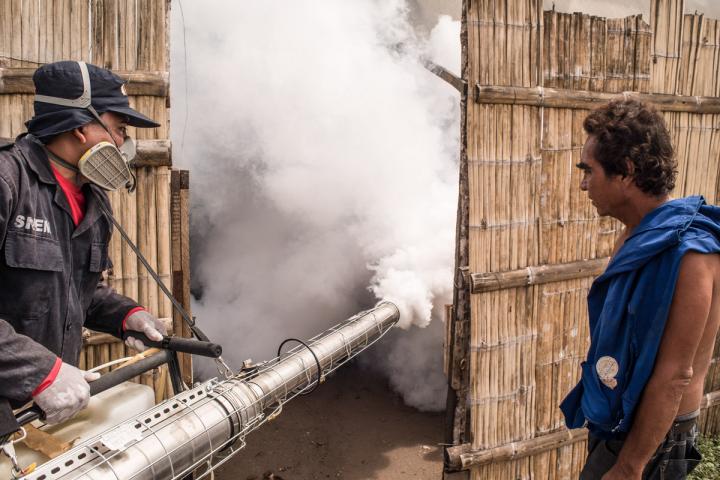
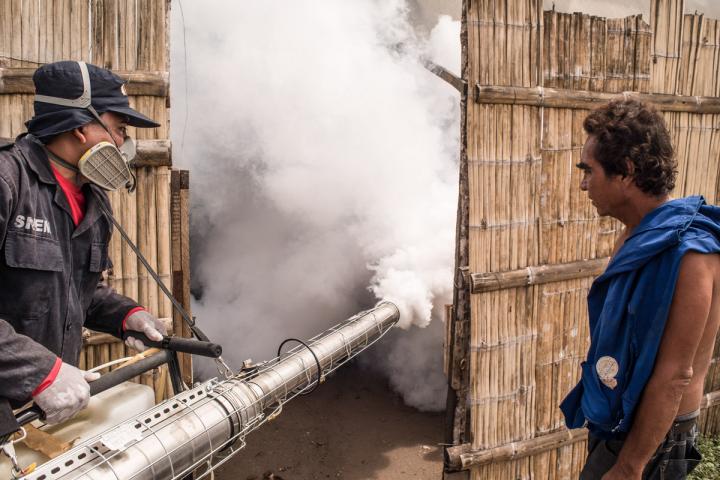
Credit: Dany Krom
As temperatures rise with climate change, mosquito season extends past the summer months in many parts of the world. The question has been how this lengthened season influences the risk of being infected with mosquito-born diseases such as dengue, chikungunya and Zika.
Now, in a paper published on April 27 in PLoS Neglected Tropical Diseases, Stanford researchers modeled how rising temperatures might influence mosquito behavior and disease risk around the world. The researchers also calibrated their model with field data on human infections of mosquito-borne diseases.
"Dengue epidemics have been on the rise in the past couple decades so there's been a growing effort trying to understand why we're seeing more dengue, and what the relationship is between dengue transmission and climate," said study lead author Erin Mordecai, an assistant professor of biology.
The ideal temperature
Temperature controls several factors that underlie the time it takes for a virus to be transmittable to humans. These include how long it takes for a mosquito to ingest a virus during one feeding and then be ready to inject it in a later feeding; the length of the mosquito's life cycle; and how often mosquitoes bite.
"All these traits rely on temperature, but they tend to be nonlinear," Mordecai said. "They increase to a point and then drop off." The group found that mosquito traits favorable to spreading disease peaked when temperatures reached 29 degrees Celsius (84 degrees Fahrenheit), but were lower when temperatures were cooler or warmer.
When Mordecai looked at transmission of dengue, chikungunya and Zika in people, those results matched what her models predicted. She said that if you graph how transmission rates change with temperature, you get a bell-shaped curve peaking at 29 degrees C.
Predicting future outbreaks
Knowing the optimal temperature for disease transmission is critical for predicting future disease rates, Mordecai said. Before this study, she said, there was a wide range of temperature predictions from other researchers.
"If we're predicting a 29 degree optimum and another model is predicting a 35 degree optimum, the other model will say that climate change will increase transmission," she said, pointing out that if local temperatures are already close to the optimal temperature, infection may, in fact, go down as temperatures rise.
The information can also help predict how and where disease might spread with climate change. "We really want to build more predictive models that take climate information and make predictions about when and where we can invest in vector control to try to prevent epidemics," Mordecai said.
This kind of planning is especially important in countries that have lower socioeconomic levels. "Concentrated urban poverty is really where you see a lot of vector-borne disease transmission," Mordecai said. She explained that the mosquito that carries dengue, chikungunya and Zika is an opportunist — it will breed in any water container it can find, from bottle caps to water storage basins. "You tend to see a lot of people exposed to a lot of mosquitoes in places where access to piped water is not reliable, because storage basins are where people are storing water."
Mordecai knows there is more work to be done with mosquito-borne illnesses. "There's lots of discussion about what's going to be the next thing. What's the next Zika?" She said this model will help researchers predict when and where transmission of the next Zika might happen — and allow enough time to prepare for the event.
###
Media Contact
Amy Adams
[email protected]
650-796-3695
@stanford
ZZZ – DO NOT EDIT – News Page
Original Source
http://news.stanford.edu/press-releases/2017/05/02/warming-planet-mo-borne-diseases/