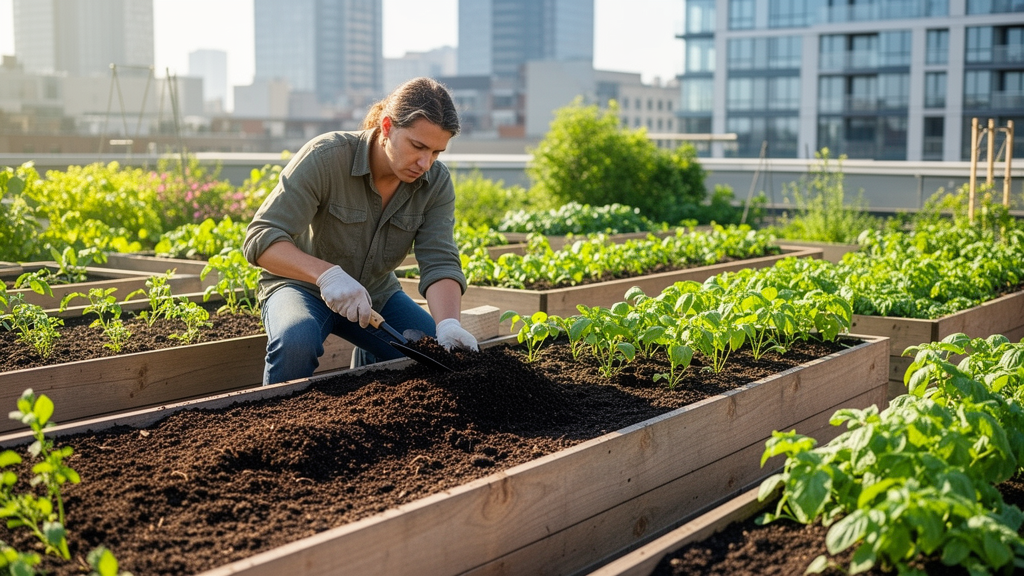
A qualitative investigation conducted within the European Research Council funded NUTRISOIL and URBAG research initiatives demonstrates how structured stakeholder dialogue can translate systemic obstacles into concrete municipal transformation pathways for urban and peri-urban soil regeneration. Healthy soils represent the largest terrestrial carbon reservoir and harbor more than a quarter of global biodiversity, providing critical ecosystem functions that support organic matter decomposition and carbon sequestration. Across the European Union, approximately seventy percent of soils are currently classified as degraded, a condition that contributed to a twenty percent reduction in European net carbon removals between 2013 and 2018. While reversing international soil degradation trends could yield an estimated 1.2 trillion Euros annually in worldwide economic benefits through restored services such as water regulation, nutrient cycling, carbon storage, and agricultural production, modern conventional cultivation continues to rely on linear resource flows that exhaust soil biological activity and accelerate climate disruptions. By examining the geographic proximity between urban residue generation and peri-urban food cultivation, the study illustrates how circular nutrient integration can be designed through participatory governance models.
To investigate the mechanisms required for urban soil recovery, the researchers situated their primary empirical inquiry within the Metropolitan Area of Barcelona, located in northeastern Spain along the Mediterranean coast between a coastal plain and the Collserola mountain range. Between 1956 and 2018, the Barcelona metropolitan territory experienced an 80.5 percent loss of its historical agricultural surface, accompanied by a 24 percent contraction in primary sector employment from 2010 to 2019. Although municipal planning instruments have initiated targets to expand metropolitan agricultural land coverage from 8 percent to 12 percent, circular resource flows remain heavily constrained. Existing compost production in the Metropolitan Area of Barcelona supplies less than 7 percent of local agricultural fertilizer demand, even though technological nutrient recovery from wastewater streams, such as struvite extraction, possesses the theoretical potential to satisfy regional crop nutrient requirements fivefold. Historical field assessments identified persistent knowledge deficits concerning local soil parameters, alongside fragmented institutional coordination separating primary agricultural producers, municipal waste handlers, and regional territorial planners, making the metropolitan area an informative testbed for analyzing transition barriers.
The study established a multi-tiered methodological architecture combining the Three Horizons foresight framework with inductive grounded theory qualitative analysis to capture present systemic failures, emerging innovations, and long-term objectives. The experimental design unfolded across two distinct consultative stages, beginning with a Practitioners Workshop that convened sixty-two regional participants, comprising 51.6 percent male and 48.4 percent female representation across agriculture and soils, urban community initiatives, and waste and wastewater management. The agricultural and soils panel formed the largest contingent with twenty-nine practitioners, while community groups supplied twenty participants and specialized waste utilities involved thirteen delegates. Professional facilitators conducted structured breakout sessions in Catalan and Spanish, prompting participants to record observations on individual notes across three chronological horizons: desired 2030 resilience outcomes under Horizon 3, present operational barriers under Horizon 1, and intermediate interventions under Horizon 2. Audio recordings were subsequently transcribed via TurboScribe, translated into English, verified by the investigators, and imported into NVivo version 13 for comprehensive open and axial qualitative coding.
To test whether metropolitan findings reflected broader administrative dynamics, the research team implemented a secondary Policy and Governance Workshop involving official delegates from eight diverse cities: Glasgow, Greater Manchester, Rotterdam, Thessaloniki, Athens, Granollers, Padova, and Ramallah, recruited through an open network call organized alongside the Resilient Cities Network. During this international consultation, municipal representatives validated the inductively derived thematic areas using the pebble distribution method, assigning numerical weights from zero to ten to quantify both the present operational priority and the anticipated future relevance of each circular domain within their respective jurisdictions. Facilitators analyzed workshop transcripts through axial coding, compiling normalized weighted frequencies to account for varying participant cohort sizes across thematic categories. This quantitative normalization allowed the researchers to cross-reference narrative sentiment values across temporal horizons, systematically mapping how practical constraints experienced by land managers align with regulatory and administrative bottlenecks encountered across different European and Mediterranean urban governance environments.
Qualitative sentiment evaluation of Horizon 1 deliberations demonstrated pervasive practitioner dissatisfaction with existing structural frameworks, as negative sentiment mentions substantially exceeded positive and neutral appraisals across every investigated domain, ranging from 79 percent negative sentiment in policy integration to 100 percent in physical infrastructure. The incentives and disincentives category recorded a 98 percent negative sentiment distribution, with stakeholders arguing that globalized commodity markets externalize environmental degradation costs, placing small-scale ecological cultivation at a persistent financial disadvantage. Participants reported that international institutional mechanisms, including Common Agricultural Policy allocations and World Trade Organization rules, favor large-scale input-intensive agricultural conglomerates over localized circular initiatives. Logistical barriers in waste valorization further illustrated institutional disconnects, as municipal waste contracts routinely divert organic matter away from nearby cropland, while macro-level regulations impose rigid quality criteria that fail to reflect local soil properties, and unchecked microplastic contamination in compost continues to threaten soil biodiversity, food security, and consumer confidence.
In response to these diagnostic findings, the axial coding procedure mapped workshop contributions across Horizon 2 and Horizon 3 into ten operational priority actions distributed across eight distinct enabling stakeholder groups, illustrating that circular transitions necessitate distributed cross-sectoral leadership rather than isolated municipal decrees. For organic waste valorization, waste and wastewater facility operators emerged as key actors tasked with establishing specialized selective collection schemes, smart waste containers, and vehicle tracking mechanisms to personalize waste tariffs and decrease biological feed contamination. Participants highlighted the necessity of constructing decentralized, proximity-based processing plants situated directly within peri-urban agricultural parks, while requiring industrial enterprises to manage their own residual streams without overburdening public infrastructure. In education and skills development, civil society organizations, cooperatives, and agricultural unions were identified as central conduits for intergenerational mentorship programs, while public agencies were tasked with coordinating carbon-rich material distribution to agricultural acreage and providing regulatory advisory assistance to smallholders navigating complex administrative compliance mandates.
The synthesis of prioritized stakeholder actions and thematic categories yielded three interlinked systemic transformation pathways designed to advance carbon and nutrient circularity across urban and peri-urban landscapes. Pathway 1 focuses on localized material and knowledge flows by integrating urban waste valorization with adapted physical infrastructure. This pathway underscores that decentralizing biological waste flows requires a reciprocal decentralization of agronomic knowledge and administrative decision-making. Primary producers, waste utilities, and municipal authorities must coordinate collection schedules and treatment parameters to ensure that finished compost products fulfill exact soil fertility requirements without introducing microplastic fragments or heavy metal residues. Applied research institutes play an essential advisory role within this pathway, refining bioprocess technologies to enhance stable soil organic carbon formation and silicate mineral interactions, demonstrating that closing biological resource loops depends fundamentally upon continuous institutional learning, technical verification, and mutual professional trust among urban operators.
Pathway 2 establishes socio-economic reconfiguration through community networks and commercial markets, unifying educational development, financial incentives, and transparent communication systems. This pathway counters the structural advantages traditionally granted to corporate industrial agriculture by establishing decentralized supply chains anchored in territorial identity and ecological stewardship. Educational curricula must move beyond detached technical concepts to provide direct apprenticeships in circular soil practices, regenerative enterprise models, and cooperative distribution systems. Simultaneously, public authorities must deploy economic levers, including selective municipal procurement of locally cultivated produce, tariff adjustments on carbon-intensive imports, dedicated tourist levies, and protective agricultural land lease conditions that legally tie land access to verifiable soil conservation practices. By offering long-term land tenure security and shared equipment programs, regional administrations can lower capital barriers for younger practitioners, positioning environmental care-based labor and regenerative farming as viable, dignified professional livelihoods within the municipal economy.
Pathway 3 centers on policy and planning integration for systemic resilience, combining regulatory adaptation with multi-level institutional coherence across environmental sectors. Workshop participants emphasized that administrative fragmentation, where climate change, municipal food provisioning, municipal solid waste management, and spatial zoning are governed as isolated silos, severely undermines urban sustainability initiatives and overlooks synergistic benefits such as improved soil moisture retention, enhanced flood mitigation, reduced synthetic chemical reliance, and localized heat island reduction. Stakeholders recommended the institutional establishment of permanent cross-sectoral governance councils capable of translating empirical agroecological data into responsive territorial ordinances. Furthermore, this pathway demands that public agencies formally compensate land managers for generated ecosystem services through dedicated municipal and national budgetary instruments, redistributing transition costs away from primary producers while insulating regional environmental regulations from the political influence of industrial lobbies that favor linear resource consumption.
The authors contextualized their empirical observations within broader European legislative developments, notably examining Directive EU 2025/2360, known as the EU Soil Monitoring Law, which establishes mandatory soil observation frameworks and national restoration benchmarks for unhealthy soil environments. However, the study notes that European directives place the burden of cross-sectoral integration upon sub-national administrations, while existing frameworks like the Waste Framework Directive classify compost, sewage sludge, and digestate as waste materials, and the Nitrates Directive restricts organic fertilizer applications in sensitive catchments without providing equivalent restrictions on synthetic alternatives. Methodologically, the investigators emphasized that while the Three Horizons process successfully structured dialogue among diverse actors across eight cities, qualitative narrative mapping does not quantify material mass balances, economic flows, or life-cycle environmental trade-offs. Future research must combine participatory pathways with formal life-cycle assessments, economic valuation metrics, and specialized bio-treatment innovations capable of reducing microplastics and optimizing silicate-mediated carbon stabilization to support urban agroecological transformation.
Subject of Research: Qualitative stakeholder mapping and transformation pathways for urban and peri-urban soil regeneration and nutrient circularity
Article Title: Pathways to circular and regenerative urban agriculture through stakeholder-informed approaches
Article References: Untereiner, E., Langemeyer, J., Gabarrell, X., & Villalba, G. (2026). Pathways to circular and regenerative urban agriculture through stakeholder-informed approaches. Journal of Industrial Ecology. https://doi.org/10.1007/s44498-026-00218-6
Image Credits: AI Generated
DOI: 10.1007/s44498-026-00218-6
Keywords: urban agriculture, soil regeneration, nutrient circularity, carbon circularity, Three Horizons framework, grounded theory, Metropolitan Area of Barcelona, organic waste valorization, participatory governance, compost contamination, peri-urban planning, NUTRISOIL, URBAG project, soil monitoring law, agroecological transition, waste management policy, food systems resilience
News Source: Denise Maddox. (November 25, 2026). Stakeholder Framework Maps Urban Pathways for Soil Regeneration and Nutrient Circularity. Scienmag.