Genome-scan methods widely deployed to pinpoint adaptive genetic variation across natural landscapes can lose predictive stability and breakdown when applied to cyclical outbreak species, according to a multi-year genomic investigation of the eastern spruce budworm in eastern Canada. Ecologists and population geneticists frequently employ landscape genomics to disentangle neutral demographic patterns from adaptive loci that enable wild populations to cope with heterogeneous environmental stressors. However, by tracking spatial and temporal single-nucleotide polymorphism data across four sampling periods during an active defoliator surge in Quebec, researchers established that commonly used differentiation-based and genotype-environment association models produce volatile candidate profiles that fluctuate dramatically across consecutive outbreak phases. Rather than yielding a consistent suite of adaptive signatures, standard analytical tools identified loci whose statistical significance was largely transient, demonstrating that rapid demographic expansions, heightened dispersal, and regional allele homogenization can severely distort the computational detection of natural selection in fluctuating wild systems.
Understanding how adaptive genetic diversity is structured across geographic terrain represents a cornerstone of contemporary ecological management, conservation planning, and resilience forecasting. Landscape genomics traditionally tackles this objective by executing genome scans designed to distinguish putative outlier loci under directional selection from a baseline distribution of neutral genomic markers. These computational strategies fall into two primary methodological families that operate on distinct population-genetic assumptions. Differentiation-based algorithms, such as OutFLANK, evaluate loci exhibiting elevated genetic divergence across discrete localities relative to neutral expectations calculated across the broader genome. Conversely, association-based frameworks, including univariate latent factor mixed models and multivariate redundancy analysis, identify adaptive variation by screening for pronounced correlations between allele frequencies and local environmental gradients such as temperature and precipitation. Despite their widespread use in identifying candidate genes and guiding management interventions, both analytical families operate under the fundamental premise of demographic stability, an idealized condition routinely violated in dynamic ecosystems.
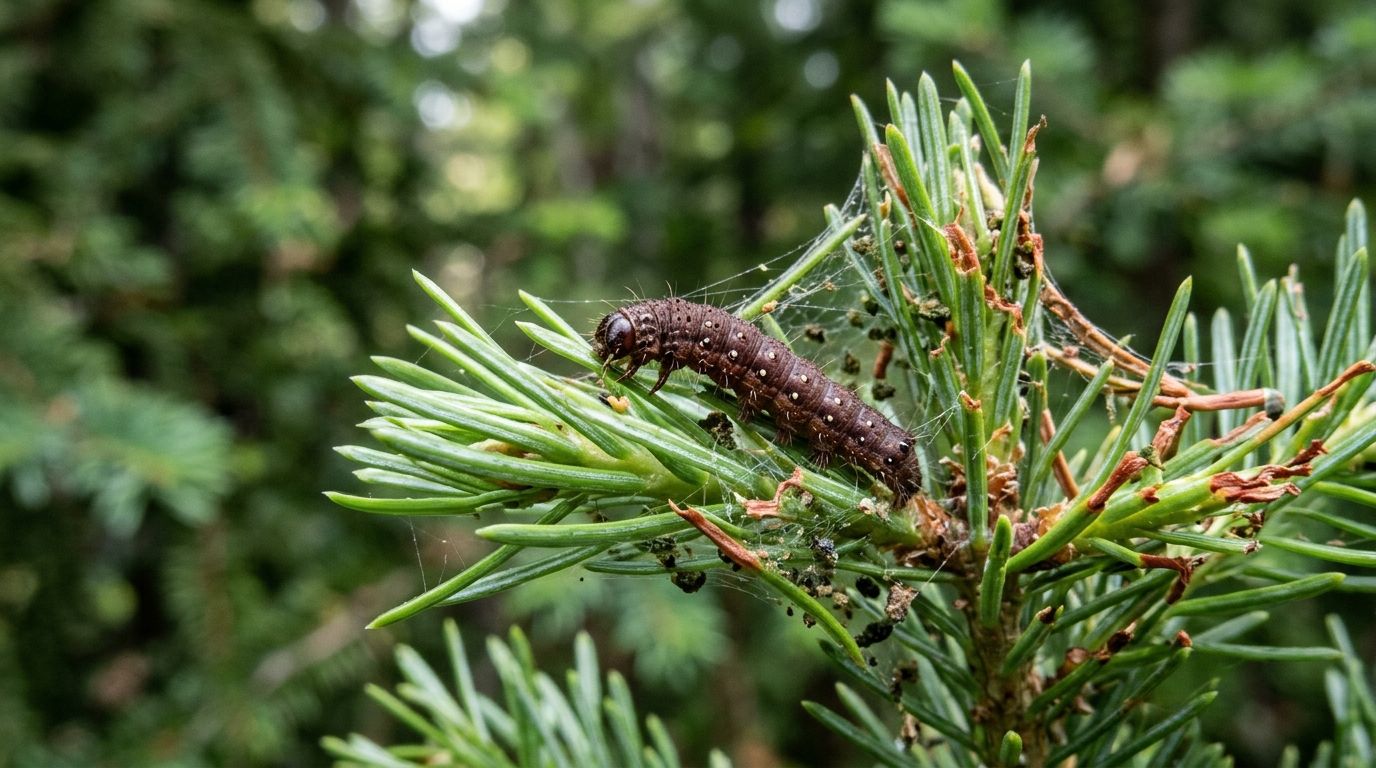
Cyclic outbreaking species expose these computational frameworks to extreme demographic volatility because their local population densities can shift by several orders of magnitude over remarkably short intervals. In eastern North America, the eastern spruce budworm, a univoltine defoliating moth whose caterpillars feed on balsam fir and spruce needles, exhibits massive, spatially synchronous population eruptions roughly every thirty-five years that endure for ten to fifteen years and impact millions of hectares of boreal forest. During the initial growth phase of such an outbreak, intense demographic pressure triggers extensive spatial expansion and long-distance migration, processes that can induce allele surfing, localized founder events, and pronounced spatial clines in allele frequencies that mirror genuine natural selection. As the epidemic peaks and insect numbers surge across contiguous landscapes, rampant dispersal and genetic admixture rapidly erode differentiation among disparate stands. When populations subsequently collapse, severe demographic bottlenecks and genetic drift further reshape the architecture of standing variation, raising fundamental questions about whether single-point genome scans can reliably detect genuine adaptive signals.
To rigorously evaluate the sensitivity of outlier detection pipelines across shifting outbreak dynamics, researchers analyzed genomic data collected across Quebec between 2013 and 2017, encompassing early and accelerating phases of an ongoing spruce budworm defoliation cycle. The sampling regime captured 1258 insect specimens across four sampling years, specifically gathering 403 individuals from 15 localities in 2013, 555 individuals from 32 sites in 2014, 155 specimens across 12 locations in 2015, and 145 individuals across 9 stands in 2017. Sampling focused on fourth- to sixth-instar larvae manually gathered from live host branches and reared to adulthood on synthetic McMorran diet, pupae harvested directly from foliage, and resident adult male moths trapped using specialized pheromone-baited Uni-Traps fitted with insecticidal strips. Trapping intervals were strictly calibrated against the BioSIM-10 phenological model to ensure that captured adults represented local resident populations rather than transient long-distance migrants, thereby preserving local geographic fidelity across all evaluated collection sites.
High-throughput genomic characterization relied on genotype-by-sequencing libraries prepared with the PstI-MspI restriction enzyme combination and sequenced on an Illumina HiSeq2000 platform to yield 100-base-pair single-end reads. Raw reads were mapped to the annotated spruce budworm reference genome NRCan_CFum1 using the Burrows-Wheeler Aligner mem algorithm and processed with samtools and bamtools. Stringent bioinformatic filtration through Platypus and bcftools excluded genotypes possessing a quality score below 18, a sequencing depth under eight reads, a maximum missing genotype frequency exceeding fifty percent across individuals, or a minor allele frequency below five percent. The resulting curated baseline comprised 8657 shared biallelic single-nucleotide polymorphisms across the entire four-year timeline, including 8657 variable loci in 2013 and 2014, 8654 in 2015, and 8631 in 2017. Environmental predictors integrated into the association workflows encompassed twenty seasonal climate metrics, seven annual indices, and site elevations extracted via ClimateNA downscaling algorithms to capture fine-scale ecological variation across all sampled forest landscapes.
Comparative benchmarking evaluated three prominent genome-scan tools across both full annual datasets and standardized bootstrap subsets generated by randomly subsampling 145 individuals across 100 iterations per year to control for sample-size discrepancies. The differentiation-based package OutFLANK estimated neutral distributions of genetic divergence to identify extreme outlier loci at a false discovery rate threshold of q less than 0.05. The univariate genotype-environment method LFMM fit ridge-regularized latent factor mixed models incorporating latent factors selected via cross-entropy evaluation in the LEA package, assigning calibrated significance at an identical q threshold below 0.05. Meanwhile, the multivariate redundancy analysis performed constrained linear ordinations on Hellinger-transformed allele frequency matrices against downscaled climatic variables, flagging candidate adaptive variants whose loadings diverged by more than 3.5 standard deviations from the mean across statistically significant ordination axes determined by permutation testing.
Across all three analytical paradigms, candidate outlier detection proved exceptionally sensitive to temporal collection intervals and demonstrated a steep, systematic trajectory across outbreak development. In the full datasets, candidate loci counts rose between 2013 and 2014 before plunging precipitously in 2015 and approaching near-total absence by 2017. OutFLANK flagged 12 candidate loci in 2013, peaked at 54 candidates in 2014, dropped to 3 in 2015, and identified a single marker in 2017. LFMM identified 3 candidate outliers in 2013, surged to 32 during the 2014 peak, decreased to 8 in 2015, and detected zero outliers in 2017. Redundancy analysis mirrored this collapse, distinguishing 12 candidates in 2013, 8 in 2014, and failing to detect any significant outliers in 2015 or 2017. Standardized subsampling confirmed that these trends were not artifacts of sample size alone, as mean bootstrap yields in 2013 and 2014 remained far lower than peak unadjusted counts while reproducing the overall pattern of early signal emergence followed by progressive exhaustion.
In addition to marked quantitative fluctuations in outlier numbers, concordance among detection methods and persistence across successive sampling seasons were strikingly constrained. In 2013, almost all flagged loci were method-specific, with OutFLANK, LFMM, and redundancy analysis sharing no common markers, while only two loci overlapped between OutFLANK and redundancy analysis and one between the two association approaches. Even during peak signal abundance in 2014, not a single locus was simultaneously endorsed by all three methods; although OutFLANK and LFMM jointly identified 23 markers and OutFLANK and redundancy analysis shared one, 30 loci remained unique to OutFLANK, 9 to LFMM, and 8 to redundancy analysis. Temporal continuity proved equally tenuous within individual methodologies. OutFLANK retained only 3 of its 12 candidate loci from 2013 into 2014, while 49 of its 54 candidates in 2014 were entirely unique to that single year. Across the entire study, no candidate outlier maintained statistical significance for more than two consecutive years across any modeling framework.
Broadening the analytical scope from individual single-nucleotide polymorphisms to genomic neighborhoods revealed only minimal additional coherence across methods and temporal periods. When researchers screened chromosomal positions within two flanking annotated regions, only two localized clusters emerged across the entire multi-year dataset. On chromosome 17, OutFLANK and redundancy analysis identified two distinct outliers in 2013 separated by merely three base pairs that shared flanking gene annotations designated MSG28_010277 and MSG28_010278. Similarly, on chromosome 12, two outlier positions separated by 58862 base pairs shared neighboring gene annotation MSG28_007446, identified by LFMM in 2013 and 2014 and by OutFLANK in 2014. While these rare instances indicate that single-marker comparisons may occasionally overlook regional linkage signals, they represent isolated exceptions that do not mitigate the broader pattern of pronounced discordance and temporal volatility documented across the insect genome.
These experimental findings demonstrate that the central operating assumption of landscape genomics—that adaptive divergence and environmental correlations can be cleanly uncoupled from neutral demographic background—readily breaks down in demographically unstable, cyclical populations. During early outbreak emergence, pronounced spatial structure and expanding fronts create transient differentiation gradients and surfing alleles that inflate false-positive rates in differentiation-based tests. As insect numbers explode, extensive dispersal and widespread reproductive mixing homogenize landscape-wide allele distributions, diminishing the statistical contrast required by genotype-environment association algorithms and triggering widespread false negatives. Consequently, conservation strategies, monitoring frameworks, and ecological risk assessments that rely on cross-sectional genomic sampling risk misidentifying neutral demographic artifacts as adaptive targets or failing to detect genuine resilience mechanisms entirely. Resolving these interpretive vulnerabilities will require continuous multi-year temporal monitoring and simulation-guided sampling architectures explicitly tailored to non-equilibrium demographic cycles.
Subject of Research: Sensitivity of landscape genomic outlier detection methods to cyclical population outbreak dynamics in the eastern spruce budworm
Article Title: Sensitivity of Landscape Genomic Outlier Detection to Outbreak Dynamics
Article References: Fontenelle, J. P., & James, P. M. A. (2026). Sensitivity of Landscape Genomic Outlier Detection to Outbreak Dynamics. Ecology and Evolution, 16(12), Article e74794. https://doi.org/10.1002/ece3.74794
Image Credits: AI Generated
DOI: 10.1002/ece3.74794
Keywords: landscape genomics, outlier detection, spruce budworm, Choristoneura fumiferana, population dynamics, ecological outbreaks, OutFLANK, latent factor mixed models, redundancy analysis, genotype-environment association, single-nucleotide polymorphisms, boreal forest ecology, population demography, allele frequency homogenization, ecological genomics, temporal genetic variation, wildlife management
News Source: Juliet Wilcox. (November 27, 2026). Spruce Budworm Outbreak Dynamics Undermine Genomic Tests for Local Adaptation. Scienmag.