• HOME
  • NEWS
  • EXPLORE
    • CAREER
      • Companies
      • Jobs
    • EVENTS
    • iGEM
      • News
      • Team
    • PHOTOS
    • VIDEO
    • WIKI
  • BLOG
  • COMMUNITY
    • FACEBOOK
    • INSTAGRAM
    • TWITTER
Saturday, February 7, 2026
BIOENGINEER.ORG
No Result
View All Result
  • Login
  • HOME
  • NEWS
  • EXPLORE
    • CAREER
      • Companies
      • Jobs
        • Lecturer
        • PhD Studentship
        • Postdoc
        • Research Assistant
    • EVENTS
    • iGEM
      • News
      • Team
    • PHOTOS
    • VIDEO
    • WIKI
  • BLOG
  • COMMUNITY
    • FACEBOOK
    • INSTAGRAM
    • TWITTER
  • HOME
  • NEWS
  • EXPLORE
    • CAREER
      • Companies
      • Jobs
        • Lecturer
        • PhD Studentship
        • Postdoc
        • Research Assistant
    • EVENTS
    • iGEM
      • News
      • Team
    • PHOTOS
    • VIDEO
    • WIKI
  • BLOG
  • COMMUNITY
    • FACEBOOK
    • INSTAGRAM
    • TWITTER
No Result
View All Result
Bioengineer.org
No Result
View All Result
Home NEWS Science News Chemistry

Sponge-like 2D material with interesting electrical conductivity and magnetic properties

Bioengineer by Bioengineer
October 31, 2019
in Chemistry
Reading Time: 2 mins read
0
IMAGE
Share on FacebookShare on TwitterShare on LinkedinShare on RedditShare on Telegram

Researchers synthesize a new 2D Metal Organic Framework with an ever-growing list of possible applications
IMAGE

Credit: IBS


Chemists at the Center for Multidimensional Carbon Materials (CMCM), within the Institute for Basic Science (IBS, South Korea), have reported the synthesis of a novel type of 2D metal organic framework (MOF) with interesting electrical conductivity and magnetic properties. Published in the Journal of the American Chemical Society, this new material may potentially contribute to optoelectronics, photovoltaics, (photo)electrocatalysis, and energy storage.

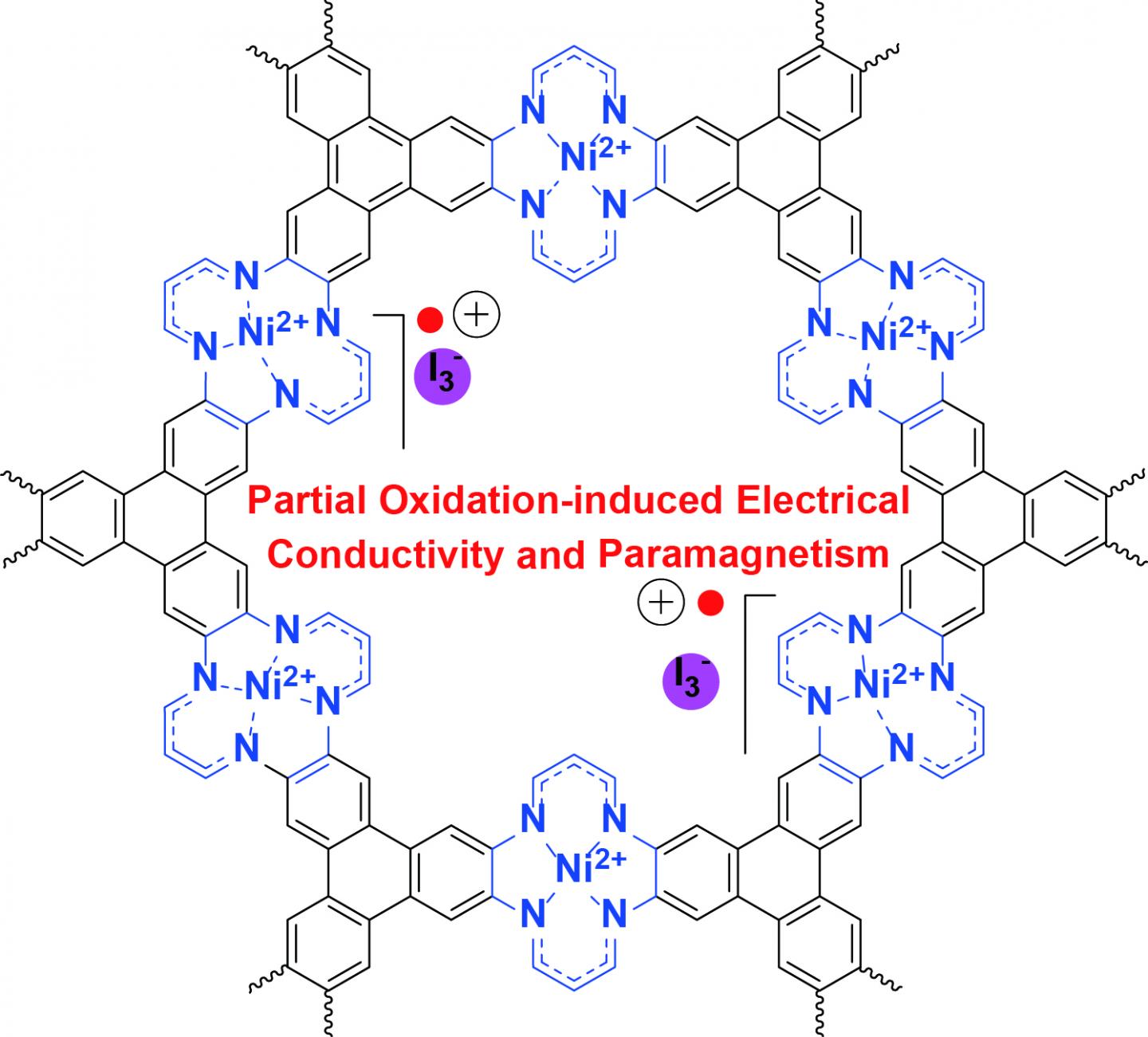
Also known as sponge-like or Swiss-cheese-like materials, MOFs are made of metal ions connected to organic ligands and are characterized by nano-sized holes. IBS researchers in collaboration with the School of Materials Science at the Ulsan National Institute of Science and Technology (UNIST) designed and synthesized Ni(II) tetraaza[14]annulene-linked MOF (NiTAA-MOF), where the metal component is nickel and the nickel tetraaza[14]annulene molecules are used as MOF building blocks for the first time.

The researchers discovered that doping this MOF with iodine changes its conductivity and magnetism. Pristine NiTAA-MOF conducts poorly. It is actually an insulator with an electrical conductivity smaller than 10-10 Siemens per centimeter. However, when it is chemically oxidized by iodine, the same measurement rises to 0.01 Siemens per centimeter (the larger this number, the better the conductor). This result shows the vital role of ligand oxidation in the electrical conductivity of some 2D MOFs, expanding the understanding of the origin of electrical conductivity in this type of MOFs.

In addition, the team checked how this material becomes magnetized in an applied magnetic field. Magnetization measurements performed by the researchers of the School of Materials Science showed that iodine-doped NiTAA-MOF is paramagnetic, that is it is weakly attracted by an external magnetic field, and becomes antiferromagnetic at very low temperatures. This means that it could become useful as a polarizing agent in dynamic nuclear polarization-nuclear magnetic resonance (DNP-NMR) that is used in experiments for material characterization.

The 2D MOF structure was also modeled through detailed calculations and analyzed by a variety of methods, such as X-ray diffraction, infrared, X-ray photoelectron, diffuse reflectance UV-vis, electron paramagnetic resonance, and Raman spectroscopies.

“Our work can contribute to the fundamental understanding of structure-property relationships in 2D electrically conductive MOFs, and may pave the way to develop new electrically conductive MOFs,” says Professor Ruoff, one of the corresponding authors of this study and UNIST professor. “Besides, the as-synthesized and iodine-doped NiTAA-MOF might be applicable in catalase mimics, catalysis, and energy storage.”

###

Media Contact
Dahee Carol Kim
[email protected]
82-428-788-133

Related Journal Article

http://dx.doi.org/10.1021/jacs.9b08601

Tags: Chemistry/Physics/Materials Sciences
Share13Tweet8Share2ShareShareShare2

Related Posts

blank

Breakthrough in Environmental Cleanup: Scientists Develop Solar-Activated Biochar for Faster Remediation

February 7, 2026
blank

Cutting Costs: Making Hydrogen Fuel Cells More Affordable

February 6, 2026

Scientists Develop Hand-Held “Levitating” Time Crystals

February 6, 2026

Observing a Key Green-Energy Catalyst Dissolve Atom by Atom

February 6, 2026
Please login to join discussion

POPULAR NEWS

  • Robotic Ureteral Reconstruction: A Novel Approach

    Robotic Ureteral Reconstruction: A Novel Approach

    82 shares
    Share 33 Tweet 21
  • Digital Privacy: Health Data Control in Incarceration

    63 shares
    Share 25 Tweet 16
  • Study Reveals Lipid Accumulation in ME/CFS Cells

    57 shares
    Share 23 Tweet 14
  • Breakthrough in RNA Research Accelerates Medical Innovations Timeline

    53 shares
    Share 21 Tweet 13

About

We bring you the latest biotechnology news from best research centers and universities around the world. Check our website.

Follow us

Recent News

Digital Health Perspectives from Baltic Sea Experts

Florida Cane Toad: Complex Spread and Selective Evolution

Exploring Decision-Making in Dementia Caregivers’ Mobility

Subscribe to Blog via Email

Enter your email address to subscribe to this blog and receive notifications of new posts by email.

Join 73 other subscribers
  • Contact Us

Bioengineer.org © Copyright 2023 All Rights Reserved.

Welcome Back!

Login to your account below

Forgotten Password?

Retrieve your password

Please enter your username or email address to reset your password.

Log In
No Result
View All Result
  • Homepages
    • Home Page 1
    • Home Page 2
  • News
  • National
  • Business
  • Health
  • Lifestyle
  • Science

Bioengineer.org © Copyright 2023 All Rights Reserved.